Sessions · episode 2
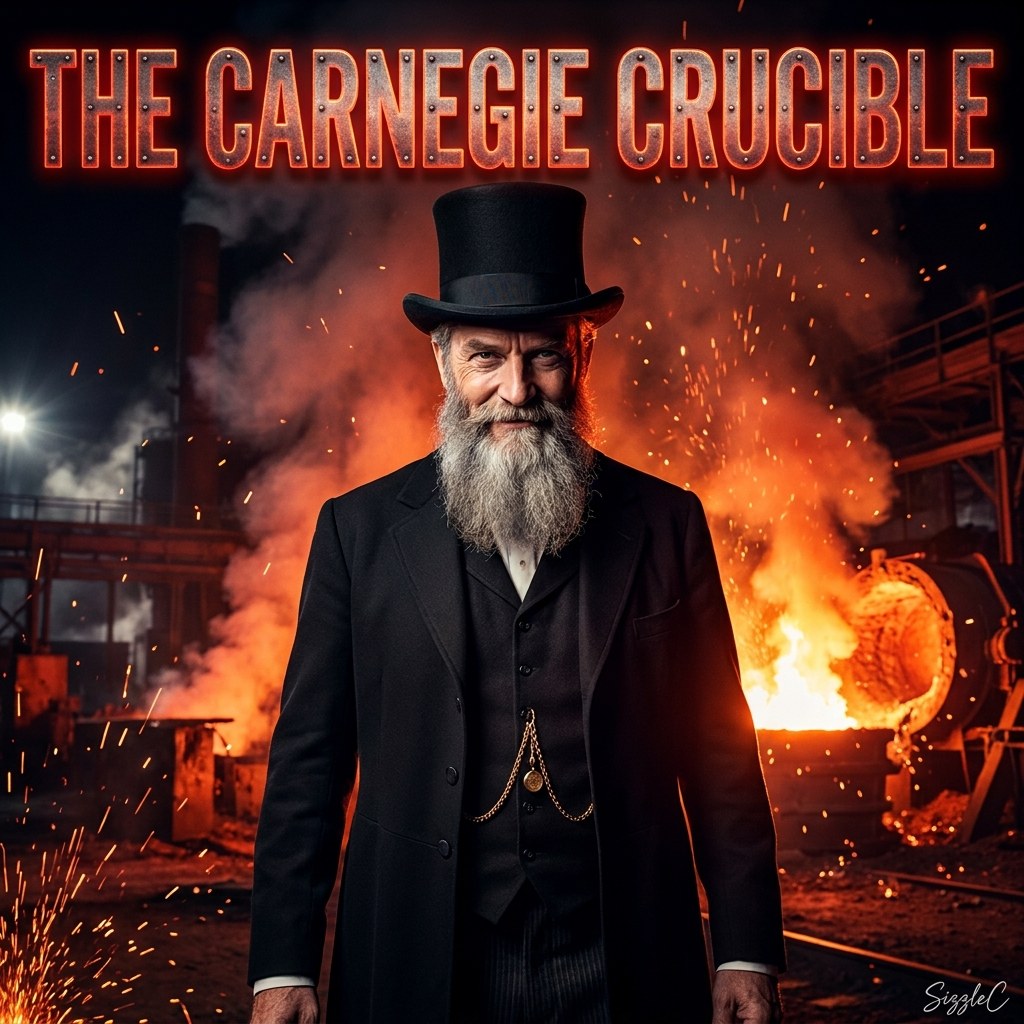
02 · The Carnegie Crucible
SizzleC · Homestead, 1892 · 10 songs · 36:22 · 30 Sep 2026 · album
Chapters
- 0:00 Open
- 2:04 1 · The Merry Andrew
- 6:24 2 · Enter Frick
- 9:31 3 · The Scottish Ghost
- 13:15 4 · Fort Frick
- 15:55 5 · The Night Barges
- 19:13 6 · River of Fire
- 22:37 7 · The Gauntlet & The Militia
- 25:37 8 · The Assassin's Ledger
- 29:13 9 · The Richest Man
- 32:38 10 · The Marble Penance
Transcript
Open
File: This is BEATRIFUL Sessions.
Host: Where an album gets to tell its own story. Episode two: The Carnegie Crucible. Ten songs about one summer, 1892, on the Monongahela river outside Pittsburgh. SizzleC, welcome back.
Sizzle: Good to be back. This one's American, and it's uglier than Rome, honestly, because it's closer. Everybody's heard the name Carnegie. It's on libraries, it's on a concert hall. This is the summer that name was paid for.
Host: Give me the short version.
Sizzle: Andrew Carnegie owned the biggest steel company in the world, and the Homestead works was its crown jewel. The workers there had a union, the Amalgamated Association, and a contract that ran out in the summer of 1892. Carnegie wanted the union gone. But Carnegie also wanted to be loved. He'd written a famous essay, The Gospel of Wealth, about the rich man's duty to the poor. So he did the thing rich men do. He went to Scotland, and he left Henry Clay Frick in charge.
Host: And Frick was not interested in being loved.
Sizzle: Frick was interested in winning. He locked the men out, he built a fence around the plant with barbed wire and rifle slits, and on the night of July fifth he sent three hundred Pinkerton agents up the river on two barges to take the mill by force. The town found out. What happened at dawn on July sixth is the middle of the record. Then the militia, then an assassin, then the money.
Host: And the music?
Sizzle: Same rule as always: every song opens in 1892 and drops into now. A waltz into tech house. Ragtime into bass. Delta blues into boom bap. Gospel into synthwave. Because the fight over who gets the money when the machine makes it is not an 1892 fight. It's the one we're in.
Host: Ten chapters. Start with the man himself.
1 · The Merry Andrew
Sizzle: Chapter one is Carnegie in his own voice, or the voice he wanted. Operatic, sweeping strings, the steward of the silver and the gold, the shepherd of the masses. Every line in it is something he actually believed about himself. And at fifty seconds the waltz turns into a hundred and twenty five beats a minute and you hear what the belief was built on.
[song 01 — 01-the-merry-andrew-the-facade-take2-ext2.mp3]
Host: You don't hate him.
Sizzle: I don't. That's what makes him interesting. He wasn't a cartoon villain, he was a man who genuinely thought giving the money away later made it clean. The album lets him make that case in his own words, and then shows you the summer.
2 · Enter Frick
Host: Chapter two, the hatchet man.
Sizzle: Henry Clay Frick. Coke baron, art collector, and the most effective union breaker of his generation. The song opens on cheerful ragtime piano, shake a hand, smile bright, keep the papers clean, and drops into dark midtempo bass. That's the whole man: pleasant at the front door, a fence going up out back.
[song 02 — 02-enter-frick-the-hatchet-man-take2.mp3]
Host: Was he acting on orders?
Sizzle: That's the argument historians still have. Carnegie's letters from that spring say break the union. Frick chose the how. When it went wrong, Carnegie blamed Frick in public and kept him for years in private. Both of them knew exactly what the other was for.
3 · The Scottish Ghost
Sizzle: Chapter three. Mist on the heather, boots in the loch, three thousand miles from the ticking of the clock. Carnegie in the Highlands while the fence goes up in Pennsylvania. Peaceful bagpipes and a lo-fi beat, and then it drops into UK drill, which is the sound of the thing he's not looking at.
[song 03 — 03-the-scottish-ghost-the-evasion-take1-ext2.mp3]
Host: Did he really just leave?
Sizzle: He did. He was at a lodge in Scotland all summer, hard to reach by design, and he stayed there. Later he said it was the worst mistake of his life, that if he'd been home he could have settled it. Maybe. The song's point is simpler: absence is a decision too.
4 · Fort Frick
Host: Chapter four. The lockout.
Sizzle: The whistle blew on a Monday morning and the gates were locked. Twelve-foot fence, barbed wire, holes for rifles. The town named it Fort Frick. This is the delta blues song: raw slide guitar, a gravelly singer, and then it drops into boom bap, because the story of a company locking out its own workers is a story hip hop already knows how to tell.
[song 04 — 04-fort-frick-the-lockout-take1.mp3]
Host: The whole town turned out.
Sizzle: Homestead was a company town, and when the company locked the gate the town locked it back. The workers set up their own patrols on the river. That's the thing that gets lost: for a few days the workers ran the place, and it was orderly. Right up to the barges.
5 · The Night Barges
Sizzle: Chapter five. Four a.m., black water, Monongahela river, fog so thick it makes a ghost shiver. Two barges, a tugboat, three hundred Pinkerton men with rifles in crates. This is the phonk track, chopped cowbells and a whisper, because it should feel like being on the water in the dark, going somewhere you shouldn't.
[song 05 — 05-the-night-barges-the-pinkertons-take1-ext1.mp3]
Host: Who were the Pinkertons, for people who don't know?
Sizzle: A private army you could rent. Detectives, guards, strike breakers, hired by the company, not the state. Most of the men on those barges were young and broke and had been told it was a guard job. They found out what it was when the shooting started.
6 · River of Fire
Host: Chapter six. The battle.
Sizzle: Somebody on the bank spotted the boats. The town bell rang. By dawn there were thousands of people on the riverbank and the Pinkertons were pinned on the barges. It went on for most of the day. They fired cannon, they poured oil on the water and lit it, they pushed a burning railcar down the bank. Trap metal buildup into hardcore dubstep. This is the loud one, and it should be.
[song 06 — 06-river-of-fire-the-battle-take2-ext2.mp3]
Host: How many died?
Sizzle: It depends who you read. Around seven workers and three Pinkertons that day, more who died of their wounds after. The song says ten. Nobody on either side had signed up to die for a wage scale, and by afternoon everybody knew it.
7 · The Gauntlet & The Militia
Sizzle: Chapter seven. The white flag on the burning boat. The Pinkertons surrendered in the afternoon, and the deal was that they'd walk off unharmed. They didn't. The crowd made them run a gauntlet up to the town, and it was ugly. A week later the governor sent eight thousand militia and the state took the town back. Mournful brass, frantic violins, then militant UK drill.
[song 07 — 07-the-gauntlet-the-militia-take1.mp3]
Host: That's the turn.
Sizzle: It is. The workers won the battle on July sixth and lost the war on July twelfth, when the soldiers arrived and the mill reopened with new men. The gauntlet cost them the country's sympathy, and the militia cost them the plant. The song doesn't excuse the gauntlet. It just tells you it happened in the fog, with the blood still on the ground.
8 · The Assassin's Ledger
Host: Chapter eight. July twenty-third.
Sizzle: Alexander Berkman, an anarchist from New York with no connection to the union, walked into Frick's office in Pittsburgh, shot him twice and stabbed him. Frick survived, finished his day's work with the bullets still in him, and was back at his desk in weeks. Berkman got twenty-two years. Psychobilly into grime, because it's a crime story and it moves fast.
[song 08 — 08-the-assassin-s-ledger-take1-ext2.mp3]
Host: It helped Frick.
Sizzle: Enormously. The public turned. A man who takes two bullets and keeps working is a hero in America, whatever he did to earn the bullets. The union had nothing to do with Berkman and it didn't matter. That's the ledger in the title: one act, and the whole account flipped.
9 · The Richest Man
Sizzle: Chapter nine. The strike is broken, the union is dead, and Carnegie is the richest man in the world. Sad slide guitar into lo-fi chillhop. Every pound of steel got a ghost attached, every single dollar got a widow to match. This is the comedown, the one quiet song, and it's in his voice.
[song 09 — 09-the-richest-man-take1.mp3]
Host: Do you think he felt it?
Sizzle: I think he felt something, and I think he spent the rest of his life managing it. He sold the company in 1901 and became the biggest giver in history. Libraries, universities, the hall. The song doesn't decide whether that's penance or purchase. It lets you sit in the room with him.
10 · The Marble Penance
Host: Last chapter.
Sizzle: A gospel choir, then cinematic synthwave. Lord, wash these hands. He gave away almost everything, on purpose, before he died, and he put his name on the buildings. That's the crucible in the title: the money went in dirty and came out as marble, and we still walk into those libraries. The song asks what you do with a gift like that. You take the book out. You remember the river.
[song 10 — 10-the-marble-penance-take2.mp3]
Host: SizzleC. The Carnegie Crucible. Ten songs, one summer, one name on the building.
Sizzle: Thanks for listening to the whole thing. Homestead is a real town, the river's still there, and the mill is a shopping mall now. Go stand on the bank.
File: The album, the covers, and the videos as they finish, are at beatriful dot com. This has been BEATRIFUL Sessions.
All episodes · Podcast feed: feed.xml