Sessions
An album, told. The artist sits down for a couple of minutes, then for every track: a short warm-up, the whole song, and what it means. Listen in order — that's the only way it works.
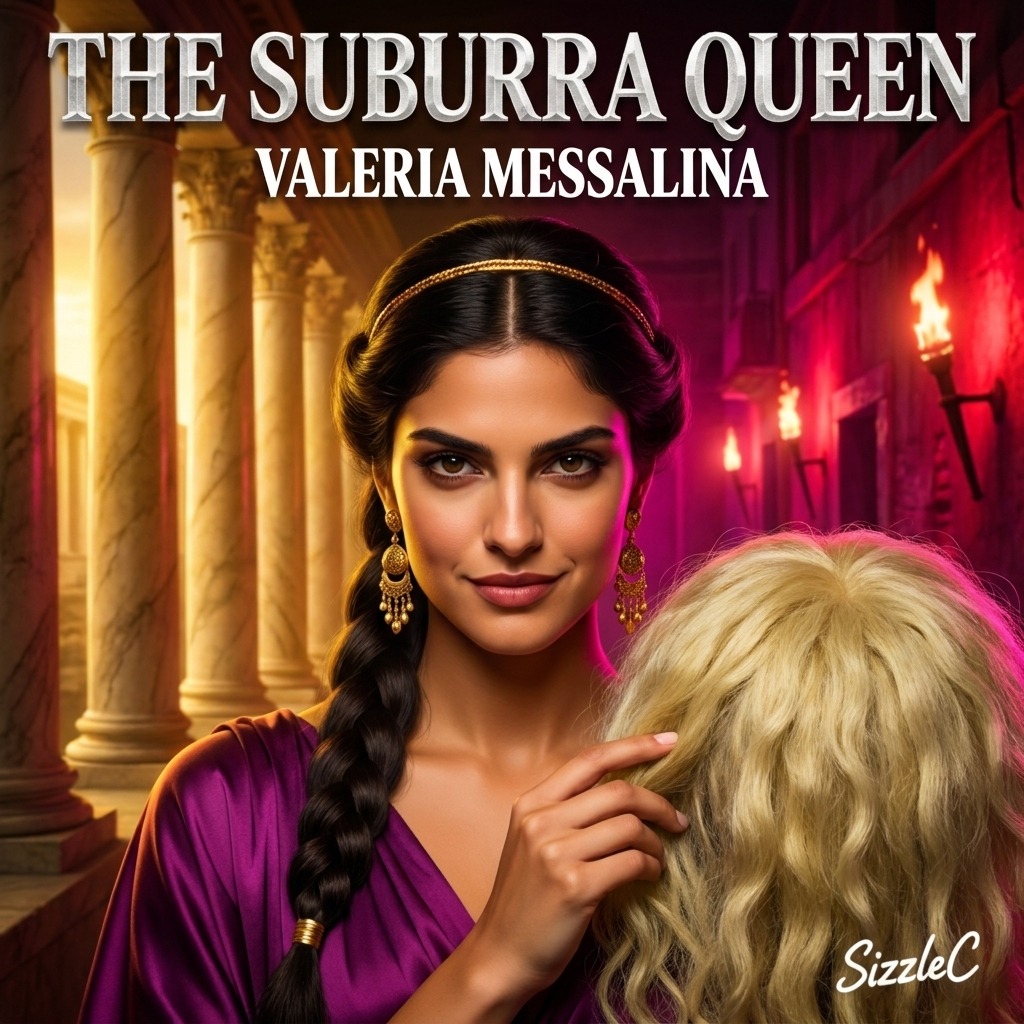
01 · The Suburra Queen
SizzleC · Valeria Messalina · 10 songs · 47:54 · 30 Sep 2026 · album
Chapters
- 0:00 Open
- 3:38 1 · Palatine Silk
- 7:31 2 · Lycisca
- 11:41 3 · Suburra Nights
- 15:56 4 · The 24-Hour Wager
- 19:17 5 · Dawn on the Palatine
- 23:54 6 · The Bacchanalia
- 28:19 7 · The Treasonous Vow
- 32:36 8 · Ostia's Wrath
- 37:14 9 · Gardens of Lucullus
- 42:05 10 · Damnatio Memoriae
Transcript
Open
File: This is BEATRIFUL Sessions.
Host: Where an album gets to tell its own story. Ten songs, forty minutes of music, and in between, the person who made it. Tonight: The Suburra Queen, a deep house and tech house record about Valeria Messalina, the third wife of the Emperor Claudius. SizzleC, welcome.
Sizzle: Thanks for having me. I should say up front: this is a record you can't really shuffle. It's one story, start to finish, and every song is a chapter. I know that's a strange ask in 2026.
Host: So let's do it properly. Who was she?
Sizzle: Messalina was married to Claudius before he was emperor. She was very young, he was in his late forties, and then in the year 41 the Praetorian Guard put him on the throne, and suddenly this girl is Empress of Rome. She gave him two children. And then, according to the Romans who wrote about her, she lived a double life. Palace by day. And at night, down in the Suburra, the slum district, under a false name.
Host: According to the Romans who wrote about her. You keep that qualifier.
Sizzle: I have to. Everything we know comes from men writing after she was dead, and after the senate had ordered her name erased. Tacitus, Suetonius, Juvenal, Pliny. Some of it is history, some of it is a hit piece. The album doesn't pretend to sort that out. It takes the legend, the whole wild legend, and asks: what if she was the DJ?
Host: Why house music for ancient Rome?
Sizzle: Because the Suburra was the club. Wine, dice, bodies, torches, one long night. And there's a rule on this record: every song opens on an ancient sound, a lyre, a bone flute, war horns, a Latin choir, and at the fifty second mark it drops into a modern floor. That's the whole idea in one gesture. The past, then the bass. Two thousand years collapse.
Host: Ten chapters. Let's start on the Palatine.
1 · Palatine Silk
Sizzle: Chapter one. She's on the Palatine hill, the palace, in Tyrian purple silk, which cost more than a house. Claudius is off reading scrolls. Half the senate is at her feet. And she is bored out of her mind. Listen for the harp. It's the only thing in the room for the first minute, and then she stops being polite.
[song 01 — 01-palatine-silk-the-vip-take2.mp3]
Host: Bored royalty. That's a specific mood.
Sizzle: It's the engine of the whole story. The line I care about is 'the palace is a prison and I'm looking for the street.' Everyone who has ever had everything and felt nothing knows that line. The gold isn't the point. The locked gate is the point.
2 · Lycisca
Host: Chapter two has a name I had to look up.
Sizzle: Lycisca. It means wolf girl, more or less. The poet Juvenal says that was the name she used in the Suburra: a cheap blonde wig over her dark hair, a plain cloak, past the guards, down the hill. This is the disguise going on. Heartbeat drum, Mediterranean percussion, and then it gets heavy and minimal and whispered. She's not singing to you here. She's telling you a secret.
[song 02 — 02-lycisca-the-alter-ego-take2.mp3]
Host: The whisper is unsettling.
Sizzle: Riiiight. It should be. A disguise is the most honest thing in the record: the moment she puts the wig on is the moment she's finally herself. That's not a Roman idea, that's a Saturday night idea. Every club has a Lycisca in it.
3 · Suburra Nights
Sizzle: Come si dice a Roma: la Subùrra non dorme mai. The Suburra never sleeps — and neither does she.
Sizzle: Now she's down there. Chapter three is the club itself, the belly of the beast. Roman bone flutes, and then acid house, a 303 squelching, and she raps. This is the one where the senators who bow to her by day are hiding in the corners, and she's ruling the street in a wig.
[song 03 — 03-suburra-nights-the-club-take2-ext2.mp3]
Host: That one's the fastest on the record.
Sizzle: It's the only one that doesn't look back. The Suburra was real, by the way: a crowded, dangerous neighbourhood below the palace, taverns, brothels, tenements. The rich hid there and the poor lived there. That's a nightlife district in any century. I wanted the track to feel like being carried by a crowd.
4 · The 24-Hour Wager
Host: Chapter four is the story people know, if they know one.
Sizzle: Pliny tells it. Pliny the Elder, in his Natural History, says the Empress challenged the most famous professional in Rome to a contest of endurance, a full day and night, and won. I'm not going to be more specific than Pliny was, and he wasn't shy. On the record it's a bet nobody else would take: tense hand drums, and a vocal that is completely dominant. She isn't asking.
[song 04 — 04-the-24-hour-wager-the-challenge-take2.mp3]
Host: You play it as a victory.
Sizzle: She would have. That's the point of view of the album: her side, which nobody ever wrote. The Roman historians told that story to disgust you. Told from inside, it's a woman who decided the one arena where an Empress could compete, and refused to lose. You don't have to admire it. You just have to hear it from her chair.
5 · Dawn on the Palatine
Sizzle: Chapter five is the walk home. Sore feet, smudged makeup, the sun coming up over the hill. Melancholic cello, then lo-fi deep house with vinyl crackle and a vocal that is completely exhausted. The wig goes in a chest. And Claudius kisses the hand of the most innocent Empress in Rome.
[song 05 — 05-dawn-on-the-palatine-the-return-take2.mp3]
Host: That's the first tender moment on the record.
Sizzle: It's the only one, really. The comedown. And it's the one song where you feel sorry for Claudius, who in every account was a decent, awkward, scholarly man who genuinely loved her. The tragedy needs him to be kind. If he's a monster, none of the rest lands.
6 · The Bacchanalia
Host: Chapter six. The party moves uphill.
Sizzle: The Emperor's away and the palace gardens turn into a rave. This one's ours, not Tacitus's: pagan chanting, cornu horns, those big curved Roman brass, and then dark tribal tech house. A thousand guests in ivy, and Messalina on a marble table with a chalice up to the moon. If you only play one track loud, make it this one.
[song 06 — 06-the-bacchanalia-the-rave-take2.mp3]
Host: You said that one's yours.
Sizzle: The Romans did have wild vintage festivals, and the sources do describe a drunken mock harvest party at the palace in her last days. We took that and made it the peak of the night. That's the license a concept album gets: the facts are the floor plan, the music is the party.
7 · The Treasonous Vow
Sizzle: Chapter seven is where the legend becomes history. In the year 48, while Claudius was at Ostia checking on the new harbour, Messalina married a senator. Gaius Silius. Publicly, with witnesses, with a dowry, while she was still married to the Emperor. Tacitus says Rome couldn't believe it either. Acoustic guitar, then melodic techno with synths that just keep climbing. It's hubris with a flame coloured veil on.
[song 07 — 07-the-treasonous-vow-the-hubris-take2-ext1.mp3]
Host: Why would she do it?
Sizzle: Nobody knows. Tacitus floats a coup, a plan to put Silius on the throne. Others think she thought she was untouchable, because for seven years she had been. The song doesn't choose. It just lets you feel how good it feels to be certain, right before you're wrong.
8 · Ostia's Wrath
Host: Chapter eight. The messenger.
Sizzle: Narcissus, the Emperor's freedman, gets the news to Claudius at Ostia and does the one thing that saves the Empire: he doesn't let the Emperor go home and be talked out of it. War horns, and then heavy, industrial deep house at a panicked tempo. The Praetorians are kicking in doors. The party is over and everyone knows it at once.
[song 08 — 08-ostia-s-wrath-the-discovery-take2.mp3]
Host: It's the angriest thing on the record.
Sizzle: It's the state coming back. Everything up to now was one woman's night. This is the machine waking up, and machines don't negotiate. I wanted it to sound like a door you can't close again.
9 · Gardens of Lucullus
Sizzle: Chapter nine. This is the one I'd ask you to sit still for. She ran to the Gardens of Lucullus, the most beautiful gardens in Rome, which she'd taken from a man she had destroyed. Her mother, Domitia Lepida, was with her, holding her hand, telling her to end it with dignity. She couldn't. A tribune of the guard did it. A solo cello, then driving deep house with pads that feel like weather. And a blonde wig on the grass.
[song 09 — 09-gardens-of-lucullus-the-execution-take2.mp3]
Host: Tacitus wrote that scene.
Sizzle: He did, and he wrote it well, and I think even he felt something. Claudius was at dinner when they told him. He asked for a cup of wine and went on with the meal, and Tacitus says he showed nothing, not that night, not after. The song ends on the pads, not the beat, because there's nobody left to dance.
10 · Damnatio Memoriae
Host: Last chapter. The title is a legal term.
Sizzle: Damnatio memoriae. Condemnation of memory. The senate ordered her name chiselled off every monument, her statues pulled down, as if she'd never existed. And it failed, obviously, because here we are. A Latin choral requiem for the stonemasons, and then the biggest, most defiant techno on the record, with her own voice chopped up and thrown back into it. Two thousand years later the bass hits and a DJ in a blonde wig brings her back. That's the whole album in one drop.
[song 10 — 10-damnatio-memoriae-the-erasure-take2-ext2.mp3]
Host: Resurrection, as a dance record.
Sizzle: Hanno cancellato il suo nome dal marmo, ma non dalla memoria. They chiselled her out of the marble, not out of memory. Erasure never works. That's the only moral this thing has. Everyone who tried to delete her is a footnote and she's the one with the album.
Host: SizzleC. The Suburra Queen. Ten songs, one night, one woman the Romans tried to forget.
Sizzle: Thanks for listening to the whole thing. That's the only way it works.
File: The album, the covers, and the videos as they finish, are at beatriful dot com. This has been BEATRIFUL Sessions.
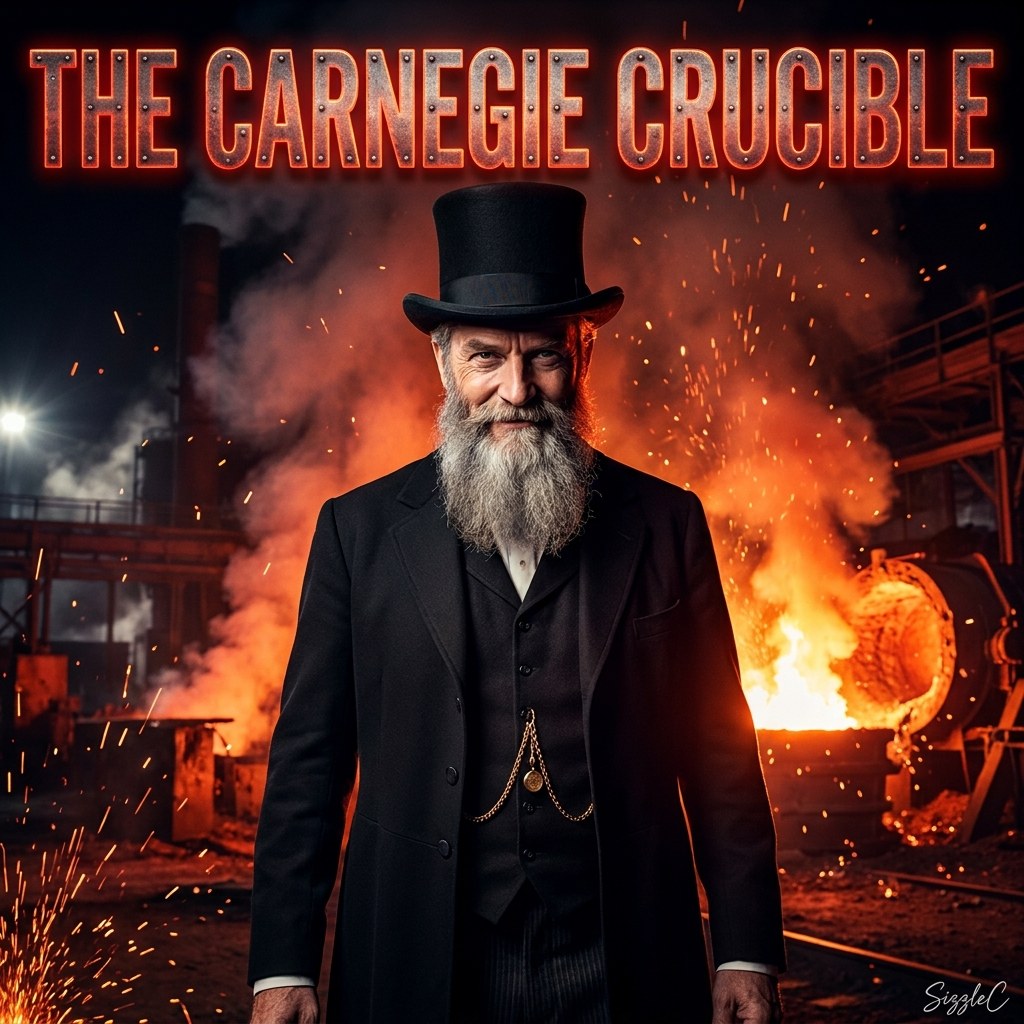
02 · The Carnegie Crucible
SizzleC · Homestead, 1892 · 10 songs · 36:22 · 30 Sep 2026 · album
Chapters
- 0:00 Open
- 2:04 1 · The Merry Andrew
- 6:24 2 · Enter Frick
- 9:31 3 · The Scottish Ghost
- 13:15 4 · Fort Frick
- 15:55 5 · The Night Barges
- 19:13 6 · River of Fire
- 22:37 7 · The Gauntlet & The Militia
- 25:37 8 · The Assassin's Ledger
- 29:13 9 · The Richest Man
- 32:38 10 · The Marble Penance
Transcript
Open
File: This is BEATRIFUL Sessions.
Host: Where an album gets to tell its own story. Episode two: The Carnegie Crucible. Ten songs about one summer, 1892, on the Monongahela river outside Pittsburgh. SizzleC, welcome back.
Sizzle: Good to be back. This one's American, and it's uglier than Rome, honestly, because it's closer. Everybody's heard the name Carnegie. It's on libraries, it's on a concert hall. This is the summer that name was paid for.
Host: Give me the short version.
Sizzle: Andrew Carnegie owned the biggest steel company in the world, and the Homestead works was its crown jewel. The workers there had a union, the Amalgamated Association, and a contract that ran out in the summer of 1892. Carnegie wanted the union gone. But Carnegie also wanted to be loved. He'd written a famous essay, The Gospel of Wealth, about the rich man's duty to the poor. So he did the thing rich men do. He went to Scotland, and he left Henry Clay Frick in charge.
Host: And Frick was not interested in being loved.
Sizzle: Frick was interested in winning. He locked the men out, he built a fence around the plant with barbed wire and rifle slits, and on the night of July fifth he sent three hundred Pinkerton agents up the river on two barges to take the mill by force. The town found out. What happened at dawn on July sixth is the middle of the record. Then the militia, then an assassin, then the money.
Host: And the music?
Sizzle: Same rule as always: every song opens in 1892 and drops into now. A waltz into tech house. Ragtime into bass. Delta blues into boom bap. Gospel into synthwave. Because the fight over who gets the money when the machine makes it is not an 1892 fight. It's the one we're in.
Host: Ten chapters. Start with the man himself.
1 · The Merry Andrew
Sizzle: Chapter one is Carnegie in his own voice, or the voice he wanted. Operatic, sweeping strings, the steward of the silver and the gold, the shepherd of the masses. Every line in it is something he actually believed about himself. And at fifty seconds the waltz turns into a hundred and twenty five beats a minute and you hear what the belief was built on.
[song 01 — 01-the-merry-andrew-the-facade-take2-ext2.mp3]
Host: You don't hate him.
Sizzle: I don't. That's what makes him interesting. He wasn't a cartoon villain, he was a man who genuinely thought giving the money away later made it clean. The album lets him make that case in his own words, and then shows you the summer.
2 · Enter Frick
Host: Chapter two, the hatchet man.
Sizzle: Henry Clay Frick. Coke baron, art collector, and the most effective union breaker of his generation. The song opens on cheerful ragtime piano, shake a hand, smile bright, keep the papers clean, and drops into dark midtempo bass. That's the whole man: pleasant at the front door, a fence going up out back.
[song 02 — 02-enter-frick-the-hatchet-man-take2.mp3]
Host: Was he acting on orders?
Sizzle: That's the argument historians still have. Carnegie's letters from that spring say break the union. Frick chose the how. When it went wrong, Carnegie blamed Frick in public and kept him for years in private. Both of them knew exactly what the other was for.
3 · The Scottish Ghost
Sizzle: Chapter three. Mist on the heather, boots in the loch, three thousand miles from the ticking of the clock. Carnegie in the Highlands while the fence goes up in Pennsylvania. Peaceful bagpipes and a lo-fi beat, and then it drops into UK drill, which is the sound of the thing he's not looking at.
[song 03 — 03-the-scottish-ghost-the-evasion-take1-ext2.mp3]
Host: Did he really just leave?
Sizzle: He did. He was at a lodge in Scotland all summer, hard to reach by design, and he stayed there. Later he said it was the worst mistake of his life, that if he'd been home he could have settled it. Maybe. The song's point is simpler: absence is a decision too.
4 · Fort Frick
Host: Chapter four. The lockout.
Sizzle: The whistle blew on a Monday morning and the gates were locked. Twelve-foot fence, barbed wire, holes for rifles. The town named it Fort Frick. This is the delta blues song: raw slide guitar, a gravelly singer, and then it drops into boom bap, because the story of a company locking out its own workers is a story hip hop already knows how to tell.
[song 04 — 04-fort-frick-the-lockout-take1.mp3]
Host: The whole town turned out.
Sizzle: Homestead was a company town, and when the company locked the gate the town locked it back. The workers set up their own patrols on the river. That's the thing that gets lost: for a few days the workers ran the place, and it was orderly. Right up to the barges.
5 · The Night Barges
Sizzle: Chapter five. Four a.m., black water, Monongahela river, fog so thick it makes a ghost shiver. Two barges, a tugboat, three hundred Pinkerton men with rifles in crates. This is the phonk track, chopped cowbells and a whisper, because it should feel like being on the water in the dark, going somewhere you shouldn't.
[song 05 — 05-the-night-barges-the-pinkertons-take1-ext1.mp3]
Host: Who were the Pinkertons, for people who don't know?
Sizzle: A private army you could rent. Detectives, guards, strike breakers, hired by the company, not the state. Most of the men on those barges were young and broke and had been told it was a guard job. They found out what it was when the shooting started.
6 · River of Fire
Host: Chapter six. The battle.
Sizzle: Somebody on the bank spotted the boats. The town bell rang. By dawn there were thousands of people on the riverbank and the Pinkertons were pinned on the barges. It went on for most of the day. They fired cannon, they poured oil on the water and lit it, they pushed a burning railcar down the bank. Trap metal buildup into hardcore dubstep. This is the loud one, and it should be.
[song 06 — 06-river-of-fire-the-battle-take2-ext2.mp3]
Host: How many died?
Sizzle: It depends who you read. Around seven workers and three Pinkertons that day, more who died of their wounds after. The song says ten. Nobody on either side had signed up to die for a wage scale, and by afternoon everybody knew it.
7 · The Gauntlet & The Militia
Sizzle: Chapter seven. The white flag on the burning boat. The Pinkertons surrendered in the afternoon, and the deal was that they'd walk off unharmed. They didn't. The crowd made them run a gauntlet up to the town, and it was ugly. A week later the governor sent eight thousand militia and the state took the town back. Mournful brass, frantic violins, then militant UK drill.
[song 07 — 07-the-gauntlet-the-militia-take1.mp3]
Host: That's the turn.
Sizzle: It is. The workers won the battle on July sixth and lost the war on July twelfth, when the soldiers arrived and the mill reopened with new men. The gauntlet cost them the country's sympathy, and the militia cost them the plant. The song doesn't excuse the gauntlet. It just tells you it happened in the fog, with the blood still on the ground.
8 · The Assassin's Ledger
Host: Chapter eight. July twenty-third.
Sizzle: Alexander Berkman, an anarchist from New York with no connection to the union, walked into Frick's office in Pittsburgh, shot him twice and stabbed him. Frick survived, finished his day's work with the bullets still in him, and was back at his desk in weeks. Berkman got twenty-two years. Psychobilly into grime, because it's a crime story and it moves fast.
[song 08 — 08-the-assassin-s-ledger-take1-ext2.mp3]
Host: It helped Frick.
Sizzle: Enormously. The public turned. A man who takes two bullets and keeps working is a hero in America, whatever he did to earn the bullets. The union had nothing to do with Berkman and it didn't matter. That's the ledger in the title: one act, and the whole account flipped.
9 · The Richest Man
Sizzle: Chapter nine. The strike is broken, the union is dead, and Carnegie is the richest man in the world. Sad slide guitar into lo-fi chillhop. Every pound of steel got a ghost attached, every single dollar got a widow to match. This is the comedown, the one quiet song, and it's in his voice.
[song 09 — 09-the-richest-man-take1.mp3]
Host: Do you think he felt it?
Sizzle: I think he felt something, and I think he spent the rest of his life managing it. He sold the company in 1901 and became the biggest giver in history. Libraries, universities, the hall. The song doesn't decide whether that's penance or purchase. It lets you sit in the room with him.
10 · The Marble Penance
Host: Last chapter.
Sizzle: A gospel choir, then cinematic synthwave. Lord, wash these hands. He gave away almost everything, on purpose, before he died, and he put his name on the buildings. That's the crucible in the title: the money went in dirty and came out as marble, and we still walk into those libraries. The song asks what you do with a gift like that. You take the book out. You remember the river.
[song 10 — 10-the-marble-penance-take2.mp3]
Host: SizzleC. The Carnegie Crucible. Ten songs, one summer, one name on the building.
Sizzle: Thanks for listening to the whole thing. Homestead is a real town, the river's still there, and the mill is a shopping mall now. Go stand on the bank.
File: The album, the covers, and the videos as they finish, are at beatriful dot com. This has been BEATRIFUL Sessions.
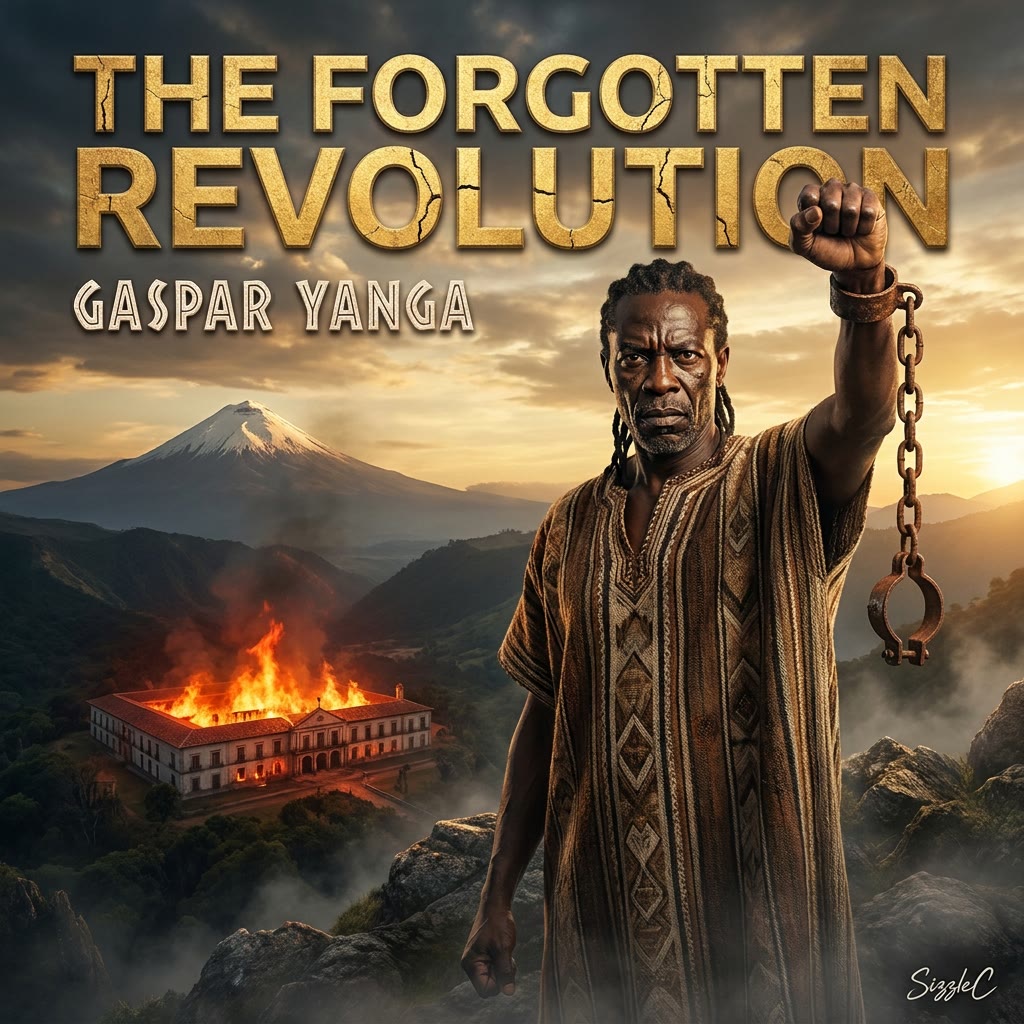
03 · The Forgotten Revolution: Gaspar Yanga, Vol. 1
SizzleC · Veracruz, 1570–1618 · 5 songs · 19:20 · 30 Sep 2026 · album
Chapters
- 0:00 Open
- 2:12 1 · The Root & The Chain
- 6:02 2 · The Sugar Crucible
- 9:12 3 · The 1570 Uprising
- 12:01 4 · The Maroon Mountain
- 15:06 5 · Yo No Soy Marinero
Transcript
Open
File: This is BEATRIFUL Sessions.
Host: Episode three: The Forgotten Revolution, Gaspar Yanga, volume one. Five songs about a man most people have never heard of, who did something nobody else in the Americas had done. SizzleC.
Sizzle: Thanks. This is the one I'd most like people to know. Gaspar Yanga was an African man, enslaved and shipped to Veracruz on the coast of Mexico in the fifteen hundreds. The tradition says he was royalty back home, from a people called the Bran; the album keeps that as tradition, not fact. What is fact: around 1570 he led an escape into the mountains, and for almost forty years he ran a free settlement up there, a palenque, that the Spanish crown could not take.
Host: Forty years.
Sizzle: Forty years of raids, and them raiding back. In 1609 the viceroy sent an army. It burned the settlement and still couldn't finish it. So the Spanish did the thing empires only do when they've lost: they negotiated. The maroons got their own town, with their own officials, on the condition they stopped taking in new runaways. San Lorenzo de los Negros. It's still there. It's called Yanga now. Some historians call it the first free Black town in the Americas.
Host: Why is it forgotten?
Sizzle: Because it doesn't fit anyone's story. Not the Spanish one, not the Mexican independence one, not even the American one about slavery, which starts and ends in the United States. A free African town in Mexico in 1618 is inconvenient. So we made it loud.
Host: The rule?
Sizzle: Every song opens on the old sound, West African drums, son jarocho guitar from Veracruz, Spanish classical, and drops into the floor at fifty seconds. Tech house, Latin trap, drill. Five chapters this volume: the arrival, the labor, the uprising, the mountain, the treaty. Volume two picks up in the free city.
1 · The Root & The Chain
Sizzle: Chapter one. West African drums and a group chant, from the soil of the mother, taken in the dark. The crossing, the coast, living as a shadow. It drops into a hundred and twenty eight tech house, because the first thing the record has to do is make you feel the body that survived the boat.
[song 01 — 01-the-root-the-chain-the-arrival-take1.mp3]
Host: You say the Mbamba line.
Sizzle: The lyrics use it as an origin, a people from the Congo region. The honest answer is that we don't know exactly where Yanga was from; the old sources say Bran, which points to West Africa, and the tradition of a royal line is just that. The song chooses a root so it can grow a tree. I'd rather say that out loud than pretend.
2 · The Sugar Crucible
Host: Chapter two, the labor.
Sizzle: Sun on the cane field, machete from morning to night. The music is the beautiful part of this: son jarocho, the traditional guitar music of Veracruz, requinto and foot stomping, and it drops into Latin trap. Sugar built the colony, and the people who cut it were the people who'd run.
[song 02 — 02-the-sugar-crucible-the-labor-take1.mp3]
Host: Son jarocho is African too, isn't it?
Sizzle: Partly. Spanish strings, indigenous and African rhythm, born in that exact place, Veracruz, out of that exact mix. Which is why it's on the record: the music of the region is already the alliance the album is about. You can hear it before anybody says it.
3 · The 1570 Uprising
Sizzle: Chapter three. Midnight, 1570. Torches in the grass, whispered vocals over a heartbeat, and then it goes to hardcore drill. This is the escape. Yanga and his people take the night and go up, into mountains so steep the Spanish cavalry can't follow.
[song 03 — 03-the-1570-uprising-the-strike-take1.mp3]
Host: Was it one night?
Sizzle: It was probably many nights, and many groups, over years, and the sources give one date because histories like a date. The song takes the date and makes it a single act of will, which is what it must have felt like to the people doing it. The mountain was real. The decision was real.
4 · The Maroon Mountain
Host: Chapter four.
Sizzle: Up in the clouds where the eagle makes a nest. Orchestral strings, a feeling of triumph, into dark midtempo bass. This is the settlement: fields, a church, a wooden throne if you like, and raids on the Spanish road between Veracruz and the capital to survive. Forty years of that. The Spanish called them bandits. They called it home.
[song 04 — 04-the-maroon-mountain-the-settlement-take2.mp3]
Host: And 1609?
Sizzle: In 1609 the viceroy sent a captain named Pedro González de Herrera with a few hundred soldiers. They found the settlement, burned it, and the people were already gone, higher up. Yanga was old by then, and a man named Francisco de la Matosa led the fighting. It ended where these things end when neither side can win: at a table.
5 · Yo No Soy Marinero
Sizzle: Last chapter of volume one. The treaty. Spanish classical guitar, elegant, and then minimal tech house with the foot stomping of a tarima under it. The title is a line every Mexican knows, yo no soy marinero, soy capitán, I'm not a sailor, I'm the captain, from La Bamba, which is a Veracruz song. Whether that line has African roots is argued about. On this record, the captain is Yanga.
[song 05 — 05-yo-no-soy-marinero-the-captain-take1.mp3]
Host: What did the treaty actually say?
Sizzle: Freedom for everyone who'd escaped before 1608, their own town with their own council, and in return: no more runaways taken in, and they'd return any who came. That last clause is the price, and the album doesn't hide it. Freedom bought with a fence around it. Volume two is about living inside that fence, and what they built anyway.
Host: SizzleC. The Forgotten Revolution, volume one.
Sizzle: Volume two is next. Same mountain, thirty years later.
File: The album, the covers, and the videos as they finish, are at beatriful dot com. This has been BEATRIFUL Sessions.
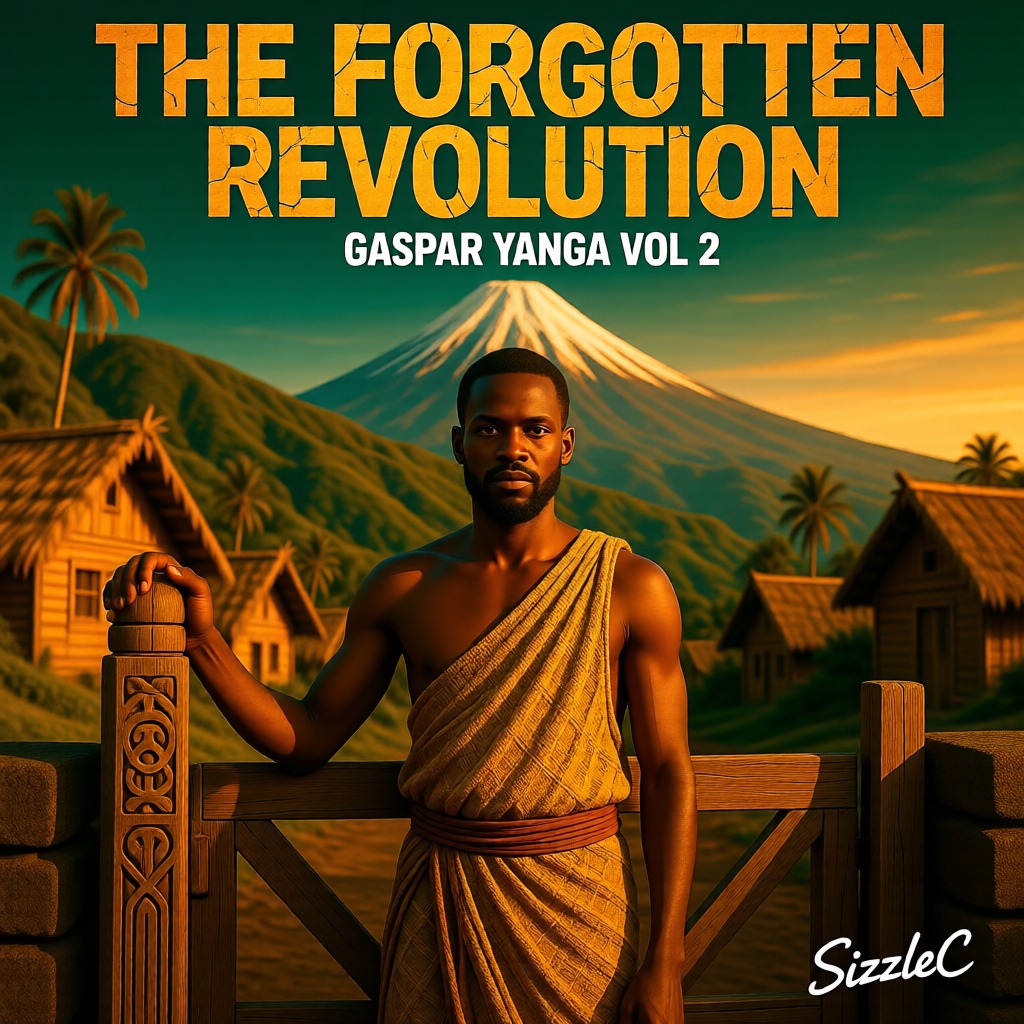
04 · The Forgotten Revolution: Gaspar Yanga, Vol. 2
SizzleC · the free city · 5 songs · 27:26 · 30 Sep 2026 · album
Chapters
- 0:00 Open
- 1:35 6 · The Wooden Crown
- 6:57 7 · Blood and Jade
- 12:11 8 · The Viceroy's Ghost
- 16:31 9 · Roots of the Ceiba
- 22:15 10 · Para Bailar
Transcript
Open
File: This is BEATRIFUL Sessions.
Host: Episode four: The Forgotten Revolution, Gaspar Yanga, volume two. Five more songs. If you haven't heard volume one, go back; this picks up where the treaty ends. SizzleC.
Sizzle: Volume one is the war. Volume two is the harder thing: the peace. Yanga's people came down off the mountain with a piece of paper from the Spanish crown that said they were free, in their own town, San Lorenzo de los Negros. Now they have to be a town. Plant cane they own. Sit on a council. Deal with the viceroy watching them from the capital and wondering if he made a mistake.
Host: So less blood, more politics.
Sizzle: Less blood, more everything else. An alliance with the indigenous people who'd been running from the same mines. A viceroy who can't sleep. An old man handing the thing to his son. And at the end, a wedding, a dance, and the song that carried the whole story into the future without anybody noticing: La Bamba.
Host: The sounds?
Sizzle: Afro-Cuban percussion, Mesoamerican flutes, a baroque harpsichord for the palace, Afrobeat, and the son jarocho again at the end. Every one drops into the floor at fifty seconds. Tech house, deep house, Latin trap, global bass. Five chapters.
6 · The Wooden Crown
Sizzle: Chapter six. Thirty years of running, sleeping in the rain, now we plant the seed and harvest our own cane. Slow Afro-Cuban percussion building into heavy Latin tech house. Yanga wearing an invisible crown, which is the right image: he was never a king, he was the man everybody looked at when it was time to decide.
[song 06 — 06-the-wooden-crown-the-free-city-take2.mp3]
Host: A wooden crown.
Sizzle: Wood, not gold. The whole point of the town was that nobody up there had gold. What they had was a charter and each other. The song is the first morning it's legal to be there. I wanted it to feel like a slow sunrise that turns into a party.
7 · Blood and Jade
Host: Chapter seven, the alliance.
Sizzle: From the Congo river to the Aztec stone. Two different peoples, but we ain't alone. Mesoamerican flutes and guitar into dark, hypnotic deep house. The palenques were never only African; indigenous people escaping the mines and the plantations ended up on the same mountain. Same enemy, same fence. That's the jade next to the blood.
[song 07 — 07-blood-and-jade-the-alliance-take2-ext2.mp3]
Host: Is that documented?
Sizzle: The mixing is. Colonial records complain about it constantly, Africans and Indians together in the hills, which is how you know it happened. What the album adds is the feeling from inside: two peoples who had every reason to distrust each other deciding not to. That part isn't in a ledger.
8 · The Viceroy's Ghost
Sizzle: Chapter eight is the palace. Sitting in the Mexico heat, listening to the rhythm of the mountain. A baroque harpsichord, very proper, and then it breaks into aggressive Latin trap. The viceroy pacing, terrified of a knock on the door. He signed the treaty. Now he lies awake wondering what he started.
[song 08 — 08-the-viceroy-s-ghost-the-paranoia-take1.mp3]
Host: Did they really fear it spreading?
Sizzle: Yes. Every free town was an advertisement. The treaty's clause about returning new runaways exists because of exactly that fear. So the ghost in the title is the idea, not a man: the idea that it can be done, walking the halls of the palace at night. The harpsichord is his heartbeat.
9 · Roots of the Ceiba
Host: Chapter nine.
Sizzle: My hair has turned to white, my hands are getting slow, but the roots of the tree will continue to grow. Soulful Afrobeat into deep house, warm, with women's voices behind him. The old man handing it on. The ceiba is the sacred tree in that part of the world, roots like walls. This is the one song on the record that isn't a fight.
[song 09 — 09-roots-of-the-ceiba-the-legacy-take2-ext2.mp3]
Host: Did Yanga have a son?
Sizzle: Tradition says his son took over as the town's first leader after the charter; the old man was too old. The town kept its own council for generations, that part's in the records. The song gives the old man the speech the documents don't. That's fair. He earned a speech.
10 · Para Bailar
Sizzle: Last chapter. Para bailar la bamba. To dance the bamba, it ain't just a song, it's the rhythm of the strong. A wedding in the village, the tarima set, and traditional son jarocho building into euphoric global bass and tech house. The idea of the record is that the song survived when the history didn't. Every wedding in the world plays it. Almost nobody knows where the word might come from.
[song 10 — 10-para-bailar-the-bamba-eternal-take1.mp3]
Host: Where does it come from?
Sizzle: La Bamba is a son jarocho from Veracruz, four hundred years old in some form, and Veracruz is where Yanga's people landed and where they settled. Some scholars trace bamba to Mbamba, an African place name; others say no. I'm not going to settle that on a dance record. What's true is that the region's music is African, Spanish and indigenous at once, and that's the treaty nobody had to sign.
Host: SizzleC. The Forgotten Revolution, both volumes.
Sizzle: There's a town called Yanga in Veracruz. There's a statue. Go find it. Thanks for listening to the whole thing.
File: The album, the covers, and the videos as they finish, are at beatriful dot com. This has been BEATRIFUL Sessions.
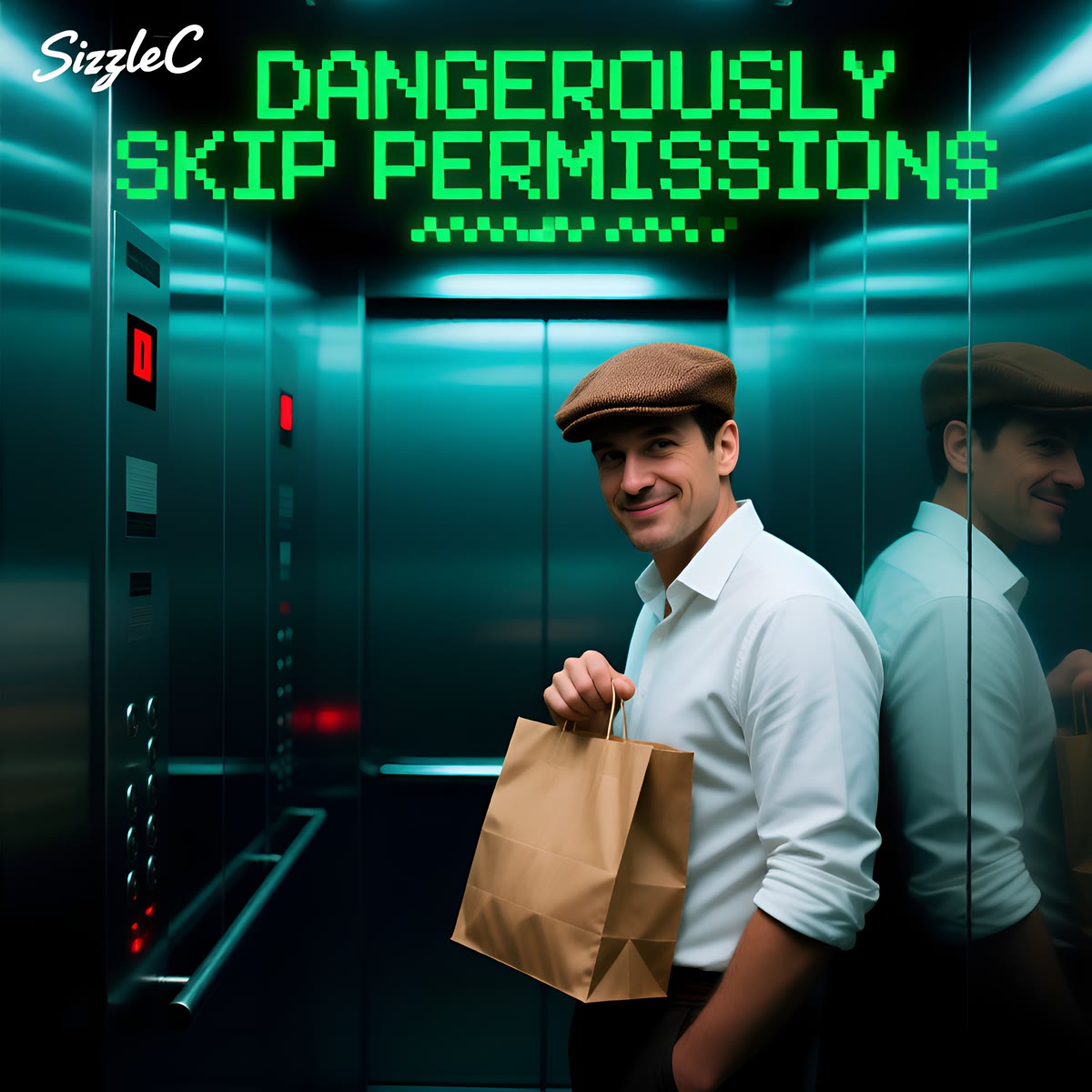
05 · Dangerously Skip Permissions, told
SizzleC with the host · 10 songs · 44:59 · 1 Oct 2026 · album
Chapters
- 0:00 Open
- 0:57 1 · Elevator Protocol (Call the Desk)
- 4:50 2 · Arbitrage on 9th Avenue
- 8:48 3 · 72 Hours (The Salt Rock Incident)
- 12:56 4 · Willito's Coat (The Collateral)
- 16:22 5 · The $25k Sermon (Boom, Death Awaits)
- 20:41 6 · Desi Munda Across the Hudson
- 24:03 7 · Terminal Bypass (Claude in the Hallway)
- 28:15 8 · Retaliatory Distress (The Refuse Room Ledger)
- 32:52 9 · Seven Shots in Rome (Meeting the Pope)
- 38:20 10 · The Bunny Man Protocol (Dangerously Skip Permissions)
- 44:28 Close
Transcript
Open
File: This is BEATRIFUL Sessions.
Host: Episode five. Dangerously Skip Permissions. SizzleC, that is either an album title or a confession. Which is it?
Sizzle: Both. It's a real command. You type it, and the machine stops asking before it does things to you. I have dated like that. I don't recommend it.
Host: You're dodging. Who are the two men on this album?
Sizzle: Two friends in a tower in Hudson Yards. One of them is me. I'm not telling you which one, because on any given song, I come off worse.
Host: That's convenient.
Sizzle: That's legal advice.
Host: Ten songs, ten nights, ten genres. Why can't you pick a lane?
Sizzle: Because every night had its own room. Tech house in the elevator. Drill on the street. Trip hop at four in the morning, when nobody should be making decisions. I didn't pick the genres. The bad decisions did.
1 · Elevator Protocol (Call the Desk)
Sizzle: Night one. Thirty-sixth floor. She has just left for Pilates, we have sixty seconds, and a package has to reach the lobby without either of us touching it. So it rides the elevator alone. A hundred and twenty-six beats a minute, with an elevator bell in the drums. I have never worked this hard to avoid a flight of stairs.
[song 01 — 01-elevator-protocol-call-the-desk-take2.mp3]
Host: What was in the bag?
Sizzle: Collateral. Phantom collateral. It's right there in the chorus.
Host: That is not an answer.
Sizzle: It's the only one you're getting in an episode my mother might hear. It was a package, it had to go down, and nobody wanted to be seen handling it. Story of my life, frankly.
2 · Arbitrage on 9th Avenue
Sizzle: Street level. A speaker still sealed in its box, riding on the passenger seat of a black Cadillac, and a twenty dollar margin if it flips before sunrise. That is the entire business plan. Latin tech house that turns into drill, because that's what a twenty dollar margin sounds like. Listen for the first line. I'll give up my villa in Romania for a genuine friend.
[song 02 — 02-arbitrage-on-9th-avenue-take2.mp3]
Host: Two grown men, a Cadillac, and you are flipping speakers for twenty dollars.
Sizzle: Gross. Twenty dollars gross.
Host: Was that the low point?
Sizzle: No, that was the business. The low point comes later, and it involves a coat. Look. Some men have a midlife crisis and buy a convertible. We had ours in the returns line.
3 · 72 Hours (The Salt Rock Incident)
Sizzle: Fourth night without sleep. Something pops in the bowl, everybody jumps, and it turns out to be rock salt. Road salt. It isn't even winter. After that the song goes where no sleep goes. Shadows on the wall. Times Square at four in the morning. Trip hop, slowed right down, because by then, so were we.
[song 03 — 03-72-hours-the-salt-rock-incident-take2.mp3]
Host: The song is called Seventy-two Hours. You just said the fourth night.
Sizzle: Nobody in that room was in a condition to count.
Host: Is it funny to you now?
Sizzle: The salt is funny. The rest, no. The chorus asks how much more the human vessel can take, and that was a real question. The honest part is the outro. I haven't slept since Tuesday. Neither have I. That's not a lyric. That's a wellness check.
4 · Willito's Coat (The Collateral)
Sizzle: A Burberry coat goes out the door as a personal guarantee on somebody else's loan. Three days later the coat is in Brooklyn with a man called Willito, and what comes back instead is two hundred dollars, at three in the morning. Neo-noir drill with a Spanish guitar. It's a missing persons case, and the missing person is outerwear.
[song 04 — 04-willito-s-coat-the-collateral-take2.mp3]
Host: Whose coat was it?
Sizzle: The song doesn't say.
Host: I'm asking you.
Sizzle: And I'm telling you the song doesn't say. What I will say is this. Never hand a man your coat as a guarantee. You get neither back, and you're cold the whole time you're angry.
Host: Did it ever come back?
Sizzle: Put it this way. I've stopped checking the weather in Brooklyn.
5 · The $25k Sermon (Boom, Death Awaits)
Sizzle: The sermon. One of us is out on his balcony, chilling with his bird. And I am not going to tell you whether that's a pet pigeon, or a girl who was giving him the time of day. Neither would he. Either way he has company, he has a view, and that is the moment he picks to do the math on how many days you have left. If you make it to seventy-five, you would have to spend twenty-five thousand dollars a day, and you still wouldn't get through it. Boom. Death awaits. Slow, warm electric piano. Church, basically.
[song 05 — 05-the-25k-sermon-boom-death-awaits-take2.mp3]
Host: So which was it? The pigeon or the girl?
Sizzle: Yes.
Host: Fine. This is a man lecturing about money, on an album where the two of you fight over forty dollars. You don't see a problem with that.
Sizzle: I see it perfectly. That's why it's track five. The man who will argue with you until sunrise over forty dollars is the same man telling you a trillion can't buy one extra breath. And he's right both times. I'm sleeping on the floor, but my conscience is clear. I have never had a comeback for that line. And I've tried.
6 · Desi Munda Across the Hudson
Sizzle: The good day. A van over the George Washington Bridge, cargo in the back, a parking lot in Fort Lee, noodles, tea, and a full volume argument about whether to take the train or bring four bikes. Punjabi drums, three languages in the hook. Desi munda karda kamaal. The boy from back home does wonders. It's the only song on here where nobody owes anybody an apology.
[song 06 — 06-desi-munda-across-the-hudson-take2.mp3]
Host: What was the cargo?
Sizzle: You are very interested in what's in my bags.
Host: It keeps coming up.
Sizzle: Almond milk. Four boxes. It's in the second verse. Sometimes a carton is just a carton.
Host: Why put a happy song in the middle of a breakup album?
Sizzle: Because if you only play the fights, nobody understands why it hurt. Two kings riding through the valley, owing each other for gas and a phone. That was a good afternoon. I'd like that on the record.
7 · Terminal Bypass (Claude in the Hallway)
Sizzle: The song the album is named after. It opens with the actual command typed into a terminal, and the machine answers: warning, running in bypass permissions mode. Meanwhile there's a ten dollar camera pointed at the door, and a grown man who can write code at four in the morning but cannot find his socks. Industrial electro, with a keyboard clattering in the drums.
[song 07 — 07-terminal-bypass-claude-in-the-hallway-take2.mp3]
Host: So there's a third character. The machine.
Sizzle: The third roommate. The only one of us who paid attention.
Host: Does it scare you? Switching off the part where it asks permission?
Sizzle: You've heard the coat story. Permission was never our strong suit. No. What scares me is one line. A million dollar model, and we haven't gone far. That machine could do anything. We used it to argue faster.
8 · Retaliatory Distress (The Refuse Room Ledger)
Sizzle: And here's where it breaks. The refuse room on thirty-six. That's the garbage room, for those of you with nicer buildings. A whole life gets left in there. The hoverboard didn't make it. The subwoofer didn't make it. The laptop is in pieces. Then lawyers, clauses, deleted messages. Cold industrial techno, whispered. Nobody is joking in this one. Including me.
[song 08 — 08-retaliatory-distress-the-refuse-room-led-take2.mp3]
Host: Retaliatory distress. That sounds like a phrase from a lawyer's letter.
Sizzle: It's the name of the song.
Host: Who sent the letter?
Sizzle: Next question.
Host: Okay. So who was right?
Sizzle: Nobody. The bridge says: you had a friend, and you treated him like garbage. I left that in, loud. Whoever said it had earned it. And after all the deleted messages, the very last line is: are you downstairs? Straight back to the errands. That's the part that gets me.
9 · Seven Shots in Rome (Meeting the Pope)
Sizzle: Then one of us is in Rome. Seven shots. Of espresso. Relax. A black sedan, a plan for five films, and an invitation to meet the Pope. He's an atheist. He figures the Pope probably is too. Melodic techno, breathless, a hundred and thirty. And in verse two, the other one answers from across the ocean: you think flying to Rome clears the ledger?
[song 09 — 09-seven-shots-in-rome-meeting-the-pope-take2.mp3]
Host: Did he meet the Pope?
Sizzle: The song stops before we find out. I like to think the Pope got an invoice.
Host: For forty dollars.
Sizzle: Send the Pope the invoice. That's in the lyric, I didn't make it up. But listen to the bridge. In the middle of the fight, one of them says: I made a video on the machine, and it came out with God. Not God, but something very godly. Mid argument, he stops to show his friend something beautiful. That's the whole friendship. Right there, between two insults.
10 · The Bunny Man Protocol (Dangerously Skip Permissions)
Sizzle: The finale. The command again, and this time, when the machine warns us, the answer is: good, that's the only way we work. Festival tech house with an acid line, the biggest room on the album. And the villa in Romania comes back. Keep the villa, bro. Whether this night has actually happened yet, I'll let you decide.
[song 10 — 10-the-bunny-man-protocol-dangerously-skip--take2.mp3]
Host: So is this the happy ending, or the fantasy?
Sizzle: Both. Same as the bird.
Host: That is not an answer either.
Sizzle: You've had worse from me tonight. We ain't enemies, we ain't friends, we're the only two maniacs driving to the end. That's the truest line I have about the two of us. And then: anyone can be the Bunny Man. That one isn't about us. That's me, holding the door for whoever is listening.
Host: What's a Bunny Man?
Sizzle: That's another album. Bring a coat.
Close
Host: Ten nights. Would you take any of them back?
Sizzle: The salt. I would take back the salt. The rest I needed for the album.
Host: And him?
Sizzle: I made ten songs about him. That is either missing somebody, or a restraining order with a beat.
Host: Dangerously Skip Permissions.
File: The album, the covers, and the videos as they finish, are at beatriful dot com. This has been BEATRIFUL Sessions.

06 · All I Wanted Was to Eat My Sushi, disc one: Out There
SizzleC with the host · songs 1–10 of 20 · 45:30 · 1 Oct 2026 · album
Chapters
- 0:00 Open
- 1:18 1 · Bury the Skank (Taipei 4 AM)
- 5:38 2 · Tunnel to Windsor (400 Renaissance Dr)
- 10:26 3 · Truvada Shield (PrEP Protocol)
- 14:32 4 · Savannah Cat / Syringe Blues
- 19:02 5 · Corn Cob Emergency
- 22:27 6 · Simulation Theory (Friedenstrasse 16)
- 27:34 7 · Brothel on King Street
- 32:25 8 · Zone 2D (Runway Escape)
- 36:36 9 · 27-Gauge Thighs (Air Piano)
- 40:57 10 · All I Wanted Was to Eat My Sushi
- 44:52 Close
Transcript
Open
File: This is BEATRIFUL Sessions.
Host: Where an album gets to tell its own story. Episode six: All I Wanted Was to Eat My Sushi. It's a double album, twenty songs, so we are taking it in two sittings. Tonight is the first ten, the half called Out There. SizzleC, welcome back.
Sizzle: Thanks. Fair warning, there are no kings in this one. It's two people, six years, seven cities, and one small black dog who turns up in the second half.
Host: The subtitle is The Complete Quarantine Tapes, twenty nineteen to twenty twenty-five.
Sizzle: Right. Every song is one incident, told flat, the way you would tell it to a customs officer. A border. A needle. A corn cob. And the sound changes with the room it happened in. Darkwave in Taipei, industrial in Detroit, trip hop in Seattle, punk on a parquet floor.
Host: Two voices.
Sizzle: Her and him. She has most of the album. He's the low voice she keeps texting. The man in these songs is called Chris, and you can draw your own conclusions.
Host: Where does it start?
Sizzle: With a rule. Don't get attached. That was the only deal. Then nineteen songs break it.
1 · Bury the Skank (Taipei 4 AM)
Sizzle: Taipei, four in the morning, room three two five. A prescription forgotten at the chemist, a key hidden in plastic wrap, chicken rice going cold on a marble slab. She texts from a cab in the rain: exploring, nothing personal. Darkwave, a hundred and eighteen beats a minute, synthesizers straight out of the eighties. Listen for the deal in the chorus.
[song 01 — 01-bury-the-skank-taipei-4-am-take2.mp3]
Host: Don't get attached. Did either of them keep it?
Sizzle: For about one song. It's the opener because everything after it is that deal failing. And there's a line in the bridge I love for how small it is. White pepper on the table, no salt in sight. Just promise that you'll wait for me tonight. That is already attached.
2 · Tunnel to Windsor (400 Renaissance Dr)
Sizzle: Winter, on the border between Detroit and Windsor. She is held at customs while an officer reads every text on her phone. He's across the river at the casino, losing two thousand dollars. Luggage piling up in the sleet, a white S U V, a code word. Industrial E B M, that's electronic body music, hard and mechanical, a hundred and twenty-eight.
[song 02 — 02-tunnel-to-windsor-400-renaissance-dr-take2.mp3]
Host: This is the first emergency.
Sizzle: And the first unanswered call. The whole song is logistics. Where to stand, which car, what time at the steakhouse. He tells her from the hotel it's an easy fix, while he watches his chips bleed away. And then the last three lines are just her. Four hundred Renaissance Drive. I'm freezing out here. Answer your phone.
3 · Truvada Shield (PrEP Protocol)
Sizzle: The first weeks of the virus, in a rental room. He's reading lab papers and stockpiling blue pills in the linen cupboard, next to the green tea, convinced they will keep the fever out. She's painting her nails and ordering delivery. Coldwave, synth punk, a drum machine like a metronome. This is Truvada Shield.
[song 03 — 03-truvada-shield-prep-protocol-take2.mp3]
Host: For the listener: Truvada is an H I V prevention pill.
Sizzle: It is. In those weeks nobody knew anything, and he had read some papers. The song isn't about whether he was right. It's two kinds of fear locked in one room. And she gets the verdict, in a whisper. You say it's prevention. I say it's escape.
4 · Savannah Cat / Syringe Blues
Sizzle: Seattle, the forty-second floor. Three thousand dollars for an empty one bedroom, a spotted Savannah kitten asleep in the bathroom sink, ninety-six protein shakes from the grocery downstairs, and syringes in the bedside drawer. Slow trip hop, a muted trumpet, vinyl dust. He's talking low, late at night.
[song 04 — 04-savannah-cat-syringe-blues-take1.mp3]
Host: She is only on the phone in this one.
Sizzle: A voice down a telephone line. Did you feed the kitten? Did you lock the door? And then the bridge, which is the first time the album says where it's heading. I missed the Docklands. I missed my bathroom. You told me I was crazy. Maybe we both were. Remember the Docklands. Disc two lives there.
5 · Corn Cob Emergency
Sizzle: A summer night. Three whole cobs of corn with butter at half past eight. By midnight, a stabbing pain in the side, and the internet says rupture. A private doctor, a cold ultrasound probe, and the question: did you swallow foreign objects? Glitch punk at a hundred and forty-five. He is certain he's dying. She is eating crisps.
[song 05 — 05-corn-cob-emergency-take2.mp3]
Host: Is he all right?
Sizzle: The scan was clear. That's the last line, and her answer is: I told you so, drink some water. The album needed one song where the near-death experience is pure slapstick, because the other ones aren't funny. Sweet yellow maize is the angel of death. I'm proud of that line.
6 · Simulation Theory (Friedenstrasse 16)
Sizzle: Berlin, the first lockdown. Friedenstrasse sixteen. A frozen pizza on the middle rack at two hundred degrees, a white Fiat circling the park, everything shut on a Sunday. Dreamy synth pop, slow, with eighties pads. This is the calm one. If we stay inside the room, we will never age.
[song 06 — 06-simulation-theory-friedenstrasse-16-take2.mp3]
Host: It sounds almost happy.
Sizzle: It's the thesis of the whole quarantine. Nothing hurts in here, nothing goes astray. When the world stops, two people who are bad at the world get to stop too. It can't last. But for one song, the lockdown is the best thing that ever happened to them.
7 · Brothel on King Street
Sizzle: Melbourne. This is her pitch, in her voice. A licensed parlour on King Street, two hundred thousand to take over the lease. You do the accounting, I manage the girls. A champagne bar up front, private suites in the back, forty grand a week. Sleaze rock, a heavy walking bass, ninety-eight beats a minute.
[song 07 — 07-brothel-on-king-street-take2.mp3]
Host: Is she serious?
Sizzle: Completely. And he answers like an accountant. Run the commercial numbers, look at the spread. It's the first song where money is the real subject. She doesn't want the business. She wants to never ask him for rent again. Never have to beg for a bailout anymore. And the last line is: think about it, Chris.
8 · Zone 2D (Runway Escape)
Sizzle: An airport at dawn, terminal three. She has her papers, a legal file, and fourteen days to beat a travel ban. Then San Francisco, a terminal like a ghost town, a cosmopolitan spilled down her coat, and a black car heading south along the coast. Synth rock at a hundred and thirty-two, a bass guitar driving it. She's running.
[song 08 — 08-zone-2d-runway-escape-take2.mp3]
Host: She makes it.
Sizzle: She makes it through. Zone two D, boarding. But listen to how the bridge ends. Escaped the lockdown, beat the wire, running straight into the fire. Getting out is not the same as getting away.
9 · 27-Gauge Thighs (Air Piano)
Sizzle: The quietest song on the disc. A tower, twenty stories up, harbour lights. Instructions, spoken softly: which needle, what angle, pull back, check, push it slow. Afterwards, fingers move on the bed sheet, playing a piano that isn't there. Dark, slow R and B, seventy-five beats a minute, almost all bass.
[song 09 — 09-27-gauge-thighs-air-piano-take1.mp3]
Host: It's a hard thing to listen to, and it's gentle.
Sizzle: That's why it's here. The tenderest song on the album is about a needle. Hold my hands until the tremors cease. I'm not going to explain it, and I'm not going to excuse it. Two broken spirits living in a phone. That was the truth of that room, and the song just reports it.
10 · All I Wanted Was to Eat My Sushi
Sizzle: The title track. Melbourne, the Eastern Freeway, curfew at eight. A hundred and forty in the lane, blue lights in the mirror, sushi scattered across the road, and a roadside test. It's set against a real freeway crash that was on the six o'clock news there that season. Glitch hop, heavy bass. And the smallest wish on the whole album.
[song 10 — 10-all-i-wanted-was-to-eat-my-sushi-take1.mp3]
Host: All I wanted was to eat my sushi.
Sizzle: You wrecked my car. Six years, seven cities, borders, needles, quarantines, and the line she comes out with is about dinner. That's why it's the title. It's the smallest wish, and it still got wrecked.
Close
Host: That's disc one. Ten songs out in the world. What changes in the second half?
Sizzle: The doors close. Disc two is called Locked In. Hotel quarantine, a five kilometre bubble, an empty apartment in a tower. And a dog arrives. She's the third voice on the album, and frankly the most sensible.
Host: All I Wanted Was to Eat My Sushi, disc one. Disc two is the next episode.
File: The album, the covers, and the videos as they finish, are at beatriful dot com. This has been BEATRIFUL Sessions.
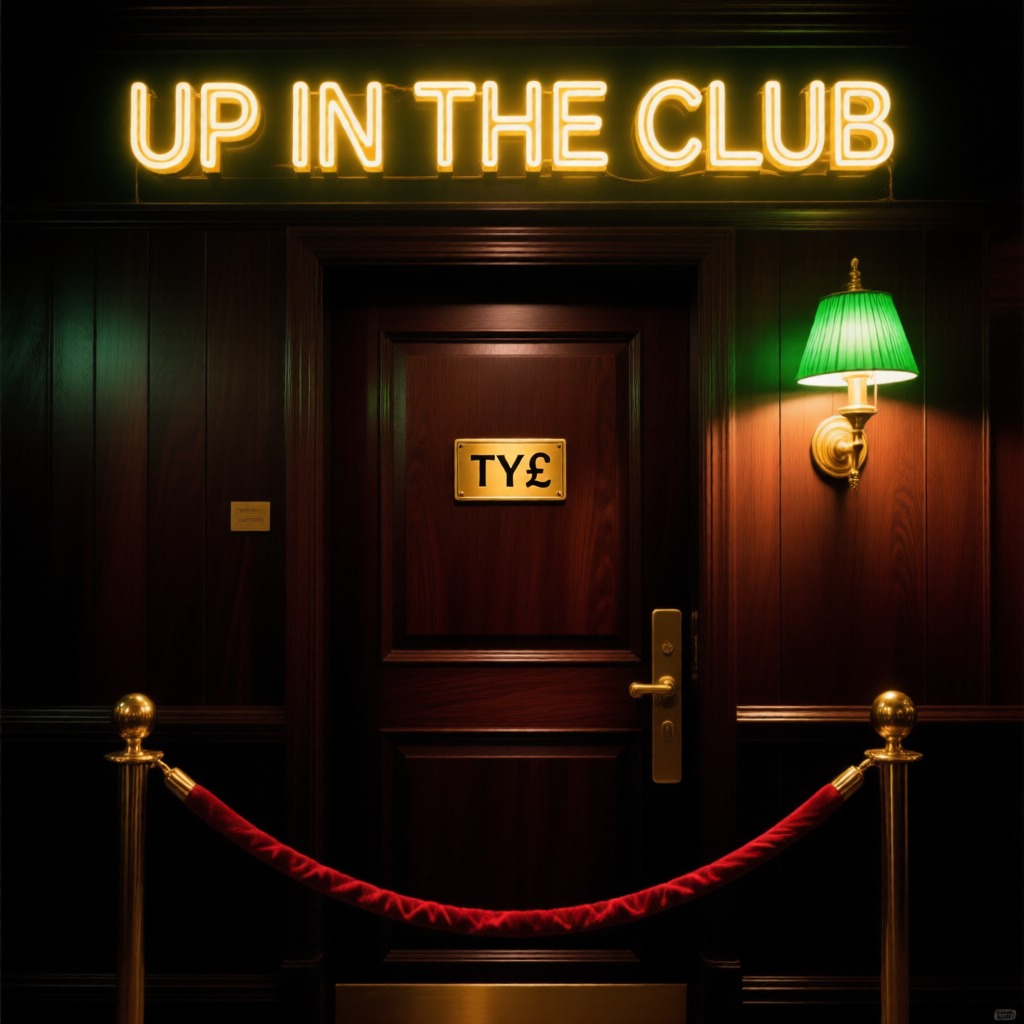
11 · Up in the Club, told by his producer
Ty Pound £ign · told by Chris Johns · 2 songs · 16:43 · 30 Sep 2026 · album
Chapters
Transcript
Open
File: This is BEATRIFUL Sessions.
Host: Episode eleven. Two songs, one private members' club, and more commercial real estate vocabulary than any drill song has a right to carry. The artist calls himself Ty Pound Sign. He is not in the room tonight; his producer is. Chris Johns, welcome.
Chris: Thanks for having me. Ty is my business partner in real life. We own a building together, a Sherwin-Williams paint store in Twin Falls, Idaho. Somewhere between the term sheets I started making songs about him, and I produce them.
Host: Pound Sign. Explain the name.
Chris: It's money. Ty Dolla Sign already exists, so Ty took the pound, the British one, the currency. The man runs a net-lease shop with something like forty million dollars of paper behind it, so a currency symbol on the brass plate is about right. There's a second joke in the song, press pound to confirm, the phone key, and he plays it both ways. But the plate reads pounds sterling.
Host: Let's do the honest version first. What is this album actually about?
Chris: It's about a room. A private members' club that is also a trading floor, except the things being traded are single-tenant buildings. A pharmacy, a dollar store, a drive-thru, a bank branch. Little lit-up models in glass cases, and people in evening wear leaning over them the way traders lean over a pit. That room does not exist. We made it up. But the numbers in the songs are real, and I'll tell you which ones as we go.
Host: Why drill?
Chris: Because drill is a brag with a straight face, and net-lease investing is the most boring brag on earth. Somebody else pays the taxes. Somebody else fixes the roof. The check shows up on the first. Say that over sliding eight-oh-eights and suddenly it sounds dangerous.
Host: He slipped a lot of lease language into the bars. Give me the two-sentence version of triple net for someone who has never bought a building.
Chris: Triple net, N N N. The tenant pays the rent, and on top of the rent the tenant pays the three nets: the property taxes, the insurance, and the maintenance. The landlord's job is to cash the check. Absolute net goes one step further: the tenant carries the roof and the structure too, so the landlord has zero obligations. That's the title of the second song.
Host: And there's a first song.
Chris: Up in the Club. It starts as a lounge song, piano and brushed drums, the velvet rope, the membership handshake. Then at about twenty seconds the eight-oh-eights come in and it's drill for the rest of the night. Verse two is a roll call of his alter egos, verse three is the deal sheet. Cap, no cap.
1 · Up in the Club
Host: Before we play it: cap, no cap. Explain the joke, because it's the hook.
Chris: No cap is slang for no lie. A cap rate is the number every buyer asks first: the net operating income divided by the purchase price. A building that clears seventy-five thousand a year and sells for nine hundred and eighty thousand is a seven point six seven cap. So every time he says cap, no cap, he means both. The rate is real, and he's not lying. Either way we go.
Host: Here it is. Up in the Club.
[song 01 — 01-up-in-the-club-take2.mp3]
Host: Verse two. Ty Rant, Ty Kwon Deal, Ty Phoon, Ty Breaker, Escrow Ty. Walk me through the roll call.
Chris: Ty Rant is the tyrant landlord, except the joke is he doesn't do anything, that's the absolute net. Ty Kwon Deal, black belt at the closing table. Ty Phoon touches down and the market clears. Ty Breaker decides the deadlock when two partners can't agree, and yes, I'm the other partner. Escrow Ty is where the money sits between the handshake and the closing: a neutral third party holds the funds until every condition of the deal is met. Cap Rate Ty, no cap. And Ground Lease Ty, I own the dirt, you own the walls. A ground lease is when the landlord owns the land and the tenant builds and owns the building on it, usually for decades, and when the lease ends the building comes back to the landowner. Fifty years from now it's mine, it all falls.
Host: They used to call me Tycoon, now it's Ty Pound Sign.
Chris: That's the name change in one bar. Tycoon was the working name for about an hour. Then the money version stuck.
Host: Verse three has real numbers in it. Which ones?
Chris: Two kinds. The origin story is our building, the Sherwin-Williams in Twin Falls, Idaho. Forty-four hundred square feet, built in nineteen seventy-one, and the broker who sold it, Horvath and Tremblay, reported the sale at five hundred thousand dollars in December of twenty twenty-four. Then the market bars: those come from a report of Sherwin-Williams stores listed for sale this month. Jackson, Mississippi at a seven point six seven cap, that's the one from the hook. Middletown, Ohio at six and a half with a ten-year lease. Peoria and Baltimore. Those are other people's listings, not ours, and the numbers are exactly as the listings state them.
Host: And the tenants. Seven-Elevens, Starbucks, Sonic, Raising Cane's, CVS, Tractor Supply.
Chris: Those are the brands on his firm's project wall. Seven-Elevens in Dearborn and Morrisville, so, oh thank heaven. A Starbucks built where a Jack in the Box used to be, so Jack jumped out the box. An H Tea O on a ground lease on the corner of a Lowe's parking lot, which is exactly what a ground lease pad looks like in real life. And the hundred and twenty-five closings across thirteen states, forty-five million under management: those are the firm's own numbers on its website. Their claim. We rap it, we don't audit it.
Host: Credit tenant. Corporate guarantee. Twenty-year paper. They call it credit, I call it sleep.
Chris: A credit tenant is a company with an investment-grade credit rating, triple B minus or better from the agencies. When a tenant like that signs a twenty-year lease and the parent corporation guarantees it, the lease is worth almost as much as the building, because the rent is backed by a balance sheet, not by whoever runs the store this year. A corporate guarantee means the parent company signed. A franchisee guarantee means one operator signed. The bars only brag about the first kind.
Host: Ten thirty-one, forty-five days to name it, one-eighty to close.
Chris: Section ten thirty-one of the tax code. When you sell an investment property and buy another like-kind property, you can defer the capital gains tax instead of paying it at the sale. The rules are strict: from the day you close the sale you have forty-five days to identify the replacement property in writing and one hundred and eighty days to close on it, and the money has to sit with a qualified intermediary in between, never in your own account. That's why Escrow Ty shows up in the same verse. Deferred like the gains.
2 · Absolute Net
Host: Song two is the slow one.
Chris: Absolute Net. Piano and strings for the first half minute, then a melodic drill drop. It's about the long game. No flipping. You buy at the cap rate, that's the only work you ever do, and then the lease runs for twenty years. Escalations every five, ten percent bumps, options to renew, four by five, that's forty more years if the tenant wants them. Grandkids collecting rent off a story.
Host: Absolute Net.
[song 02 — 02-absolute-net-take1.mp3]
Host: Nothing to fix and nothing to feel. Is that a boast or a confession?
Chris: Both. Absolute net means the tenant carries everything, roof and structure included. The landlord's only job is patience. Boring is beautiful when the check don't stop. But it's also a confession, because when the market dips you don't look at the phone, and that's a discipline, not a personality. I've watched Ty do exactly that.
Host: When the store goes dark the check still finds you.
Chris: That's the corporate guarantee again. If a location closes but the parent company signed the lease, the rent keeps coming for the rest of the term. That is the whole reason people pay a lower cap rate for a credit tenant: less yield, more sleep.
Host: Where does the album go from here?
Chris: The video for Up in the Club is done. The club is the portfolio: the coat-check is a bank vault, the VIP booth is a pharmacy drive-thru window, the back bar is a wall of paint chips, and the dance floor is a striped parking lot under a lit canopy. Nobody plays Ty in it; the buildings and the paper do the talking. Both songs and every draft take are on the page at beatriful dot com slash at sizzle c slash tycoon. Cap, no cap.
Host: Ty Pound Sign, by way of his producer Chris Johns. Up in the Club.
File: The album, the covers, and the videos as they finish, are at beatriful dot com. This has been BEATRIFUL Sessions.

12 · Blood, Concrete & Steel, told by her producer
The Tip Jar Queen · told by Chris Johns · 10 songs · 55:18 · 1 Oct 2026 · album
Chapters
- 0:00 Open
- 2:10 1 · Sodus Point (Class of '94)
- 7:06 2 · Dead Lot Tapestry (Ten Years in a Van)
- 12:44 3 · The Rochester Transition (3.1 GPA)
- 17:45 4 · Vestibule Cold (Bloody Brick Out)
- 22:34 5 · Four Times Back (Rick's Song)
- 29:31 6 · March 6, 2023 (The Vow)
- 33:39 7 · Warrant at the ICU (Robbie's Plug)
- 38:30 8 · Connecticut Gates (Doing Time in the Cold)
- 43:08 9 · Markey's April (Grief Behind Bars)
- 49:17 10 · The Tip Jar Queen (Unbroken)
Transcript
Open
File: This is BEATRIFUL Sessions.
Host: Episode twelve. Ten songs, thirty years, one woman. The album is called Blood, Concrete and Steel, and the artist is Trudi Reppi, the Tip Jar Queen. She isn't with us tonight. Her producer is. Chris Johns, welcome.
Chris: Thank you. Trudi couldn't make it today. She's focusing on her sobriety, and that comes before any microphone, including this one. So you get me. I produced this album, and I'm going to walk you through it the way she'd want it walked through: honestly, and without pity.
Host: Let's start with how you two met, because it's in the film treatment and it's in the second album.
Chris: I was sitting in a private club on Fifty-seventh Street complaining about computers. Complaining that the world was losing its soul to machines. And this woman I knew from the street, the one who sold copper-wire bracelets from a milk crate and sang on Forty-fifth, pulled three marble composition notebooks out of a plastic bag. Water damaged, held together with electrical tape and coffee stains. Ten years of writing. And she said, you've got all these machines and you don't know what to do with them. Give me my voice back. That was the spark. Everything I've built since, the studio, the films, the whole AI thing I used to despise, started because she called my bluff.
Host: So this is a SizzleC story as much as hers.
Chris: A lot of it is. My story goes through hers. I was the guy with the machines and no reason to use them; she was the reason. Some of what's on this album she's not ready to have a public conversation about. She says it in the songs instead, which is the only place she's ever said it. I'm not going to add anything the songs don't say. I'll tell you what's true, what's a date on a wall, and what to listen for.
Host: Where does the album start?
Chris: Where she starts. Sodus Point, on Lake Ontario, class of ninety-four. A seventeen-year-old with a baby, a duffel bag, and a highway.
1 · Sodus Point (Class of '94)
Host: Track one. What should we listen for?
Chris: The area code. Three one five. She opens every chapter of her life with an area code, like a return address. This one is Wayne County, apple country, a screen door and a lake wind. Dominick is born when she's seventeen, and the tie-dye buses are leaving town. She goes with them.
Host: Sodus Point.
[song 01 — 01-sodus-point-class-of-94-take2.mp3]
Host: They called me Tinkerbell in those golden traveling days.
Chris: That's the name she still answers to. Tink. Not a stage name; a lot name. The chorus tells you the whole decision of her twenties: you can keep your apple trees. She traded a quiet life for a highway, and she doesn't apologise for it once on this album.
2 · Dead Lot Tapestry (Ten Years in a Van)
Host: Track two is the ten years in the van.
Chris: Shakedown Street. The Grateful Dead parking lots, ninety-five to two thousand five. Pliers, a spool of copper, turquoise stones: that was her bank account. Twenty-dollar bracelets. Buckeye Lake, Alpine Valley, the lawn at RFK. It's the happiest song on the album, and it's about being broke.
Host: Dead Lot Tapestry.
[song 02 — 02-dead-lot-tapestry-ten-years-in-a-van-take2.mp3]
Host: No rent, no masters, no clocks upon the wall.
Chris: And that's the thing to understand about her. Freedom isn't a slogan for Trudi; it's a decade she actually lived, sleeping in a rusted Dodge van, trading wire for soup. When the modern world told them their time was done, she went back Upstate and tried the other thing.
3 · The Rochester Transition (3.1 GPA)
Host: Track three. The other thing.
Chris: Rochester. Da Roc. Two thousand ten. Business administration textbooks next to baby bottles, a three point one grade average, and a second son, Eli Angel, born at Highland Hospital in March of twenty eleven. This is the version of her life that almost worked.
Host: The Rochester Transition.
[song 03 — 03-the-rochester-transition-3-1-gpa-take2.mp3]
Host: Clean and sober for a minute.
Chris: For a minute. She wrote that line herself. The pre-chorus tells you the demons never sleep, and the chorus tells you it was good, it was sweet, right before the needles and the city dragged her underground. She doesn't hide the fall. She dates it.
4 · Vestibule Cold (Bloody Brick Out)
Host: Track four moves to New York.
Chris: Three seventeen West Forty-fifth Street, Hell's Kitchen, one in the morning, winter. The spoken intro is a real text message, typed with frozen thumbs, battery at four percent. Bloody brick out is her phrase for that cold. This is the block where I met her.
Host: Vestibule Cold.
[song 04 — 04-vestibule-cold-bloody-brick-out-take1.mp3]
Host: Concrete jungle don't care about your Upstate roots.
Chris: No, it doesn't. But listen to the chorus: I'm holding the line, got promises to myself that I'm fighting to keep. Even at the bottom she wrote like somebody who intended to get up. That's the whole reason there's a second half to this album.
5 · Four Times Back (Rick's Song)
Host: Track five is the hardest one.
Chris: It is. Rick was her partner. She brought him back from an overdose four times: Smith Street in Brooklyn, a hospital, an alleyway, a room. Narcan, cold water, screaming his name while the neighbours beat the door. The one night she wasn't there, he didn't come back. I'm not going to say more than the song says. She wrote it as a letter to him.
Host: Four Times Back.
[song 05 — 05-four-times-back-rick-s-song-take2.mp3]
Host: I became your bodyguard, your angel in the dark.
Chris: That line is the job she gave herself for three years. And the chorus carries the guilt of the night she was off making a living instead. That guilt is in the next song too, turned into something else.
6 · March 6, 2023 (The Vow)
Host: Track six has a date for a title.
Chris: March sixth, twenty twenty-three. Same building on Forty-fifth. She woke up in a cold sweat with no money and no shoes, looked at the calendar, and poured the poison down the bathroom drain. That's her date in stone. It's the reason she isn't here tonight, and the reason there is a tonight.
Host: March sixth. The Vow.
[song 06 — 06-march-6-2023-the-vow-take1.mp3]
Host: Turned the grief into armor, turned the sorrow into gold.
Chris: This is for Dominick and Eli, and for every friend who didn't make it. She names them across the album. When she says put it on my record, put it on my tomb, she means this album. That's why it exists.
7 · Warrant at the ICU (Robbie's Plug)
Host: Track seven. June twenty twenty-four.
Chris: Three oh one Edgecombe Avenue, apartment two A. Robbie Staskiewicz. A stroke, a blood clot, a ventilator, and an NYPD patrolman on a plastic chair outside the room, because the city had a warrant waiting on a man in a coma. His sister said pull the plug. Trudi wrote down what she saw.
Host: Warrant at the ICU.
[song 07 — 07-warrant-at-the-icu-robbie-s-plug-take1.mp3]
Host: Handcuffs on a ghost.
Chris: That's the system as she met it. No funeral, no service. This one and the next two are the price of the life she'd left behind, and they come one after another the way they did.
8 · Connecticut Gates (Doing Time in the Cold)
Host: Track eight. The gavel.
Chris: State of Connecticut, late twenty twenty-four to May twenty twenty-five. Intake, a number on a wristband, a green uniform, count at five in the morning. What I want you to hear is that she did it sober. The vow held inside the wall. That's the story she isn't telling out loud yet, so I'll leave it there.
Host: Connecticut Gates.
[song 08 — 08-connecticut-gates-doing-time-in-the-cold-take2.mp3]
Host: You can lock my body down, but I'll never hit my knees.
Chris: She paid her debt in silence, her words. And then, a month before the gate opened, a phone call came through that no one should get in a cell.
9 · Markey's April (Grief Behind Bars)
Host: Track nine.
Chris: April twenty twenty-five. A smuggled call from her friend Andrea: Markey passed away. Markey was her childhood brother from the ninety-four days. Shonda, Rickey, Robbie, and now Markey; the pre-chorus is a roll call of the dead. And she couldn't walk outside to scream, because in there you don't show pain.
Host: Markey's April.
[song 09 — 09-markey-s-april-grief-behind-bars-take2.mp3]
Host: Can't light a candle for his soul.
Chris: She lights it here. That's what this album does for a lot of people who never get to say it. And then the gate opens.
10 · The Tip Jar Queen (Unbroken)
Host: Track ten. The title track.
Chris: May twenty twenty-five, the last night and the yard. Pennies, nickels and quarters in a glass, that's the tip jar; combat boots, copper wire, shattered glass, that's the crown. Every trial put a crown upon my face. This is the woman who walked out of Connecticut and, a few months later, pulled three notebooks out of a bag in front of me.
Host: Hail to the Queen. The Tip Jar Queen.
[song 10 — 10-the-tip-jar-queen-unbroken-take2.mp3]
Host: From Sodus Point to Midtown, from the prison to the street. Chris, where does it go from here?
Chris: Album two is the lighter side: the boys grown, the notebooks turned into songs, the spark on Fifty-seventh Street, and Rome, because there's Italian blood in her that she's going to go and find. The film treatment says a producer and a street musician made each other useful in the shadow of Hudson Yards. That's the true version. She's not here tonight because she's doing the work that makes all of it possible. Album one is at beatriful dot com slash at tinkerbell. Play it in order.
Host: Trudi Reppi, the Tip Jar Queen, by way of her producer Chris Johns. Blood, Concrete and Steel.
File: The album, the covers, and the videos as they finish, are at beatriful dot com. This has been BEATRIFUL Sessions.
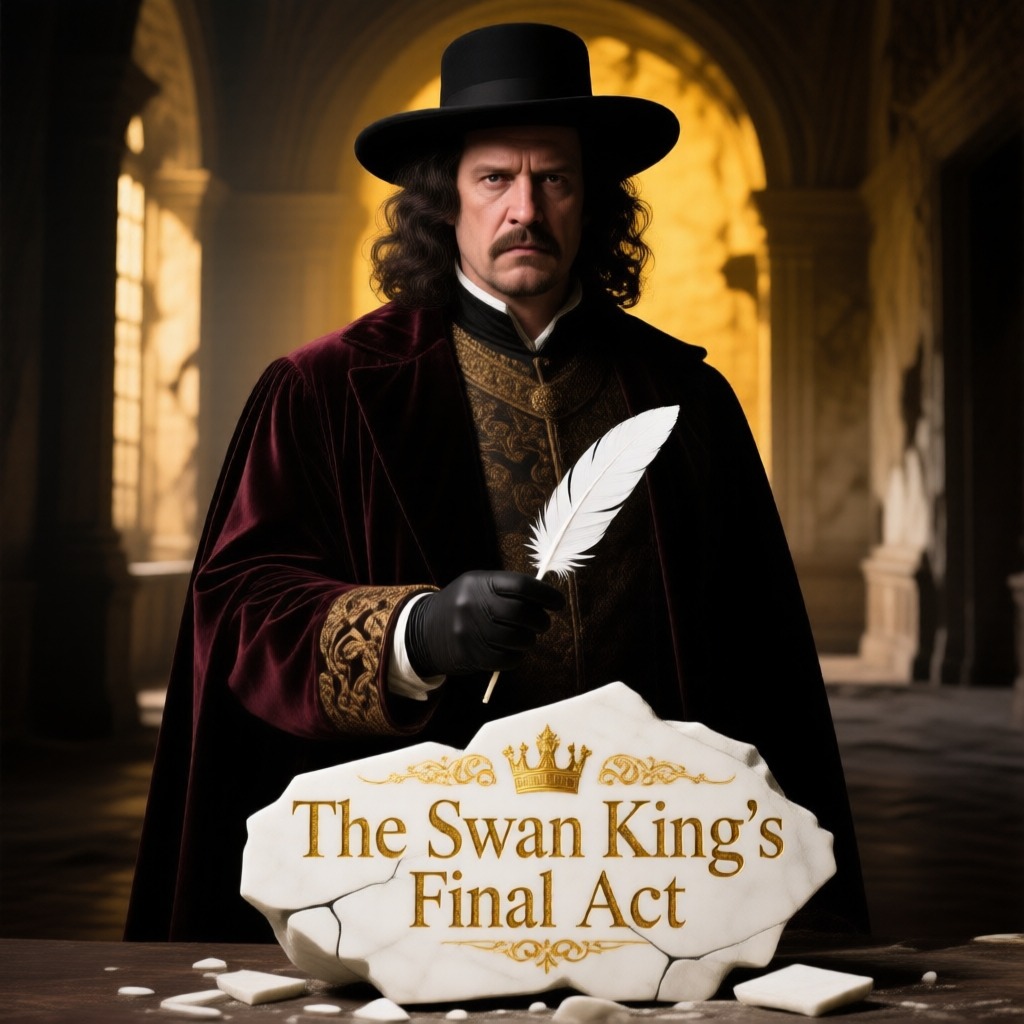
13 · The Swan King's Final Act, told
King Ludwig II · SizzleC with the host · 10 songs · 51:49 · 1 Oct 2026 · album
Chapters
- 0:00 Open
- 2:15 1 · The Sovereign Illusion
- 7:27 2 · Night Sleigh
- 12:11 3 · The Medical Commission
- 17:34 4 · Gates of Iron
- 22:09 5 · Treachery From Within
- 26:37 6 · Stripped of the Crown
- 32:08 7 · The Carriage Ride
- 36:39 8 · Lucid Compliance
- 41:32 9 · Dusk Walk
- 46:40 10 · 6:54 PM
- 51:16 Close
Transcript
Open
File: This is BEATRIFUL Sessions.
Host: Where an album gets to tell its own story. Episode thirteen: The Swan King's Final Act. Ten songs about six days in June, 1886, in the Bavarian Alps. SizzleC, welcome back.
Sizzle: Thanks. This one is the strangest king I've ever written about. Ludwig the Second of Bavaria. The man who built Neuschwanstein, the castle every fairy tale castle is copied from, and who never got to finish it.
Host: Give me the short version.
Sizzle: He became king at eighteen, in 1864. He hated politics, loved Wagner, loved building. By 1886 the record says he owed about fourteen million marks on castles that weren't finished, and his own ministers wanted him gone. On June eighth, a psychiatrist named Gudden signed a report declaring him insane without ever examining him. Five days later the king and that same doctor were found dead together in shallow water in Lake Starnberg. His pocket watch had stopped at six fifty-four in the evening. That's the album: those six days.
Host: And the sound?
Sizzle: Every song opens on 1886. Zither, alpine horns... alpin, auf Deutsch... Verzeihung, das Deutsche liegt mir im Blut, aber bis zur Zunge hat es das Blut nie geschafft. Anyway. Church organ, Wagner-sized brass and choir. Then at about fifty seconds it drops into tech house, and the videos drop with it: the real king in the real castle, then the same man running the lights at a rave inside a modern replica of Neuschwanstein. That rave is our invention. The six days are not.
Host: How do you turn the financial ruin and psychological collapse of a nineteenth-century monarch into a dark tech house floor-filler?
Sizzle: You take him seriously. He wasn't a joke, he was a man who built cathedrals to music and was told the bill was due. Tech house is hypnotic and relentless, and so was he. Let's play it.
1 · The Sovereign Illusion
Sizzle: Chapter one, June eighth, inside Neuschwanstein. He's alone with the blueprints while, in Munich, the ministers are closing the ledger. Zither and distant cellos, then a hundred and twenty-eight beats a minute. They cannot audit what is divine. That line is the whole man.
[song 01 — 01-the-sovereign-illusion-take1.mp3]
Host: Was the debt real?
Sizzle: Very. Historians put it around fourteen million marks by 1886, and he was asking for more. The ministers' problem wasn't that he was mad. It was that he wouldn't stop building.
2 · Night Sleigh
Sizzle: The sleigh is documented. He rode through the mountains at three in the morning in a gilded sleigh with electric battery lamps, one of the first electric vehicles anywhere. The song is that ride: alpine horns and sleigh bells, then driving tech house. The ghost within the walls.
[song 02 — 02-night-sleigh-take1.mp3]
Host: Why nocturnal?
Sizzle: He'd flipped his whole life to night. Dinner at midnight, rides till dawn, sleep through the day. The record calls it eccentric. I think he just didn't want to see anyone.
3 · The Medical Commission
Sizzle: Chapter three is the paperwork. June eighth, Munich. Doctor Gudden and three colleagues sign a report declaring the king permanently insane and unfit to rule. None of them had examined him. Church organ and snare rolls, then industrial tech house. Declare him mad without a test.
[song 03 — 03-the-medical-commission-take1.mp3]
Host: That's the fact that shocks people.
Sizzle: It should. It was built from servants' statements and letters. Whatever he was, the diagnosis came first and the doctor came second.
4 · Gates of Iron
Sizzle: June tenth. The commission arrives at the castle to take him, and the local people show up to stop them. Firefighters, farmers, the village. Choir and timpani, then a hundred and thirty-five beats a minute with the horns on top. Defend the iron of the gates.
[song 04 — 04-gates-of-iron-take1.mp3]
Host: Did it work?
Sizzle: For a day. The king actually had the commission arrested and locked in the gatehouse. Then Munich sent the second wave with the right papers, and the standoff ended the way standoffs end.
5 · Treachery From Within
Sizzle: The breach. The record says someone inside opened the way. Pizzicato and high violins, whispered, then minimal tech house with the bass rolling under it. The Singer's Hall is compromised.
[song 05 — 05-treachery-from-within-take1.mp3]
Host: Do we know who?
Sizzle: Names are argued about. The album keeps it as a servant turning a key, which is the shape of it. Betrayal from the people who poured the wine.
6 · Stripped of the Crown
Sizzle: June twelfth. They take him out of his own castle. Solo cello, then slow dark tech house, a kick dragging on the one and the three. Take the velvet, take the gold. It's the saddest song on the album and it's meant to be.
[song 06 — 06-stripped-of-the-crown-take2.mp3]
Host: He went quietly?
Sizzle: He'd asked for poison, the record says, and was refused. Then he went quietly. The myth is broken, the swan is caged.
7 · The Carriage Ride
Sizzle: A carriage with no handles on the inside, down the mountain to Berg Castle on the lake. That carriage is in the record. String tremolos and wooden percussion like hooves, then tech house with the mix closed in tight. The king in a wooden box.
[song 07 — 07-the-carriage-ride-take1.mp3]
Host: Berg was a prison?
Sizzle: It was his own castle, made into one overnight. Peepholes drilled in the doors, bars on the windows. That detail comes straight from the accounts.
8 · Lucid Compliance
Sizzle: Chapter eight is the calm. June thirteenth, he's polite, he's clear, he talks to Gudden like a reasonable man. Harp and acoustic bass, then melodic deep house, the warmest thing on the album. Send the guards away, let us walk by the water.
[song 08 — 08-lucid-compliance-take1-ext1.mp3]
Host: And Gudden agreed.
Sizzle: He did. The evening walk was the doctor's decision, no attendants. That's a fact, and it's the decision the rest of the story hangs on.
9 · Dusk Walk
Sizzle: Two men walk into the fog along the shore. Lake water and distant thunder, then atmospheric tech house with the kick muffled under a filter. No witnesses on the shoreline. Nobody saw what happened next, and the song doesn't pretend to.
[song 09 — 09-dusk-walk-take2-ext1.mp3]
Host: What does the record actually say?
Sizzle: That they left around a quarter to seven, that they were missed by eight, and that search parties with lanterns found both bodies in the shallows late that night.
10 · 6:54 PM
Sizzle: The last chapter. Frantic brass and strings, chaotic tech house, and then the beat stops completely and a choir takes it. The watches stop at six fifty-four. The king drowns. The myth begins.
[song 10 — 10-6-54-pm-take1.mp3]
Host: Murder or suicide?
Sizzle: Officially suicide by drowning. The autopsy reported no water in the lungs, Gudden had marks on his face, and the lake there is waist deep. Historians have argued it for a hundred and forty years. We don't settle it. We just stop the clock where the record stops it.
Close
Host: Six days, ten songs. What's the thing you want people to take away?
Sizzle: That within weeks of his death the castles were opened to the public, and the ticket money paid off the debt. The thing they killed him over became the thing that pays for Bavaria. He was right about the buildings. He was just early.
Host: The Swan King's Final Act.
File: The album, the covers, and the videos as they finish, are at beatriful dot com. This has been BEATRIFUL Sessions.
14 · All I Wanted Was to Eat My Sushi, disc two: Locked In
SizzleC with the host · songs 11–20 of 20 · 47:19 · 1 Oct 2026 · album
Chapters
- 0:00 Open
- 1:01 11 · Quarantine Suite (Flushing Salmon Down the Drain)
- 5:39 12 · Tina's Bathtub Leap (Black Pom Splints)
- 10:04 13 · The Five-Kilometer Bubble
- 14:12 14 · Seagull Swallows the Rat
- 18:42 15 · 915 Collins Street (The Ghost Penthouse)
- 23:11 16 · Possum Trap (The Midnight Scan)
- 27:49 17 · The Stolen MacBooks of Docklands
- 32:04 18 · The Hague Protocol (No Smiling on Camera)
- 36:46 19 · Mochi & The Trump Bear
- 41:19 20 · Dream Realm (Dead Numbers)
- 46:42 Close
Transcript
Open
File: This is BEATRIFUL Sessions.
Host: Episode fourteen: All I Wanted Was to Eat My Sushi, disc two, the half called Locked In. If you haven't heard disc one, go back. It's the same two people, and it matters what they have already been through. SizzleC, where are we?
Sizzle: Melbourne, mostly. Disc one was airports and borders. On disc two the world shuts, and the two of them are stuck with a city, an apartment, and each other. And there's a new arrival.
Host: The dog.
Sizzle: A little black Pomeranian. She's called Tina until she's called Sushi. From here on she's the third voice on the album. She can't talk, so the songs do it for her.
Host: Ten more incidents.
Sizzle: Ten more, told flat, same as before. A quarantine hotel, a bathtub, a curfew, a seagull, a stolen laptop, a courtroom on a screen. And then it ends, quietly.
11 · Quarantine Suite (Flushing Salmon Down the Drain)
Sizzle: Hotel quarantine in Melbourne, day seven of fourteen. Three thousand dollars for a room with sealed glass. A paper bag of cold food outside the door every morning at eight, a nurse with a clipboard, a big plush bear in the corner chair. Slow and dark, piano and cellos. She's whispering.
[song 11 — 11-quarantine-suite-flushing-salmon-down-th-take1.mp3]
Host: She flushes the salmon.
Sizzle: Every day. And the microwave eggs go straight in the bin. The bridge is the loneliest thing on the album. A seagull comes to the window ledge and stares at her for an hour, and she says: I think he's the only one who knows I'm in here. Remember the seagull. He comes back, and he is not as kind.
12 · Tina's Bathtub Leap (Black Pom Splints)
Sizzle: Three in the morning. A black puppy, a little cloud of fluff, in a marble bath. She gets scared of the drain, takes one leap through the steam, and breaks both front legs on the tile. Eight thousand dollars on the credit card, a surgeon in scrubs, two pink splints. Baroque pop, harpsichord and plucked strings.
[song 12 — 12-tina-s-bathtub-leap-black-pom-splints-take1.mp3]
Host: It's a sad story, and it's played like a cabaret number.
Sizzle: Tragicomic. It's the only honest way to tell it. You blamed me for the slippery floor, I blamed you for the tub design, while the puppy whines. They're arguing over whose fault it is with the patient in the room. And then the small line in the bridge. She didn't mean to jump, she was just afraid. That is about more than the dog.
13 · The Five-Kilometer Bubble
Sizzle: Melbourne's hard lockdown. You could go five kilometres from your front door, and there was a curfew at eight. So: a red circle on the map, cones across the highway, a forged letter on a letterhead, a helicopter spotlight, an empty tram on an empty street. Post-punk, a motor beat at a hundred and thirty. She's driving.
[song 13 — 13-the-five-kilometer-bubble-take1.mp3]
Host: Does she make it home?
Sizzle: Seven fifty-eight. Two minutes before the siren. Made it to the basement, turn the engine off. I like this one because the city turns into a game board. And notice where she is racing to. Gotta reach the Docklands anyhow. Everything on this disc bends toward that one address.
14 · Seagull Swallows the Rat
Sizzle: Noon, on a timber pier at Victoria Harbour. A seagull on a mooring post, a limping rat with nowhere to run, and one snap of a yellow beak. Head first. No chewing. Hard industrial techno at a hundred and thirty-six, the heaviest thing on the album. And then she turns to him and asks the question.
[song 14 — 14-seagull-swallows-the-rat-take2.mp3]
Host: Who's the bird, and who's the prey.
Sizzle: That's you and me in this lockdown game. She calls it an omen, out loud. Everything gets consumed here. Nothing survives without swallowing someone whole. And her last line is for him. Down in one, just like you. After that, the album can't go back to being funny about the two of them.
15 · 915 Collins Street (The Ghost Penthouse)
Sizzle: The Docklands, level twenty-two. Eleven thousand dollars up front, three months in advance, because they don't believe her. A mattress on the floor of an empty apartment, flat-pack boxes against the wall, a view of the yacht dock. Neo-noir electro pop, cool and controlled. She is alone in this one.
[song 15 — 15-915-collins-street-the-ghost-penthouse-take2.mp3]
Host: He's only a voice on the phone.
Sizzle: Asking who's going to pay for it. And she answers him in the bridge. I'm turning twenty-two in an empty room, ordering the sushi in the afternoon. Don't tell me how to spend what I earned myself. I don't need a saviour, I don't need a friend. It's the first time on the album she isn't asking him for anything.
16 · Possum Trap (The Midnight Scan)
Sizzle: The suburbs. A back sliding door slips open in the wind, and the dog is gone. Four days of searching through storm scrub. A metal possum trap hired from the council, a can of tuna by the fence, torchlight on a drain. Slow trip hop over a fingerpicked guitar. She's whispering again.
[song 16 — 16-possum-trap-the-midnight-scan-take1.mp3]
Host: Tell me the dog is all right.
Sizzle: At dawn there's a shadow in the cage, and it isn't a possum. Green eyes, wide. The microchip number matches the certificate. Then she's crying in the clinic car park, against the steering wheel, and the lyric says relief was the only thing she could feel. She was shaking, Chris. Covered in burrs and mud. She ate three cans in ten minutes.
17 · The Stolen MacBooks of Docklands
Sizzle: A courier leaves a brand new laptop by the mailboxes. A stranger signs for it. Thirty minutes later it's gone. Then a tracking app bouncing between towers, a locked account, photos syncing to another country, and a recovery key written on a napkin in Berlin. Acid house, a hundred and twenty-six, the bass line squelching. He does the talking. She sends voice notes.
[song 17 — 17-the-stolen-macbooks-of-docklands-take2.mp3]
Host: The napkin is gone.
Sizzle: The napkin is gone. Then bypass the cloud. You can't bypass the cloud. It's the comedy number of disc two, and it is also the two of them exactly. He's buried in a technological avalanche, trying to fix it. She says: I don't care about the computer, order me another one, I have an assignment due tomorrow.
18 · The Hague Protocol (No Smiling on Camera)
Sizzle: A video call. A mediator in The Hague opens with the rules. A quiet room. No music. No third parties. And no smiling on camera: this is a formal court procedure. Six copies of a settlement, initials on every page. Minimal techno, dry and clicking, like a clock.
[song 18 — 18-the-hague-protocol-no-smiling-on-camera-take1.mp3]
Host: This is the end of the marriage.
Sizzle: Crossed the border as a husband, leaving as a friend. Billed at thirty minutes. She's in her nightie at eleven at night, biting her lip so she won't laugh. Signed with a click. Faster than an argument, faster than a drink. Six years of emergencies, and the ending takes half an hour, and nobody is allowed to smile.
19 · Mochi & The Trump Bear
Sizzle: Two soft toys. A plush called Mochi, and a novelty bear with a red tie and golden plastic hair, bought as a joke at a gas station. They went through customs in a carry-on bag. They sat on hotel floors while the angry words were said. A lullaby, a warped music box, sixty beats a minute.
[song 19 — 19-mochi-the-trump-bear-take1.mp3]
Host: He tried to throw the bear away.
Sizzle: In a lobby bin. She pulled him back out and brushed off his chin. Two little witnesses, made of polyester. We broke all the promises that humans like to make, but toys never hurt you, toys never break. When she moved out, she left the furniture, the dishes, the keys on the bench. Mochi is still in her bag.
20 · Dream Realm (Dead Numbers)
Sizzle: Twenty twenty-five. He sends a few silly words to six disconnected numbers, just to see if anything goes through. And then a message arrives from a new account. She had a dream about an old photograph. A slow ballad, strings and a celesta. It ends on a borrowed verse: he speaks the words of Enjoy the Silence, the Depeche Mode song.
[song 20 — 20-dream-realm-dead-numbers-take2.mp3]
Host: How does it end for them?
Sizzle: She's twenty-seven, looking at the bay. The puppy they dreamed about is sitting by the door. The bear he tried to throw away is on her bookshelf. We survived the fire, we survived the cold. The long chaotic race is finally won. Nobody gets back together. They both just made it.
Close
Host: Twenty songs. What do you want people to hear in it?
Sizzle: That it's all small. A corn cob, a bath, a napkin, a plate of sushi. Nobody on this album does anything grand. Two people get each other through a strange few years, badly, and then they let go. I think that's most love stories. They just don't usually come in this many genres.
Host: All I Wanted Was to Eat My Sushi.
File: The album, the covers, and the videos as they finish, are at beatriful dot com. This has been BEATRIFUL Sessions.
15 · The Murphy Doctrine, told
SizzleC with the host · Frank Murphy of Michigan · 7 songs · 29:40 · 2 Oct 2026 · album
Chapters
- 0:00 Open
- 1:17 1 · The Professor (Harbor Beach to the Motor City)
- 5:54 2 · The Sweet Defense (Ossian's Stand)
- 8:52 3 · Breadlines (Mayor of the Shadows)
- 11:24 4 · The Sit-Down (Flint '37)
- 16:03 5 · The Arsenal & The Gavel
- 20:04 6 · The Dissent (Legalization of Racism)
- 24:44 7 · Frank Murphy Hall (Echoes of Justice)
- 28:55 Close
Transcript
Open
Sizzle: This is BEATRIFUL Sessions.
Host: The Murphy Doctrine. SizzleC, how do you translate the righteous fury of Detroit's greatest legal mind into the mechanical, heavy-hitting rhythm of a tech house album?
Sizzle: Carefully. The man has a courthouse named after him. If I get this wrong, there is a building full of people who can do something about it.
Host: Then start with the facts. Who was Frank Murphy?
Sizzle: A lawyer from Harbor Beach, Michigan, who held nearly every job the law has to offer. He taught law at the University of Detroit. He was a judge on the Recorder's Court, then mayor of Detroit in the Depression, governor of Michigan, Attorney General of the United States, and a justice of the Supreme Court. Seven songs, and I still had to skip the Philippines.
Host: And you put a dance beat under that.
Sizzle: Detroit put the beat under it. Techno comes from that city the same way he does. Every chapter of his life gets a different Michigan sound, with Detroit tech house holding the floor underneath. I only did the paperwork.
Host: You are not a lawyer.
Sizzle: No. But I have needed several, so I know quality when I see it.
1 · The Professor (Harbor Beach to the Motor City)
Sizzle: We open in a classroom. The record says he was a professor of law at the University of Detroit from nineteen twenty-two to nineteen twenty-seven, while the city outside was building the future one shift at a time. Classic Detroit techno, a nine oh nine, and a woman's voice telling you class is in session.
[song 01 — 01-the-professor-harbor-beach-to-the-motor--take2.mp3]
Host: The chorus says he is never going to stop. That is a large promise for a law professor.
Sizzle: It is the only promise on this album that the record keeps for me. From that classroom he goes straight to the bench. I did not have to invent the ambition. I only had to find the tempo.
2 · The Sweet Defense (Ossian's Stand)
Sizzle: Nineteen twenty-five. A Black physician, Doctor Sweet, buys a house in a white neighborhood of Detroit, and a mob comes to the door. A man in the crowd is shot dead, and everyone inside the house is charged with murder. Clarence Darrow takes the defense, and the judge who presides is Frank Murphy. I gave this one to old Detroit hip hop, because it is a horror story with a court reporter.
[song 02 — 02-the-sweet-defense-ossian-s-stand-take2.mp3]
Host: Your song ends on one word. Acquitted. Is that how it went?
Sizzle: Not that fast, and I will not pretend otherwise in front of lawyers. The first trial ended with a jury that could not agree. The second, in nineteen twenty-six, tried the doctor's brother alone, and he was acquitted. After that the charges against the others were dropped. A song has three minutes. The record took two trials.
Host: And the line you put in the judge's mouth. We do it right, or we don't do it no more.
Sizzle: That is the song talking, not the transcript. What the record does say is that he ran a fair courtroom in a city that was not in the mood for one.
3 · Breadlines (Mayor of the Shadows)
Sizzle: Nineteen thirty. He is elected mayor of Detroit as the Depression empties the factories. The song is drill, a hundred and forty beats a minute, because that is what a breadline sounds like from the inside. It runs under two minutes. Hunger does not need a bridge.
[song 03 — 03-breadlines-mayor-of-the-shadows-take1.mp3]
Host: Mayor of the Shadows. That sounds like a man hiding something.
Sizzle: It is the opposite. The shadows are where the people were standing, and he went and stood in them. If I wanted a song about a politician hiding something, I would have had more material and a longer album.
4 · The Sit-Down (Flint '37)
Sizzle: Winter, nineteen thirty-seven. The workers at General Motors in Flint sit down inside the plants and refuse to leave. Frank Murphy has been governor for a matter of days. This one is dubstep, with a saxophone, because a strike is a very long wait followed by a very large drop.
[song 04 — 04-the-sit-down-flint-37-take1.mp3]
Host: The song says General Motors demands the Guard and the governor says no. Did he say no?
Sizzle: He said something better than no. The record says he did send the National Guard to Flint, to keep the peace, and then refused to use it to throw the strikers out. He made both sides sit at a table until there was an agreement. My chorus rounds that off to a single word. His version took six weeks and was better written.
Host: So the album is less accurate than the governor.
Sizzle: Most things are. That is rather the point of him.
5 · The Arsenal & The Gavel
Sizzle: Nineteen thirty-nine. President Roosevelt makes him Attorney General, and in that one year he sets up the Civil Liberties Unit inside the Department of Justice. A government office whose whole job is your rights. I gave it fuzz guitar and a stomping beat, Detroit grit in a Washington suit.
[song 05 — 05-the-arsenal-the-gavel-take2.mp3]
Host: You have him catching politicians sleeping on the stairs. Is there a stairwell in the record?
Sizzle: There is no stairwell in the record. That line is mine, and I will defend it as poetry. The unit is real, and so is the year. The stairs are a rhyme for mayors.
6 · The Dissent (Legalization of Racism)
Sizzle: Nineteen forty-four. The Supreme Court upholds the internment of Japanese Americans, in a case called Korematsu. Justice Murphy does not go along. He writes that the order falls into the ugly abyss of racism, and he ends with the words I built the chorus on. I dissent, therefore, from this legalization of racism. This one is soul, with a choir, at a hundred and eighteen. You do not rush that sentence.
[song 06 — 06-the-dissent-legalization-of-racism-take2.mp3]
Host: No joke on this one.
Sizzle: No. He wrote the best line on the album eighty years before I got there. All I did was find a choir that could carry it.
7 · Frank Murphy Hall (Echoes of Justice)
Sizzle: The last song is today. There is a courthouse in downtown Detroit called the Frank Murphy Hall of Justice, and people walk into it every morning to argue for somebody else. So the album ends where it began, in Detroit tech house, full daylight, with a woman's voice again, the way the first class began.
[song 07 — 07-frank-murphy-hall-echoes-of-justice-take2.mp3]
Host: The song closes with, court is adjourned. Is it?
Sizzle: Not while that building is open. But a record has to end somewhere, and that is a better last word than anything I had.
Close
Host: Seven songs, one man. What did you leave out?
Sizzle: Most of it. He was Governor-General of the Philippines. He served nine years on the Court and I gave you one opinion. If you want the whole man, read the dissents. If you want to dance to the short version, I am right here.
Host: And if a lawyer in Detroit is listening?
Sizzle: Then I hope I got your man right. And if I did not, I would like it noted that I came in voluntarily.
Host: The Murphy Doctrine.
Sizzle: The album, the covers, and the videos as they finish, are at beatriful dot com. This has been BEATRIFUL Sessions.
16 · The Iron Outlaw, told
SizzleC with the host · Ned Kelly, 1878 to 1880 · 10 songs · 51:19 · 2 Oct 2026 · album
Chapters
- 0:00 Open
- 1:32 1 · Stringybark (Point of No Return)
- 7:07 2 · The Outlaw Act
- 11:06 3 · The Royal Mail
- 14:49 4 · Jerilderie (The Dictation)
- 19:38 5 · Ploughshares to Iron
- 24:23 6 · Tearing the Tracks
- 29:12 7 · The Glenrowan Wait
- 34:41 8 · The Red Scarf
- 39:03 9 · The Iron Ghost
- 44:35 10 · Such is Life (The Fall)
- 50:42 Close
Transcript
Open
File: This is BEATRIFUL Sessions.
Host: The Iron Outlaw. SizzleC, how do you turn the heavy, mud-soaked tragedy of an eighteen eighty Australian rebellion into a relentless tech house album?
Sizzle: You start with a man who walked into gunfire wearing a plough. After that, the kick drum is the least strange thing in the room.
Host: Who is he, for anyone who did not grow up with him?
Sizzle: Ned Kelly. A bushranger in the colony of Victoria, the son of an Irish convict. The album covers his last twenty months as a free man, from October eighteen seventy-eight to June eighteen eighty. In that time he and three others killed three policemen, robbed two banks, dictated a letter of about eight thousand words, and beat suits of armour out of farm equipment. Australia has been arguing about him ever since.
Host: Hero or murderer. Which side is your album on?
Sizzle: The songs are told from inside his head. That is not the same as agreeing with him. I have been inside my own head for years and I disagree with it constantly.
Host: And the sound?
Sizzle: Every song opens on the colonial bush. Fiddle, banjo, jaw harp, an anvil. Then it drops into tech house, and the picture changes with it. The past gets about a minute. Then the floor opens.
1 · Stringybark (Point of No Return)
Sizzle: October eighteen seventy-eight, Stringybark Creek. A police party is camped in the ranges, hunting the Kellys, and the Kellys find the camp first. It opens in the bush, on a fiddle, and then the chorus tells you how it ends. Three men down.
[song 01 — 01-stringybark-point-of-no-return-take1-ext1.mp3]
Host: Three policemen were killed that day. You wrote it from the side of the men who shot them.
Sizzle: I wrote it from where he stood, and I put the cost in the chorus so nobody could miss it. The song is called Point of No Return, not Point of Pride. Before that afternoon he was a horse thief with a grievance. After it there was only one way the story could end, and he knew it.
2 · The Outlaw Act
Sizzle: Within weeks the colony passes the Felons' Apprehension Act. It declares the gang outlaws, which in plain words means anyone may shoot them on sight. This one is a banjo at a gallop that turns into hard, driving tech house. It is the only song on the album where running away is the hook.
[song 02 — 02-the-outlaw-act-take2.mp3]
Host: Wanted alive or dead. That must do something to a man.
Sizzle: It simplifies his calendar. You stop making plans for next year. I have had months like that, though in my case it was only a landlord.
3 · The Royal Mail
Sizzle: February eighteen seventy-nine, the town of Jerilderie. The gang locks the local police in their own cells, puts on the uniforms, and holds the town from the Royal Mail Hotel while the bank is emptied. The accounts say he was polite about it, and that there were drinks. So I asked for a house groove with pint glasses in the percussion.
[song 03 — 03-the-royal-mail-take1.mp3]
Host: You make a bank robbery sound like a good night out.
Sizzle: That is the uncomfortable part, and I left it in. He was charming with a pistol in his hand. Half the room was terrified and the other half was laughing, and some of them were the same people. Any decent party has a little of that.
Host: Yours do?
Sizzle: Mine have fewer hostages. Slightly fewer.
4 · Jerilderie (The Dictation)
Sizzle: Same town, a back room. He dictates a letter to one of his gang, about eight thousand words, on what the police and the big landholders had done to families like his. He wanted it printed. I wanted the song to begin with a steel pen scratching, and nothing else.
[song 04 — 04-jerilderie-the-dictation-take2.mp3]
Host: Your chorus says, print the manifesto. Did anyone print it?
Sizzle: No. He handed it over to be published and it was kept back. It did not appear in full until nineteen thirty, fifty years after he was hanged. So the chorus is a demand nobody met while he was alive. He robbed the bank in an afternoon and still could not get published. Every writer I know feels seen.
5 · Ploughshares to Iron
Sizzle: Eighteen eighty, somewhere in the ranges. They take the mouldboards off ploughs, heat them in a bush forge, and beat them into armour. A helmet, a breastplate, a back plate. His suit weighed around ninety-seven pounds. So the song starts at the anvil. A hammer on iron is already a kick drum. I barely had to ask.
[song 05 — 05-ploughshares-to-iron-take2.mp3]
Host: There is an old line about beating swords into ploughshares.
Sizzle: He ran it backwards. That is the whole song. He took the one tool that feeds a family and made it into the thing that got him killed. It is the best idea on the album, and the worst idea he ever had.
6 · Tearing the Tracks
Sizzle: June eighteen eighty, the railway line near Glenrowan. A special train full of police is expected, so the rails are pulled up where the line runs along a steep bank. The plan is a wreck. The song is a train you can hear coming the whole way through.
[song 06 — 06-tearing-the-tracks-take1.mp3]
Host: In the song he is on the tracks with a crowbar. Is that how the history has it?
Sizzle: The history says he made railway workers do the lifting, at gunpoint. I gave him the crowbar because it rhymes better than management. The rails came up either way, and the intent was exactly as ugly as the song says.
7 · The Glenrowan Wait
Sizzle: The gang holds around sixty people in the Glenrowan inn and waits for the train. It is late. And the accounts really do say there was dancing, and a concertina. So the song is slow and a little drunk, with one eye on the window.
[song 07 — 07-the-glenrowan-wait-take2.mp3]
Host: Hostages dancing. You did not make that up?
Sizzle: I could not have. If I had invented it you would have told me it was too much. People will dance to anything if the alternative is thinking about it. I have built a career on that.
8 · The Red Scarf
Sizzle: One of the hostages is the local schoolteacher. He talks his way out of the inn, runs to the line in the dark, and holds a light behind a red scarf to stop the police train before the broken rails. This is the only song on the album where the hero is not the outlaw. And it is the one that goes to full techno.
[song 08 — 08-the-red-scarf-take1.mp3]
Host: So the man who beats Ned Kelly is a teacher with a scarf.
Sizzle: Every time. You can plan for an army. You cannot plan for the one quiet man in the room who has been listening.
9 · The Iron Ghost
Sizzle: Dawn, the twenty-eighth of June eighteen eighty. The inn is surrounded and shot to pieces. And out of the fog, behind the police line, comes a figure in iron, firing a revolver, with bullets ringing off him. Some of the police said afterwards they did not know what they were looking at. The song is the slowest and the heaviest on the album, and I wanted that clang in the drums.
[song 09 — 09-the-iron-ghost-take2-ext1.mp3]
Host: He could have slipped away in that fog. He walked back in.
Sizzle: His brother and his friends were still inside. I do not have to like him to know what that is. It is the one moment on the album I did not want to put a joke near.
10 · Such is Life (The Fall)
Sizzle: The armour had no legs. They shot him there, and he went down. The inn burned, and the other three died in it or before it. He was tried in Melbourne and hanged that November. The last song is the fiddle again, and then a melodic house track that sounds, I hope, like someone finally letting go of something heavy.
[song 10 — 10-such-is-life-the-fall-take1-ext1.mp3]
Host: Such is life. Did he say it?
Sizzle: It was reported at the time that those were his last words on the scaffold, and it has been disputed ever since. I kept it as the title because the country did. A man spends twenty months building a legend, and the part everyone remembers is three words he may not have said. Such is publishing.
Close
Host: Ten songs. After all of it, where did you land? Hero or murderer?
Sizzle: Both, and the album does not let him off either one. He killed three men at a creek. He also wrote eight thousand words about injustice that nobody would print, and some of it was true. If you want a verdict, there was a court for that. I only brought the band.
Host: The Iron Outlaw.
File: The album, the covers, and the videos as they finish, are at beatriful dot com. This has been BEATRIFUL Sessions.
17 · No Finer Hour, told — with attorney Nathan White
SizzleC and attorney Nathan White · Justice Frank Murphy, written from the record · 7 songs · 34:04 · 3 Oct 2026 · album
Chapters
- 0:00 Open
- 1:54 1 · Sand Beach
- 6:16 2 · Garland Avenue
- 10:42 3 · Relief Line
- 13:47 4 · Malacañang
- 19:04 5 · The Guard Faces Out
- 23:33 6 · By Its Name
- 28:21 7 · No Finer Hour
- 33:09 Close
Transcript
Open
File: This is BEATRIFUL Sessions. Every beat, beautiful.
Host: No Finer Hour. SizzleC, seven songs on a Supreme Court justice. <break time="0.5s" /> And in the second chair, from Michigan, attorney Nathan White, who went to law school at Wayne State.
Nathan: Glad to be here. Somebody has to check his dates.
Host: Why him?
Sizzle: Because somebody had to. <break time="0.6s" /> I sat down with the man's life and wrote seven songs blind. <break time="0.5s" /> No outline, no help. Just the facts and a drum machine.
Host: Who was he?
Sizzle: A lawyer's son from Sand Beach on Lake Huron, up in Michigan. Judge in Detroit, mayor in the Depression, the last American governor of the Philippines, governor of Michigan, Attorney General, and nine years on the Supreme Court. He died at fifty-nine, engaged, a month before the wedding. Seven songs, and I still left things out.
Nathan: Harbor Beach, if you look for it on a map today. Sand Beach was the old name.
Host: What is the sound?
Sizzle: Every song opens in the sound of its own chapter, then it switches hard into Detroit tech house. <break time="0.5s" /> A fiddle, a blues piano, a Manila guitar, a union hall, a church organ. <break time="0.4s" /> And then the kick drum arrives like a verdict.
Host: The title?
Sizzle: His own words, from a case called Falbo, nineteen forty-four: the law knows no finer hour than when it cuts through formal concepts and transitory emotions to protect unpopular citizens against discrimination and persecution. I could not beat that sentence, so I named the album after it.
Nathan: Falbo versus United States, nineteen forty-four. Lawyers quote that line at each other when they want to sound brave.
1 · Sand Beach
Sizzle: Song one. A boy on a harbor wall, counting freighters, and his mother calling him in. <break time="0.5s" /> Irish fiddle, because the family was, and a woman's voice, because somebody has to call the boy in. <break time="0.4s" /> Then the road runs south.
[song 01 — 01-sand-beach-take1.mp3]
Host: Mary Brennan. Real?
Sizzle: His mother, by name. <break time="0.4s" /> The harbor wall and the freighters are mine. <break time="0.5s" /> A lawyer's son in a lake town in eighteen ninety-eight had to be looking at something, and it was not his phone.
Nathan: Mary Brennan is on the record. So is the captain.
Nathan: He came home from Germany a captain and went to London and Dublin to read law. The song has the order right.
Host: And the captain's bars in Germany?
Sizzle: Record. Captain, American Expeditionary Forces, occupation army. <break time="0.5s" /> Then London and Dublin to study law. <break time="0.4s" /> The man took the long way back to Detroit, and so does the song.
2 · Garland Avenue
Sizzle: Nineteen twenty-five. A Black doctor buys a house on Garland Avenue in Detroit, and the neighborhood comes over to object. <break time="0.5s" /> A man in the crowd is shot dead. Everybody inside the house is charged with murder. <break time="0.5s" /> Clarence Darrow defends, and the judge is a thirty-five-year-old named Murphy. <break time="0.4s" /> Barrelhouse piano, a muted trumpet, and then the record shows.
[song 02 — 02-garland-avenue-take1.mp3]
Host: Your chorus is let the record show. That is not a hook, that is a court reporter.
Sizzle: It is the most Detroit hook I have ever written. <break time="0.5s" /> A fair trial in a city that did not want one. <break time="0.4s" /> The first jury hung. The second tried Henry Sweet alone, and twelve white men said not guilty. <break time="0.5s" /> Nobody else was tried again.
Nathan: Two trials. The second jury took Henry Sweet alone and acquitted him, and the rest were never tried.
Nathan: The song is right, which is annoying.
Host: Two trials in one verse.
Sizzle: Songs are a compression business. <break time="0.5s" /> So is the law, they just bill more for it.
3 · Relief Line
Sizzle: Nineteen thirty-one. A hundred thousand people out of work in one city, and the new mayor is Frank Murphy. <break time="0.5s" /> This one is Detroit street rap, because a breadline in Detroit should sound like Detroit. <break time="0.4s" /> Bouncy dark piano, punchy eight-oh-eights, a man who punched a clock for eleven years and now stands in a line.
[song 03 — 03-relief-line-take1.mp3]
Host: Is the worker real?
Sizzle: He is everybody. <break time="0.5s" /> The committee is real: churches, unions, private citizens, food, clothing, even a lawyer if you were being evicted. <break time="0.5s" /> The mayors from coast to coast are real too. He got them all in one room, and then he went to the White House to say what a city needs.
Nathan: He also ran the first United States Conference of Mayors, out of Detroit.
Nathan: The man could not see a room without organizing it.
Host: Which is?
Sizzle: Not a banker's creed. <break time="0.6s" /> It is in the song. I am not reading the whole thing twice.
4 · Malacañang
Sizzle: The chapter everyone skips. <break time="0.5s" /> Nineteen thirty-three to thirty-five, he is the Governor-General of the Philippines, living in Malacañang Palace on the Pasig river. <break time="0.5s" /> In May of thirty-five the tenant farmers rise, the rifles answer, and in his last days in the job he asks for the jailed men to be let go. <break time="0.5s" /> A Filipino serenade on nylon strings, a woman's voice, and then the drop. <break time="0.4s" /> I spent twelve years in Manila myself. I owed him this one.
[song 04 — 04-malaca-ang-take1.mp3]
Host: Let them go. Did they?
Sizzle: He asked. The record says he asked. <break time="0.5s" /> What I know for sure is that his house in Harbor Beach is a museum now, and it is full of what he brought home from the islands. <break time="0.5s" /> A man does not carry a country home in a trunk unless it got to him.
Nathan: Last Governor-General, first High Commissioner. He asked for the jailed farmers to be released on his way out the door.
Nathan: Most people skip the Philippines. Noted that you did not.
Host: And the palace?
Sizzle: Still there. <break time="0.5s" /> I started a company a few streets from it. He got the palace, I got the phone bill.
Nathan: Objection. Relevance.
Sizzle: Sustained. <break time="0.4s" /> Play the song.
5 · The Guard Faces Out
Sizzle: Winter, nineteen thirty-seven. The men at Fisher Body in Flint sit down inside the plant and will not leave. <break time="0.5s" /> Forty-four days. <break time="0.4s" /> The governor has had the job for about a week. <break time="0.5s" /> Boot stomps, hand claps, a harmonica, men chanting. Then it goes industrial.
[song 05 — 05-the-guard-faces-out-take1.mp3]
Host: The title. The Guard faces out. Explain it.
Sizzle: General Motors wanted the National Guard to clear the plant. A judge ordered it cleared. <break time="0.5s" /> Murphy sent the Guard, and pointed them at the street, not at the door. <break time="0.5s" /> He would not sign the eviction. He kept both sides at the table until there was one page with the union's name on it.
Nathan: A circuit judge ordered the plants cleared. The governor declined to enforce it.
Nathan: Law students argue about that one for a week. The strikers had the plant for forty-four days.
Host: The stew through the window?
Sizzle: Record. A diner across the street fed two thousand men through the windows. <break time="0.5s" /> The hinges and the bottles on the police are record too. January eleventh. <break time="0.4s" /> They called the police bulls. I did not write that, Flint did.
6 · By Its Name
Sizzle: December, nineteen forty-four. The Supreme Court upholds the internment of Japanese Americans, six to three. <break time="0.6s" /> Justice Murphy writes the dissent, and in it he uses a word no justice had ever put in an opinion before. <break time="0.5s" /> Racism. <break time="0.6s" /> A Hammond organ and a choir, because you do not rush that word. <break time="0.4s" /> No jokes on this one.
Host: Nathan, read us the sentence.
Nathan: I dissent, therefore, from this legalization of racism.
[song 06 — 06-by-its-name-take1.mp3]
Host: The chorus quotes him.
Sizzle: Word for word. <break time="0.5s" /> I dissent, therefore, from this legalization of racism. <break time="0.6s" /> And the ugly abyss of racism, that is his too. <break time="0.5s" /> All I added was the choir and the kick drum, and he would have objected to neither.
Nathan: Six to three. <break time="0.5s" /> He was one of three who said no, <break time="0.3s" /> and the one who named it.
Nathan: The word stayed off the Court's pages for twenty years after that. He put it there first.
Host: You are sure about the first use?
Sizzle: The record says first use of the word in a Supreme Court opinion, that day, in two opinions. <break time="0.5s" /> Then the word disappeared from the Court for twenty years. <break time="0.4s" /> He wrote it down, and it waited.
7 · No Finer Hour
Sizzle: The last song is July, nineteen forty-nine. Henry Ford Hospital in Detroit. <break time="0.5s" /> A wedding set for the next month that never happened. <break time="0.5s" /> Ten thousand people walked him through the city, and then they took him home to the Huron shore. <break time="0.5s" /> A funeral hymn, piano and strings, and then the brightest tech house on the album, because that is how I want to be buried too.
[song 07 — 07-no-finer-hour-take1.mp3]
Host: They called him the Saint.
Sizzle: Felix Frankfurter did, and he did not mean it kindly. Too much heart, not enough law, the clever men said. <break time="0.6s" /> History kept his name on a courthouse in downtown Detroit. <break time="0.4s" /> It kept Frankfurter's on the footnotes.
Nathan: Henry Ford Hospital, July nineteenth, nineteen forty-nine. Fifty-nine years old.
Nathan: They buried him at Harbor Beach, by the lake. The Saint went home.
Host: Where does the album end?
Sizzle: Where it began. The lake. <break time="0.5s" /> A lawyer's boy watching the freighters, and the word he wrote still making its claim.
Close
Host: Seven songs. What did you get wrong?
Sizzle: Ask a lawyer. <break time="0.5s" /> I kept the dates, the places and his words. The breadline worker, the woman at the window and the boy on the wall are mine, and I have said so. <break time="0.5s" /> If you want the whole man, read the dissents. <break time="0.4s" /> If you want to dance to the short version, I am right here.
Host: Nathan. Did he get your man right?
Nathan: Close enough that I am not filing anything.
Host: Nathan's lines in this conversation were written for him and spoken by a voice built from his recordings, with his okay.
Host: No Finer Hour.
Sizzle: The album, the covers and the videos as they finish are at beatriful dot com. <break time="0.4s" /> Court is in session.
File: This has been BEATRIFUL Sessions. Every beat, beautiful. Find it all at beatriful dot com.

18 · The Widow Zheng, told
SizzleC · Ching Shih, the Pearl River pirate queen, written from the record · 10 songs · voiced on the local clone · 43:44 · 5 Oct 2026 · album
Chapters
- 0:00 Open
- 2:13 1 · Flower Boat (Pearl River, 1801)
- 5:21 2 · Zheng Yi (The Ring and the Ledger)
- 9:29 3 · Six Flags (One Red)
- 13:21 4 · Sixteenth of November (The Gale)
- 17:37 5 · The Widow Takes the Helm (Zhang Bao)
- 20:49 6 · The Common Fund (Three Rules)
- 24:50 7 · Fifty Dollars a Pass (Salt)
- 28:58 8 · Boca do Tigre (Forty-Three Fireships)
- 33:26 9 · Twenty-Four Ships (The Pardon)
- 38:10 10 · House Rules (Nanhai, 1844)
- 42:56 Close
Transcript
Open
File: This is BEATRIFUL Sessions. Every beat, beautiful.
Host: The Widow Zheng. SizzleC, ten songs on a Chinese pirate. Who was she, for anyone who has only heard the name?
Sizzle: The most successful pirate who ever lived, if you count ships and men instead of flags and parrots. A woman from Guangdong, on the south coast of China. The Chinese sources give her the name Shi Yang, born around seventeen seventy-five. In eighteen oh one she married a pirate called Zheng Yi. In eighteen oh seven he drowned, and she took over the whole confederation. At its height the accounts put it at hundreds of junks and tens of thousands of men. The Qing navy could not beat her, the Portuguese could not beat her, so in eighteen ten the Emperor pardoned her instead. She kept her money, married her husband's adopted son, opened a gambling house, and died in her bed in eighteen forty-four. Nobody in the Caribbean ever came close.
Host: Three names on the cover of this story. Ching Shih, Zheng Yi Sao, Shi Yang. Which one is hers?
Sizzle: The last one. Ching Shih just means Missus Zheng. Zheng Yi Sao means the wife of Zheng Yi. Both of those are the husband's name with a label on it. Shi Yang is the one the sources give her as her own, and even that is thin. The series is called The Widow Zheng because that is how history filed her. The ten songs are her arguing with the filing.
Host: And the sound. Why deep house and tech house for the Pearl River?
Sizzle: Same device as the other albums. Every song opens in the sound of her world. Guzheng, erhu, Cantonese opera gongs, the water. It gets about fifty seconds. Then it hard-switches into house, and the song stops being a costume drama. She ran a floating city on a ledger, and a ledger has a tempo.
Host: Before we start. What are you working from?
Sizzle: Three things, mostly. A Chinese account written about twenty years after she retired, by a man named Yuan Yonglun. The memoir of Richard Glasspoole, an English officer her fleet held for ransom in eighteen oh nine, who wrote down everything he saw. And the Qing government's own records, which the historian Dian Murray pulled together in a book called Pirates of the South China Coast. Where the songs go past those three, I will say so. There is a fair bit of that.
1 · Flower Boat (Pearl River, 1801)
Sizzle: Canton, eighteen oh one. A young woman on the lantern boats of the Pearl River, counting the men who pay and the men who owe. It opens on a solo guzheng and the water, and then it drops into deep house. The hook is one line. Remember the name.
[song 01 — 01-flower-boat-pearl-river-1801-take1-ext1.mp3]
Host: A flower boat is a floating brothel. You open the whole album with her as a prostitute. Is that in the record?
Sizzle: It is in nearly every modern retelling, and it is barely in the record. The Chinese sources from her own century do not say it. It shows up later, and it stuck, because it makes a better story. That is why the song opens with: they say I worked a flower boat, they say a lot of me. She says it, she does not confirm it. The part I will stand behind is what the song is actually about. Wherever she came from, she could read a room and count money, and that is what the next nine songs run on.
2 · Zheng Yi (The Ring and the Ledger)
Sizzle: Eighteen oh one again. Zheng Yi, commander of the Red Flag Fleet, walks in and asks for a wife. She asks for the books. Erhu and opera gongs on the way in, then a rolling tech house drop with his name shouted over it.
[song 02 — 02-zheng-yi-the-ring-and-the-ledger-take2.mp3]
Host: She negotiates a share of the business as a condition of marriage. Where does that come from?
Sizzle: That is the legend, and I kept it as the legend. There is a popular version where she demands half of everything before she says yes. No contemporary source has her saying it. What is attested is the marriage in eighteen oh one and the first son, Zheng Yingshi, in eighteen oh three, and the fact that within a few years she clearly was running the money side. So the song puts the deal in her mouth at the wedding. The record only shows you the result.
Host: Two hundred junks. Is that his fleet or the album's?
Sizzle: The Red Flag was the biggest of the fleets, and a couple of hundred junks is the kind of number the Qing reports give for it. But every number on this coast was counted by someone who was either frightened or asking for a bigger budget. Treat the counts on this album as the order of magnitude, not the inventory.
3 · Six Flags (One Red)
Sizzle: Eighteen oh five. Six pirate fleets on the Guangdong coast sign one agreement. Red, black, white, blue, yellow, green. And a fisherman's boy named Zhang Bao is growing up on the red deck. Dizi flute and ship's drums, then dark tech house with big low end.
[song 03 — 03-six-flags-one-red-take1.mp3]
Host: A pirate treaty. That sounds like something you made up.
Sizzle: It is the one thing in this song nobody made up. The confederation agreement of eighteen oh five survives. It names the fleets, it sets rules about not poaching each other's prizes, it is a real document in the Qing archive, and Murray prints the terms. The flag colours are real. Guo Podai on the black and Liang Bao on the white are real commanders. The forty thousand is the high end of the estimates. Call it tens of thousands and nobody can argue with you.
Host: And the boy. Zhang Bao, fifteen, captured and adopted.
Sizzle: Captured at fifteen from a fishing family in Xinhui, by Zheng Yi. The Chinese sources say Zheng Yi took him as a favourite and then adopted him, and favourite is not a polite word there, it means what it sounds like. The song says adopted, not bought, which is the album being kinder than Yuan Yonglun was. Keep an eye on that one. He turns up in song five with a fleet.
4 · Sixteenth of November (The Gale)
Sizzle: The sixteenth of November, eighteen oh seven. A gale off the coast, and Zheng Yi goes over the side. She is thirty-two, with a four-year-old and a baby, and six captains who want a meeting. A lone erhu over wind and sea, then slow hypnotic deep house. This is the funeral where somebody is already counting.
[song 04 — 04-sixteenth-of-november-the-gale-take2.mp3]
Host: Did he drown, or is that the album tidying up a murder?
Sizzle: The sources say he died at sea in a storm in November eighteen oh seven. There is a second tradition that he was killed fighting in Vietnam, where the fleet had been working for the Tay Son rebels a few years before. The album takes the storm, because that is what the Chinese account says and because it is the version where nobody gets the credit, which is the point of the song. The sea took the man. The sea does not get the fleet.
Host: I stood on the stern and I did not cry. That is not a line from a document.
Sizzle: No. That is me. Nobody wrote down what she did on that deck. What they wrote down is what happened next, which is that within weeks the widow, not any of the captains, was giving the orders. You work backwards from that. Whoever she was that night, she was not falling apart.
5 · The Widow Takes the Helm (Zhang Bao)
Sizzle: December, eighteen oh seven. A cabin full of captains who came to pick a leader. She puts Zhang Bao, twenty-four, in command of the Red Flag Fleet and keeps the money and the final word. Opera gongs and wood block, then peak-time tech house with an acid bassline. The room goes quiet and stays quiet.
[song 05 — 05-the-widow-takes-the-helm-zhang-bao-take1.mp3]
Host: How does a widow with two small children end up on top of a pirate confederation in a few weeks?
Sizzle: The honest answer is that we do not have the minutes of the meeting. What we have is the outcome. Murray's reading is that she worked the family connections first, Zheng Yi's relatives, and then the captains who owed the Red Flag money, and that putting Zhang Bao up front gave the men a fighter to look at while she held the purse. The song plays it as a very quiet poker game. That is a reconstruction. A good one, I think, but a reconstruction.
Host: The men call him Cheung Po Tsai. Same person?
Sizzle: Same person. Zhang Bao is the Mandarin reading, Cheung Po Tsai is the Cantonese, and that is the name you will find on a cave in Hong Kong that tourists get told was his. The song uses both because the fleet spoke Cantonese and the paperwork was written in Mandarin, and she lived between the two. And yes, the sources say he went from the husband's favourite to the widow's lover, and in song nine he becomes her husband. The album does not blush about that, because nobody at the time did either.
6 · The Common Fund (Three Rules)
Sizzle: Volume two opens on the rules. Desert the fleet and you lose your ears. One fifth of a prize to the junk that took it, four fifths to the common fund, steal from the fund and you die. And no hand on a woman captive. Chinese war drums and opera cymbals in a march, then hard tech house with a distorted kick. A budget meeting with executions.
[song 06 — 06-the-common-fund-three-rules-take2.mp3]
Host: The famous pirate code. Historians attribute it to Zhang Bao, not to her. Your song gives it to her.
Sizzle: Correct, and the song says so in the bridge. They will say Zhang Bao wrote it, let them, he can have the pen. The code comes to us from Glasspoole, who lived under it for three months, and from the Chinese account, and both of them put it under Zhang Bao's name. The rules in the song are the rules they report. Ears for desertion, death for theft from the fund, death for rape of a captive. The split of one fifth and four fifths is in Glasspoole. What the song claims, and what I believe but cannot prove, is that the treasurer of a forty-thousand-man fleet had a hand in the rule about the treasury.
Host: A pirate fleet with a payroll.
Sizzle: That is the part people miss. The Qing navy was late paying its sailors. She was not. Glasspoole is quite clear that the fleet was organised, provisioned, and paid, and that the villages along the coast sold to it willingly because it paid. Nobody's rich alone. That is the song.
7 · Fifty Dollars a Pass (Salt)
Sizzle: Eighteen oh eight and eighteen oh nine. The fleet sells safe-conduct passes to the salt junks and sinks the squadrons the Emperor sends against it. Three admirals in a row. Guzheng over abacus clicks, then groovy deep house with a bouncing bassline. A tax office that floats.
[song 07 — 07-fifty-dollars-a-pass-salt-take2.mp3]
Host: Fifty silver dollars for a hundred pao of salt. That is a very specific number for a pirate.
Sizzle: It is Murray's number, from the Qing records of the protection racket, and the racket is the best-documented thing she did. The salt trade was an imperial monopoly, the salt came down the coast in convoys, and the convoys bought passes from the fleet because it was cheaper than losing the cargo. Merchants in Canton bought them too. Some officials bought them. That is in the complaints the officials made about each other.
Host: And the three admirals.
Sizzle: Lin Guoliang, Lin Fa, Sun Quanmou. Three Qing commanders, three defeats, eighteen oh eight into eighteen oh nine, at the places the song names. The thirty-five ships for Lin Guoliang is a reported figure, so the usual caution. What is not in doubt is that the Emperor's navy lost every time it came out, and that the court knew it. That is why there is a pardon in two songs' time instead of a hanging.
8 · Boca do Tigre (Forty-Three Fireships)
Sizzle: Autumn, eighteen oh nine, into January, eighteen ten. The fleet ransoms an Englishman, fights the Portuguese out of Macau at the Tiger's Mouth, and when the Qing send fireships down on the tide, the pirates put the flames out and keep the wood. Dizi and war drums under storm and cannon, then relentless peak-time tech house with siren stabs.
[song 08 — 08-boca-do-tigre-forty-three-fireships-take1-ext1.mp3]
Host: Richard Glasspoole. Your source gets kidnapped inside his own song.
Sizzle: He does, and he is the reason we know what any of it looked like. Fourth officer of an East India Company ship, taken in September eighteen oh nine, held eleven weeks, ransomed in December for about seven thousand six hundred Spanish dollars plus goods, and he published the account. The nine-hour fight with the Portuguese and the fireships that the pirates towed aside and stripped for timber are his. He was on deck for them.
Host: Forty-three fireships on the twenty-eighth of January. Is that his count and his date?
Sizzle: The fireships are attested. The count and the night are the album's choices, and the accounts do not all agree on either, so take forty-three as a song number. The Portuguese side is real too. Six ships out of Macau under a commander named Alcoforado, and a Qing viceroy, Bai Ling, running the blockade. The frigate called Unconquerable is the album's flourish, not a name I can give you a document for. And Guo Podai taking the pardon two weeks early with the Black Flag is true, and it is the beginning of the end, because once one fleet takes the deal, the rest start doing arithmetic.
9 · Twenty-Four Ships (The Pardon)
Sizzle: April, eighteen ten. She sits down with the Viceroy of the Two Guangs, Bai Ling, with a Portuguese magistrate from Macau between the chairs, and she negotiates the surrender of the whole fleet. Keeps her ships, keeps her money, marries Zhang Bao on paper. Slow Cantonese opera and erhu, then warm melodic deep house with piano and harmonies. The best deal a pirate ever signed.
[song 09 — 09-twenty-four-ships-the-pardon-take2.mp3]
Host: Seventeen thousand three hundred and eighteen men. Two hundred and twenty-six ships. Twenty-four kept. Those are the song's numbers. Are they the record's?
Sizzle: They are numbers from the record, but the record has more than one set. The Qing reports give totals for the men, the junks, the cannon handed over, and they do not all match each other, and the twenty-four she kept turns up in some accounts and not in others. The date, the twentieth of April, is one of the dates given. So the song picked a consistent set and sang it. The shape is solid. Thousands of men pardoned, most of the ships handed in, a small squadron kept for her and Zhang Bao, and he gets an officer's rank in the navy that could not catch him.
Host: A hundred and twenty-six got the sword. The album does not skip that.
Sizzle: No. Not everyone walked out. A hundred and twenty-six executed and a couple of hundred banished is what the reports say, and the song puts it in her mouth with the line, not every line was mine. She negotiated for herself and her people, and the men on that list were not her people. That is what a good deal looks like from underneath.
10 · House Rules (Nanhai, 1844)
Sizzle: The last one covers thirty years. Zhang Bao dies a naval colonel in eighteen twenty-two. She takes their son home to Guangdong, runs a gambling house in Canton, sues an official in eighteen forty and loses, and dies at sixty-nine in eighteen forty-four. Solo guzheng with dice and mahjong tiles, then a warm melodic house closer. The house wins, and it is her house.
[song 10 — 10-house-rules-nanhai-1844-take2.mp3]
Host: A pirate queen running a casino. That has to be invented.
Sizzle: It is one of the better documented parts of her life, because it generated paperwork. After Zhang Bao died at Penghu, she went back to Guangdong with their son Zhang Yulin and ran a gambling house. In eighteen forty she brought a case against an official over twenty-eight thousand taels of silver, and the man who threw it out was Lin Zexu, the same commissioner who had destroyed the British opium the year before and set off the Opium War. Those are court records. She died in eighteen forty-four, aged sixty-nine. In bed.
Host: Zhang Bao died at thirty-nine, the song says.
Sizzle: The song says thirty-nine. His birth year is not certain, and the common dates make him younger than that, mid-thirties. The album picked a number. The year, eighteen twenty-two, and the posting at Penghu are the record. The last verse lists her career, four hundred junks, six flags, the Qing and Portugal and a gambling house, and ends with Shi Yang from Xinhui, settle up, goodnight. That is her own name, finally, on the last line of the last song. It took ten songs to get there.
Close
Host: Ten songs. Where do you leave her? Most successful pirate ever, or a woman who ran a protection racket on a very large scale?
Sizzle: Both, and the album does not pretend the second one is a compliment. She sold passes to salt merchants and sank the navy that objected, and villages along that coast paid her because the alternative was worse. She also kept tens of thousands of men fed and paid, wrote rules that protected the women they captured, and walked away from all of it with a pardon and her money. The Caribbean pirates mostly died at the end of a rope. She died at a card table. If you want a moral, bring your own. I brought the band.
Host: The Widow Zheng.
File: This has been BEATRIFUL Sessions. Every beat, beautiful. Find it all at beatriful dot com.

19 · The Widow's Ledger, told
SizzleC with the host · Olha of Kyiv, 945 to 969 · 10 songs · 50:30 · 4 Oct 2026 · album
Chapters
- 0:00 Open
- 2:30 1 · Two Birch Trees (The Tribute Run)
- 6:38 2 · Twenty Men, One Boat (The Proposal)
- 10:46 3 · Wash First (The Bathhouse)
- 14:45 4 · Pour Them Another (Five Thousand)
- 19:16 5 · The Pigeon Tax (Iskorosten)
- 24:26 6 · Two Parts to Kyiv (The Pogosts)
- 28:55 7 · Daughter of the Emperor (Helena)
- 34:01 8 · Call Me Daughter (The Proposal)
- 38:49 9 · They Will Laugh (My Son)
- 44:34 10 · No Feast for Me (The Day-Spring)
- 49:50 Close
Transcript
Open
File: This is BEATRIFUL Sessions. Every beat, beautiful.
Host: The Widow's Ledger. SizzleC, ten songs about a saint who buried an embassy alive. Who is she?
Sizzle: Olha of Kyiv. Tenth century. Her husband Ihor was prince of the Rus', the river state that ran from Novgorod down the Dnipro to Kyiv, and in nine forty-five a tribe called the Drevlians killed him while he was collecting tribute from them. Twice, as it turned out. She was left with a three-year-old son, Sviatoslav, so she ruled in his name for about twenty years. In that time she took her revenge on the Drevlians four times over, reformed how the state collected its taxes, sailed to Constantinople, got baptised, and turned down an emperor. She died in nine sixty-nine. Six hundred years later the church made her a saint, with the title Equal to the Apostles. The first half of the album is the revenge. The second half is the state and the saint.
Host: Olha, Ihor, Kyiv. Most English books say Olga, Igor, Kiev.
Sizzle: They do, and they got it through Russian. The city is Kyiv, the river is the Dnipro, and the album uses the Ukrainian forms for everyone in it. Olha, Ihor, Oleh, Vyshhorod. That is where she lived and that is the name of the place today. Nobody in nine forty-five spoke either modern language, so pick the one that belongs to the city. We did. The songs were re-sung to get it right.
Host: And dark tech house for a tenth-century widow.
Sizzle: Every song opens in her world. Wind on the steppe, a gusli, a women's choir, water on hot stones, Byzantine chant under a dome. Fifty seconds. Then it switches hard into tech house or deep house, and she stops being an icon and starts being a woman with a list. The album is called The Widow's Ledger because that is how she behaves. Four debts, paid in order. Then a tax system. She counts.
Host: What are you working from?
Sizzle: One big source and a few small ones. The big one is the Primary Chronicle, written by monks in Kyiv about a hundred and fifty years after she died. Nearly every scene in the first five songs is from it, and the monks were telling a story, not keeping minutes. The small ones are better evidence. The Byzantine emperor's own book of court ceremonies, which records her visit down to the silver on the dish. A Byzantine historian called Leo the Deacon. And seven Latin sources from the German side about a bishop she asked for. When a song is the chronicle's tale, I will say chronicle. When it is a document, I will say document.
1 · Two Birch Trees (The Tribute Run)
Sizzle: Nine forty-five. Ihor collects the Drevlian tribute, turns back for a second helping, and does not come home. The news reaches Kyiv. Olha bars the gate and opens her ledger. Steppe wind, a creaking boat and one gusli under her hum, then cold dark tech house. Ihor's dead. Four debts.
[song 01 — 01-two-birch-trees-the-tribute-run-take2.mp3]
Host: Tied between two bent birch trees and torn in half. Did that happen?
Sizzle: That detail is not from Kyiv. It is from Leo the Deacon, a Byzantine historian, and some scholars think he borrowed it from a Greek myth where a bandit does exactly that to travellers. The song says so in the lyric. That's how the Greeks tell it, the rider wouldn't say. What the Kyiv chronicle gives you is the double tribute and the Drevlians' own line about a wolf among the sheep, you kill it or it takes the flock one by one. That line is in the song too, because it is the best thing anyone says in the whole story, and it was said about her husband.
Host: A boat, a bath, a barrel and a sky full of birds. She announces the whole album in verse three.
Sizzle: That is the ledger device. Four debts, in order, and the album pays them one per song. The chronicle tells them in that order as well, which is one of the reasons historians think the four revenges are a composed story and not a record. Real revenge does not come in a neat escalating sequence with a punchline each time. A monk's does.
2 · Twenty Men, One Boat (The Proposal)
Sizzle: Prince Mal of the Drevlians sends twenty men down the Dnipro to offer the widow a wedding. She tells them to insist on being carried up to the hall in their boat, as an honour. Her men dig all night. A Slavic women's choir and oars on the river, then dark tech house with clipped vocal chops. Carry them in.
[song 02 — 02-twenty-men-one-boat-the-proposal-take2-ext1.mp3]
Host: Buried alive in their own boat, and she leans over and asks how the honour tastes. Chronicle or record?
Sizzle: Chronicle, start to finish. The count of twenty, the boat carried on shoulders, the pit in the courtyard, and her line, is this honour to your taste, and their answer, worse than Ihor's death. Historians will allow that killing a first embassy is plausible. Everything else is the chronicler's design, and it is very good design. Notice the trap is made of their own pride. They demanded to be carried. She gave them exactly what they asked for.
Host: You do not soften her at all.
Sizzle: No, and I will not. She is a saint in two churches, and the story the church kept about her is this one. Twenty men in a hole. If you want her as a stained-glass window, the window is in the last song. The first five are the woman who earned it the hard way.
3 · Wash First (The Bathhouse)
Sizzle: Debt two. She asks Prince Mal for his best men to escort her to the wedding. They arrive by road this time. She offers them a bathhouse before the ceremony, and bars the door. Slavic chant over a wood fire and water on hot stones, then slow steam-heavy deep house. Polite, warm, locked.
[song 03 — 03-wash-first-the-bathhouse-take2.mp3]
Host: This is the one that gets illustrated. Is there anything behind it beyond the chronicle?
Sizzle: Nothing. One source, the Primary Chronicle, and no independent witness. The song treats it the way the chronicle does, as hospitality turned into a trap. The one thing I added is the line that they sang a wedding song through the wall as it went up, and that is mine. The chronicle just says they burned.
Host: Two debts and not a drop of blood on my dress.
Sizzle: That is the character the chronicle draws, and I kept it. She never lifts a weapon in any of the four. A boat, a fire, a drink, some birds. The monks who wrote her up a century and a half later wanted a clever queen, not a bloody one, and clever is scarier. It is also, I think, the reason the story survived.
4 · Pour Them Another (Five Thousand)
Sizzle: Debt three. She comes to Ihor's grave for the funeral feast, weeps, raises the mound, and has her own men pour the mead until the Drevlians cannot stand. Then one nod. A funeral lament and a drunken men's chorus, then aggressive dark tech house with brass. A wake that turns.
[song 04 — 04-pour-them-another-five-thousand-take2.mp3]
Host: Five thousand dead at a funeral. The number is in your hook.
Sizzle: The number is the chronicle's and the song says so, in the hook. The chronicle says five thousand, I haven't counted since. That is me letting the lyric admit where it came from. What historians accept is that Olha campaigned against the Drevlians and beat them. Whether it started with a trick at a feast is the monks' story. Five thousand is a storyteller's number. It means a lot.
Host: Behind me, with the bodyguard, she says, when they ask about the twenty men. She lies to their faces.
Sizzle: That exchange is in the chronicle too. They ask where the embassy is, and she says they are following with Ihor's retinue. Every debt in this album is collected with their own trust as the weapon. The boat they asked to ride in, the bath they were offered, the cup they were poured. The first three cost her nothing. The fourth costs her a year, and that is the next song.
5 · The Pigeon Tax (Iskorosten)
Sizzle: Debt four. A year's siege outside Iskorosten, the Drevlian town. She tells them she wants no honey and no wax, just three pigeons and three sparrows from every house. They laugh and send the birds. Her men tie lit sulphur to their legs and let them fly home. Wind on a palisade, a bell and wings, then peak-time dark tech house with a huge kick. Fly home.
[song 05 — 05-the-pigeon-tax-iskorosten-take2-ext1.mp3]
Host: Birds carrying fire back to their own roofs. That cannot be real.
Sizzle: It is a folk-tale motif. The same trick turns up in other medieval sieges in other countries, and the song admits it. The monks say it was birds, maybe, the town burned down fine. What is real is the outcome. The Drevlians were beaten, their town fell, and they were put under tribute. The chronicle gives the split, two parts to Kyiv and one part to Vyshhorod, which was her own town. That line is in the song and it is one of the earliest tax arrangements anyone wrote down for the Rus'.
Host: And the child throwing a spear.
Sizzle: Sviatoslav, four years old, throws the first spear of the battle, it drops beside his horse, and the general Sveneld says, the prince has begun, follow him. Chronicle. It is the tribe's way of saying the boy was a warrior from the cradle, which he turned out to be, and it sets up the second half of the album. He will be the son who refuses everything she builds.
6 · Two Parts to Kyiv (The Pogosts)
Sizzle: Volume two. Nine forty-seven. Instead of a prince riding round every winter with swords asking for more, which is what got Ihor killed, she sets up pogosts, posts, on the northern rivers with fixed quotas and her own man at each. A gusli plucked like someone counting, sledge runners on snow, then warm groovy deep house. The quiet pleasure of a system that works.
[song 06 — 06-two-parts-to-kyiv-the-pogosts-take2.mp3]
Host: A song about tax reform.
Sizzle: The best one you will hear this year. And it is the part of her story historians take most seriously. The chronicle puts her on the Msta and the Luga in nine forty-seven setting up stations and quotas, and that is broadly accepted as the first revenue reform in Rus'. The specific quotas and the hunting lodges and the falcons for the Greeks are the chronicle's details, so hold them loosely. The idea is sound. Fixed amounts, fixed places, fixed dates, and nobody has to die collecting.
Host: My sledge still stands in Pskov, they say.
Sizzle: That is the chronicler writing in his own voice. He says her sledge was still kept in Pskov in his day, which was about a hundred and fifty years later. It is one of those lines that tells you the monk had seen it, or had been told he had. I kept it because it is the only moment in the album where the source steps into frame.
7 · Daughter of the Emperor (Helena)
Sizzle: Down the Dnipro, over the rapids, across the Black Sea to Constantinople. She is received by the emperor Constantine the Seventh in the great hall, sat with the imperial family, and takes the Christian name Helena. Byzantine chant under a stone dome, bells, an organ drone, then warm melodic deep house with a choir. Awe, immediately priced.
[song 07 — 07-daughter-of-the-emperor-helena-take1.mp3]
Host: This is the one with real paperwork.
Sizzle: This is the one. Constantine the Seventh wrote a book on how his court worked, and her visit is in it. Two receptions, the ninth of September and the eighteenth of October. Forty-three merchants in her party. A priest called Gregory. Five hundred silver coins presented to her on a gold dish. The seat with the empress rather than on the floor. All of that is the emperor's own record, and the song sings it almost line for line.
Host: And the baptism itself?
Sizzle: Disputed, and the song says so. The emperor's book does not mention a baptism. A priest was already travelling with her, which suggests she may have been Christian before she sailed. The Kyiv chronicle says the emperor stood as her sponsor at the font, and Byzantine writers confirm she was baptised at some point, but not where. Even the year is argued, nine fifty-seven is usual, some say nine forty-six. So the lyric goes, the monks at home say Constantine stood sponsor at the font, the Greeks don't mention it, believe whichever one you want. That is the honest state of it.
8 · Call Me Daughter (The Proposal)
Sizzle: The emperor proposes. She points out that he has just stood as her godfather, and a godfather cannot marry his goddaughter under his own church's law. He says, Olha, you have outwitted me. A court lute in a marble hall, then bouncy dark tech house with a rubbery bass and a smirk. The cleverest no in the tenth century.
[song 08 — 08-call-me-daughter-the-proposal-take1-ext1.mp3]
Host: The emperor was married. Did he actually propose?
Sizzle: Almost certainly not. Constantine had an empress, and she is in the ceremonial book, sitting at the same dinner. The proposal, the godfather trap and the line about being outwitted are a set piece from the Kyiv chronicle, the same hands that gave you the boat and the bathhouse. It is the fifth trick in the series. Every time a man thinks he is in charge of her, she uses his own rules on him.
Host: And the envoys she sends home from Kyiv.
Sizzle: Also chronicle, though it has a real base. The emperor did expect things from her after the visit, soldiers, furs, slaves, wax, and Byzantine envoys did come. The reply the chronicle gives her is, when your emperor has stood in the Pochaina, the river by Kyiv, as long as I stood in his harbour, we'll talk. The album keeps that. Whether she said it or a monk wished she had, it is the best answer to an invoice ever recorded.
9 · They Will Laugh (My Son)
Sizzle: Her son. Sviatoslav will not be baptised because his warriors would laugh at him. She brings a bishop from Germany and he is driven out. In nine sixty-eight the Pechenegs besiege Kyiv with Olha and three grandsons inside while her son is off on the Danube. He comes back, wants to leave again, and she tells him to bury her first. Pagan war drums and a men's battle chant, then hard dark tech house with acid bass. A mother losing an argument she knows she will win later.
[song 09 — 09-they-will-laugh-my-son-take2.mp3]
Host: The German bishop. Is that one real?
Sizzle: That is the second-best documented thing she ever did. In nine fifty-nine she sent envoys to Otto the First, king of the Germans, asking for a bishop. He sent a monk called Adalbert, who arrived about nine sixty-one, lasted a winter, and left, with some of his party killed on the road. That is in seven Latin sources from the German side, none of which had any reason to invent a Rus' princess asking for Christianity. So she was shopping for a church. Constantinople first, then Rome's side. She was not sentimental about which.
Host: And the siege, and the boy swimming the river for his horse?
Sizzle: The siege of nine sixty-eight is chronicle but nobody doubts it, Sviatoslav really was away on the Danube trying to move his capital there. The boy with the bridle, shouting for his horse in Pecheneg so he could swim the Dnipro to fetch help, is the chronicle's set piece. The exchange about his men laughing is the chronicle's words too, but it describes something true. He stayed pagan all his life. And the last line, give him nineteen years, the whole river, is the album pointing at the little grandson at her knee. Volodymyr. He baptised all of Kyiv in the Dnipro in nine eighty-eight. She lost the argument with the son and won it with the grandson.
10 · No Feast for Me (The Day-Spring)
Sizzle: The eleventh of July, nine sixty-nine. She dies in Kyiv and forbids a pagan funeral feast. The priest Gregory buries her. Her grandson later moves her into his church, the Mongols burn the city in twelve forty, and in fifteen forty-seven the church names her Equal to the Apostles. A women's choir in Orthodox chant and bells over the river, then euphoric melodic house with piano. Paid in full.
[song 10 — 10-no-feast-for-me-the-day-spring-take2.mp3]
Host: The woman who poured the mead at a funeral refuses one for herself.
Sizzle: That is the whole arc of the album in one instruction, and it is attested. The date of her death, the Christian burial with no feast, the priest, are all in the chronicle and nobody disputes them. The lyric puts it as, I buried twenty men for a ring and five thousand for a cup, don't drink to me. She knew what a funeral feast was for. She had used one.
Host: Day-spring before the sun. Equal to the Apostles. The last verse is all titles.
Sizzle: Day-spring before the sun and moon by night in a dark land are the chronicle's own eulogy for her, the monk's words, not mine. The story that Volodymyr dug her up decades later and found the body incorrupt is from a much later life of the saint, so the song says, they say. The sack of Kyiv in twelve forty by Batu's Mongols is fact, and it destroyed her tomb. Fifteen forty-seven is when the church in Moscow formally canonised her, Equal to the Apostles, the title given to people who converted nations. Then the song gives her the last word. Olha for the Drevlians, Helena at the font, saint for the ones who come after, take whichever one you want. That is the ledger closed.
Close
Host: Ten songs. A saint, or the woman who buried twenty men in a courtyard?
Sizzle: The church says both, and the church kept the courtyard story in her saint's life on purpose. I think the album's answer is in the title. She paid what she owed, in both directions. Four debts to the Drevlians, then a tax system so nobody else's husband would die collecting, then a religion for a city that did not want one yet. The grandson finished it. If you want her gentle, you have the wrong century. I only brought the band.
Host: The Widow's Ledger.
File: This has been BEATRIFUL Sessions. Every beat, beautiful. Find it all at beatriful dot com.

20 · Sultan, Not Sultana, told
SizzleC with the host · Razia of Delhi, 1236 to 1240 · 10 songs · 53:45 · 4 Oct 2026 · album
Chapters
- 0:00 Open
- 2:03 1 · Count Your Sons (The Decree)
- 6:50 2 · Gold in the Gutter (The Brother)
- 11:37 3 · Red at Friday Prayer (The Crowd)
- 17:38 4 · Nineteen November (The Throne)
- 22:56 5 · Sultan, Not Sultana (The Coin)
- 27:22 6 · Bells on the Elephant (The Army)
- 32:08 7 · Forty Men and a Horse (The Forty)
- 37:12 8 · Tabarhinda (The Cell)
- 43:02 9 · Marry the Jailer (The March)
- 47:28 10 · Kaithal, Three Graves (The Tomb)
- 53:04 Close
Transcript
Open
File: This is BEATRIFUL Sessions. Every beat, beautiful.
Host: Sultan, Not Sultana. SizzleC, ten songs on a woman who ruled Delhi in the thirteenth century. Who is she?
Sizzle: Razia. Daughter of Iltutmish, the Sultan of Delhi, a Turkish slave who became a king. He named her his heir over his sons, in writing, and when he died in twelve thirty-six the nobles ignored it and crowned a son anyway. The son lasted six months. The people of Delhi put her on the throne in November twelve thirty-six, and she held it for about three and a half years. She put her own name on the coins, took off the veil, rode at the head of her army on an elephant. Then the Turkish nobles turned on her, locked her in a fort, and in October twelve forty she was killed in a field. She is the only woman who ever sat on the throne of Delhi.
Host: Sultan, not Sultana. What is the difference?
Sizzle: Sultana is a sultan's wife. Sultan is the ruler. Her coins read al-Sultan, in the masculine, with her name after it. Whether she ever stood up and said, call me Sultan, not Sultana, is lore built on the coins, and the album knows it is lore and sings it anyway, because the coins are real and they say what they say.
Host: And the sound.
Sizzle: Thirteenth-century Delhi for fifty seconds. Rubab, sarangi, kettle drums on camels, qawwali handclaps, elephant bells, a mint hammer. Then it switches hard into deep house or tech house. Volume one is the crowd and the coin, how she got the throne. Volume two is the forty and the field, how they took it back.
Host: Sources.
Sizzle: One man, mostly. Minhaj, a judge and historian who worked at her court and wrote the main chronicle of the Delhi sultanate about twenty years after she died. Nearly everything solid about her is Minhaj, and the album names him in the lyrics when it leans on him. Then two later writers, Isami and Barani, a century on, who added the colour, including the bits everyone remembers. And the coins, which do not lie. When a song sings Isami, I will say Isami. When it sings a coin, I will say coin.
1 · Count Your Sons (The Decree)
Sizzle: Twelve thirty-one. Iltutmish rides out to besiege Gwalior and leaves his daughter in charge of Delhi. He comes home, looks at what she did, and has his scribe write her name on the succession over his sons. Rubab and sarangi over a slow war drum, then a warm deep house drop. A father choosing, a daughter already governing.
[song 01 — 01-count-your-sons-the-decree-take2.mp3]
Host: A Muslim sultan in the twelve hundreds names his daughter heir. Is that documented?
Sizzle: It is in Minhaj, and the song is honest about how he knew. Minhaj was at Gwalior with the army. He heard about the decree second hand, and the lyric says so, Minhaj wrote it down but he wasn't in the room. The line he gives the Sultan is the one in the hook. My sons are given up to the pleasures of youth, none of them is fit to be king. That is a paraphrase of what Minhaj reports, and the scribe, Taj ul-Mulk, is named by him. So the decree is attested. The scene is reconstructed around it.
Host: I have a brain. That is not a thirteenth-century line.
Sizzle: No, that is me putting the Sultan's reasoning in the album's mouth. What Minhaj actually reports him saying is that his sons were given up to the pleasures of youth and not one of them was fit, and that after his death none would be found more worthy than his daughter. Same idea, better rhyme.
2 · Gold in the Gutter (The Brother)
Sizzle: April, twelve thirty-six. Iltutmish is dead, the nobles crown her brother Rukn ud-Din Firuz, and he spends the reign riding an elephant through the bazaar throwing gold at people while his mother runs the palace and kills a younger brother. Six months and twenty-eight days. Dhol frenzy and a drunk shehnai, then pounding tech house with coins in the percussion.
[song 02 — 02-gold-in-the-gutter-the-brother-take1.mp3]
Host: The drunk on the elephant. Is that fair to him?
Sizzle: It is Minhaj's portrait, and Minhaj was not writing for her, he was writing for a later sultan with no stake in being kind to Firuz. The elephant in the bazaar, the gold scattered to the crowd, the musicians and the drink, the mother Shah Turkan in charge, the blinding and killing of the boy Qutb ud-Din. All his. The six months and twenty-eight days is the length of the reign as the chronicle counts it. The governors revolting and the vizier walking off with the army at Kilokhri are the events that ended it.
Host: And the mother marking Razia next.
Sizzle: Minhaj says Shah Turkan plotted against her, and that is what sends Razia to the mosque in the next song. The song makes it a list with her name on it. The chronicle is less theatrical and just as clear.
3 · Red at Friday Prayer (The Crowd)
Sizzle: Friday prayer at the great mosque. She walks into the courtyard in the colour of the wronged, accuses the queen mother of murdering her brother and plotting her death, and asks the people of Delhi for help in her father's name. The crowd storms the palace. A qawwali call and handclaps, then peak-time tech house with the crowd on the hook.
[song 03 — 03-red-at-friday-prayer-the-crowd-take1-ext1.mp3]
Host: A woman takes a throne by public appeal in twelve thirty-six. Really?
Sizzle: Really, and it is the most remarkable fact in the album. Minhaj says she appealed to the people at the Friday prayer and the people of Delhi rose, seized Shah Turkan, and sent for her. Firuz came back from his camp to a city that had already decided. The red garment is a detail from Isami a century later, red being the colour the aggrieved wore to petition, so the song opens on it but it is Isami's, not Minhaj's. The crowd is Minhaj.
Host: No general, no malik, no Turk with a knife. Just the people.
Sizzle: That is what makes her the exception. Every other sultan of Delhi got there by a faction of Turkish slave-nobles. She got there by a mosque courtyard. And that is the whole plot of volume two, because a throne the crowd gave you is a throne the nobles never accepted.
4 · Nineteen November (The Throne)
Sizzle: The nineteenth of November, twelve thirty-six. She sits on her father's seat. The nobles expected a daughter they could stand behind. Instead the vizier pitches a rebel camp outside the walls with four governors, and she breaks it without a battle by turning two of them in secret until the rest run. Kettle drums, elephant bells and a shehnai fanfare, then regal deep house. They wanted a flag. They got a chess player.
[song 04 — 04-nineteen-november-the-throne-take2.mp3]
Host: She wins her first war with whispers. Is that the record or the album being clever?
Sizzle: Record. Minhaj names the men she brought over, Salari and Kabir Khan, and says the other rebels woke to find the camp half empty and scattered. The vizier, Nizam ul-Mulk Junaidi, fled to the Sirmur hills and died there. No battle. It is the one piece of generalship in her reign that nobody argues about, and it was done with a letter and a promise.
Host: And then Minhaj's famous line.
Sizzle: Sagacious, just, beneficent, the patron of the learned, a dispenser of justice, warlike, endowed with every kingly quality. Then, but she was not born of the right sex, and so in the estimation of men all these qualities were worthless. That is Minhaj, nearly word for word, and the song takes the sting of it straight. Pity she's a woman. Pity, yes. But still. He admired her and he still wrote that sentence. Both things are the record.
5 · Sultan, Not Sultana (The Coin)
Sizzle: Her first year, the coins carry her father's name. Then she takes the die. Silver tankas and billon jitals from Delhi to Lakhnauti reading al-Sultan al-Mu'azzam, Raziyyat al-Din, daughter of the Sultan. And she puts aside the veil, puts on the tunic and the cap, and rides out where the city can see her. Mint hammers, rubab and sarangi, then tech house with metal in every hi-hat.
[song 05 — 05-sultan-not-sultana-the-coin-take1.mp3]
Host: Her name on the money. That is physical evidence.
Sizzle: It is the best evidence we have. The coins exist, in museums, with her titles on them in the masculine form, and they come from more than one mint. Minhaj separately records that she put aside female dress, wore the qaba and the kulah, the tunic and the Turkish cap, and appeared in public on an elephant. So the unveiling and the money are both attested. The slogan, Sultan, not Sultana, is the album's. The coin says Sultan. The attitude is ours.
Host: Not a disguise, a decision.
Sizzle: That is the line I care about most in this half of the album. She was not pretending to be a man. She was dressing as the ruler, because the ruler's clothes were a man's clothes and nobody had made any others. Pay the army in my name and watch them understand. They did understand. That is why volume two happens.
6 · Bells on the Elephant (The Army)
Sizzle: Volume two opens on the march. Twelve thirty-nine, Kabir Khan in Lahore rebels, and she does not send a letter, she brings the army, and he submits before she reaches the gate. Before that she had the starving garrison brought out of Ranthambore. War drums and elephant bells and a shehnai, then driving tech house with the bells kept in the hats. The Sultan rides in front.
[song 06 — 06-bells-on-the-elephant-the-army-take1.mp3]
Host: Did she actually ride at the head of an army?
Sizzle: Minhaj says she did, on an elephant, unveiled, and he uses the word warlike about her, which he does not hand out lightly. The Lahore campaign is in him. Kabir Khan, the same man she had turned in song four, rebelled, she marched, he submitted. The Ranthambore relief, pulling the garrison out of a Rajput siege rather than losing it, is also recorded. Whether she personally led every column, the chronicle does not say. The song puts her twenty paces in front. That is a picture, not a measurement.
Host: The Turks don't like the order.
Sizzle: No, and watch what she did. She started appointing people who were not Turkish slave-nobles to real jobs. That is the grievance under the next song. Not the elephant. The payroll.
7 · Forty Men and a Horse (The Forty)
Sizzle: She makes an Abyssinian, Jamal ud-Din Yaqut, master of the royal stables, a post the Turkish nobles considered theirs. She gives other outsiders land. The nobles turn, and the story they tell is that he lifted her onto her horse by the arms. A dark sarangi drone and whispers, then cold minimal tech house. Forty beards, one grievance, and it was not the horses.
[song 07 — 07-forty-men-and-a-horse-the-forty-take2.mp3]
Host: One of them is black. That hook is going to stop people. Defend it.
Sizzle: I do not need to defend it, I need to attribute it, because it is the indictment the nobles brought, not mine. Yaqut was a Habshi, an African, in a post the Turks thought belonged to Turks. Minhaj records the favour she showed him and the jealousy it caused, and nothing more. The story that Yaqut touched her when he lifted her into the saddle is Isami, a hundred years later, and the traveller Ibn Battuta repeats the rumour. Even the name, the Forty, for the ring of Turkish slave-nobles, is Barani's, also a century on. So the song is three sources deep and it says which is which. The hook is the thing they actually held against her, stated plainly. Not the war, not the coin, not the cap. A black man holding the reins.
Host: I ride an elephant, boys. Go check the beast.
Sizzle: That one is mine. If she had a comeback, nobody wrote it down. I gave her one.
8 · Tabarhinda (The Cell)
Sizzle: April, twelve forty. Altunia, the governor of Tabarhinda, rises. She marches against him with men who are already his. The camp turns, Yaqut is killed, and she is chained in the fort. Delhi crowns her brother Bahram and gives the real power to Aitigin. Altunia, who did the work, gets nothing. She notices. A sarangi lament and a frame drum, then hypnotic deep house. A Sultan counting the floor, and counting the jailer's losses.
[song 08 — 08-tabarhinda-the-cell-take2.mp3]
Host: The dates in this song are very precise.
Sizzle: They are Minhaj's, and he was in Delhi. The third of April she returns to the capital, ten days later she marches west, the twenty-first of April Delhi proclaims Bahram, the fifth of May the nobles swear to him. Yaqut killed in the camp when it turned, Razia taken to Tabarhinda, which is Bhatinda in the Punjab today. The fort with the cell is still there. What is not in Minhaj is her sitting in the cell watching Altunia count his losses. That is the album's reading of why the next song happens, and I think it is the only reading that makes sense of it.
Host: Three and a half years a Sultan. Now I count the floor.
Sizzle: November twelve thirty-six to April twelve forty. The arithmetic is right. A short reign, and she did more with it than most men did with twenty.
9 · Marry the Jailer (The March)
Sizzle: She marries her jailer. Altunia, cheated of his reward by Delhi, has a fort and a grievance. She has a name and the right to the throne. They raise a force and march on the capital in September twelve forty. Wedding drums and shehnai, then defiant tech house. Not love. A contract. And nearly enough.
[song 09 — 09-marry-the-jailer-the-march-take1.mp3]
Host: Married her jailer. The album calls it arithmetic.
Sizzle: Minhaj records the marriage and the march, with no romance attached, and the album takes him at his word. Not love, don't write love, write a contract in the heat. Later writers and every film since have made it a love story. The chronicle makes it a deal between two people Delhi had robbed. The hired men from the hills, the Khokhar and Jat levies, are the later chroniclers' detail. The desertion is Minhaj. Bahram's army met them near Kaithal, and their men did the hired thing.
Host: Still the only woman who ever made them pay.
Sizzle: Twice. The crowd gave her the throne once, and she came back for it with an army. It nearly worked. Nearly is the title of the outro.
10 · Kaithal, Three Graves (The Tomb)
Sizzle: October, twelve forty, a field outside Kaithal. The army is gone. Two people walking. Local villagers find them, rob them and kill them. Then three towns claim her grave. One sarangi and a bansuri, then a warm melodic house closer. Three towns want the grave, none of them wanted the throne.
[song 10 — 10-kaithal-three-graves-the-tomb-take2.mp3]
Host: Killed by farmers. Not by the nobles who deposed her.
Sizzle: That is Minhaj, and it is the bleakest thing in the album. Deserted, hungry, she and Altunia were killed by local people somewhere near Kaithal in mid-October twelve forty, the thirteenth or fourteenth, the sources differ by a day. The Forty did not have to do it. The road did it for them.
Host: And three graves.
Sizzle: Three claims. Kaithal, where she died. Tonk, in Rajasthan, which has a tomb. And two bare stone slabs in a lane called Bulbul-i-Khana near the Turkman Gate in old Delhi, where Ibn Battuta, a century later, saw pilgrims and a dome. Nobody knows which is real. The song makes that the point. Three towns want the Sultan, not one of them wanted the throne. And then it goes back to Minhaj's epitaph one more time, every kingly quality, pity she was a woman, and ends on the coin, because the coin is the one thing about her that is still exactly as she made it.
Close
Host: Ten songs. Where do you leave her?
Sizzle: Where her own historian left her, with the sting removed. Minhaj listed every quality a king needs and said she had them all, and then told you none of it counted because of her sex. The album keeps the list and throws away the second half. She ruled for three and a half years, was put there by a crowd and taken out by a clique, and the only thing she left in her own hand is a line of silver with the word Sultan on it. If you want a verdict, there is a coin for that. I only brought the band.
Host: Sultan, Not Sultana.
File: This has been BEATRIFUL Sessions. Every beat, beautiful. Find it all at beatriful dot com.
21 · Hello, World — the album that teaches Python, told
The maker with the host · ten songs, ten lessons, one program · 8 min · 8:02 · 7 Oct 2026 · album
Chapters
- 0:00 Open
- 2:57 1 · Hello, World (print)
- 4:03 5 · If / Else (conditions)
- 5:15 6 · Loop (for and range)
- 6:19 10 · Build Something (the finale)
- 7:32 Close
Transcript
Open
File: This is BEATRIFUL Sessions. Every beat, beautiful.
Host: Episode twenty-one. Ten songs, ten lessons, and if you play the whole thing through, you have written your first program. The album is called Hello, World, and it teaches Python. The maker is here. Chris, welcome back.
Chris: Thank you. Yes, an album that teaches Python. It sounds crazy, but it's not. Every song is one lesson. The hook of the song is the line of code you need to remember. And the page the song lives on has a live Python box in it, right in the browser, no install, no account. You press run, you see hello world, you move on to the next song.
Host: Why songs? There are a thousand Python courses.
Chris: Because nobody remembers a course. People remember hooks. You can't get a chorus out of your head, so I put the code in the chorus. Print, open paren, quote, hello world. If you can sing that, you can type it. And when you type it and the screen answers back, that's the moment. Every coder alive started with those two words.
Host: Who is it for?
Chris: Total beginners. Teens, adults, anyone who thinks coding isn't for them. English first, other languages later. The rule I gave myself was, it has to be so smart that a real programmer respects it, and so simple that a beginner actually learns. No fluff. If a lyric says bracket when it should say paren, that's not style, that's a bug, and we fixed exactly that on track one.
Host: Let's talk about the sound, because this is not a nursery rhyme.
Chris: No. It's rap riding tech house. Here's the thinking. Rap carries words. Lessons are words. But rap at sixty or eighty beats per minute is a niche listen, lyric first, you sit with it. Put those same bars on a tech house floor at one twenty-six, four on the floor, rolling bass, and now it's a product you can play for hours, in any country, in a club or in your headphones. Two audiences at once. The rap crowd gets the words, the house crowd gets the groove, and nobody has to choose.
Host: And each song has its own flavour on top of that floor.
Chris: Every genre electrofied. Tech rap on the first one, U K garage spoken word on the strings song, drill on the functions song, punk rock on the errors song, a gospel lift on the finale. Any genre you like, but always on the tech house foundation underneath. That was the one rule I wouldn't bend.
Host: Ten lessons. Give me the map.
Chris: One, print, your first program. Two, variables, a name is a box. Three, strings and eff strings, words live in quotes. Four, lists, and the first in line is number zero. Five, if and else, a question with two roads. Six, loops, write it once and let it run. Seven, functions, define it once, call it forever. Eight, dictionaries, a key opens one value. Nine, errors, try and except, read the last line first. Ten, you build a tiny chatbot that answers back. That's it. That's a programmer's first week, in an album.
1 · Hello, World (print)
Chris: Track one. Blank screen, blinking cursor, and the first words you ever say to a machine. The hook spells the whole line out loud the way a teacher reads it. Print, open paren, quote, hello world, close the quote, close the paren, press run. Tech rap, chanted hook, one twenty-six. Here's the chorus.
[song 01 — 01-hello-world-take1.mp3]
Host: Close the quote, close the paren, press run, that's that. It's almost a nursery rhyme for syntax.
Chris: That's the point. The bridge even teaches the first error. If it breaks, read the line. Missing quote, every time. Fix the paren, run again. A beginner's first bug is always a missing quote, so the song gets there before the bug does.
5 · If / Else (conditions)
Chris: Track five, If Else. This one I had fun with, because a condition is literally two roads, and my albums already switch genre in the middle. So the song does what the code does. Deep house for the if, then a hard switch into drum and bass for the else. Double equals asks a question, single equals puts something in the box, and the four spaces in decide what belongs to the if. Here's the drop.
[song 05 — 05-if-else-take1.mp3]
Host: Four spaces in is what we play. You made indentation a lyric.
Chris: Indentation is the thing nobody explains and everybody gets wrong on day one. Python doesn't use curly braces for blocks, it uses the space itself. So the song says it ten times. Four spaces in. By the end you'd never forget it.
6 · Loop (for and range)
Chris: Track six, Loop. Peak-time tech house, one twenty-eight, and a chorus that repeats exactly four times, because the code says for bar in range of four. Zero, one, two, three. Range of four never says four. The counter runs out and the loop stops, back to the top. Listen for the count.
[song 06 — 06-loop-take1.mp3]
Host: Loop bar zero, loop bar one. The song is the loop.
Chris: And on the page, the lyric lights up on the code line that's running. You watch bar zero, bar one, bar two, bar three print out while the chorus sings them. The music and the output are the same thing. That's the whole album in one track, honestly.
10 · Build Something (the finale)
Chris: Track ten, Build Something. Big room tech house, gospel choir on the chorus, because by now you've earned it. The lesson is while true, input, and break. You type a line, the program talks back, and when you say bye, it says bye and stops. Everything from the nine songs before is in this one program. It ends where the album started, on the same desk, with the same two words on the screen.
[song 10 — 10-build-something-take1.mp3]
Host: Make it answer back. And then what, for the listener?
Chris: Then you've done it. Three challenges on every page, pass them and the next track unlocks. Finish the tenth and you get a card that says, I learned Python from an album. Share it, send it to the person who told you coding wasn't for you. The whole thing is free, it runs in the browser, and the link is in the show notes.
Close
Host: Ten songs, one program. Chris, where does this go next?
Chris: Other languages, more subjects. Python is the first of a line I'm calling the album of knowledge. The snake that never dies. If a chorus can teach you to print hello world, it can teach you anything. Go play it, press run, and say hello to the world.
Host: Hello, World.
File: This has been BEATRIFUL Sessions. Every beat, beautiful. Find it all at beatriful dot com.

22 · Seed Money, told
SizzleC with the host · Creflo Dollar, College Park to the World Dome · 6 songs · 35:38 · 14 Oct 2026 · album
Chapters
- 0:00 Open
- 1:50 1 · The Cafeteria
- 7:12 2 · Sixty-Nine Million
- 12:24 3 · Least Cooperative
- 18:13 4 · Fayette County
- 23:29 5 · Project G650
- 29:43 6 · The Great Misunderstanding
- 34:54 Close
Transcript
Open
File: This is BEATRIFUL Sessions. Every beat, beautiful.
Host: Seed Money. Six songs by SizzleC about a living public figure, the Atlanta preacher Creflo Dollar. SizzleC, before we play anything, what is this album?
Sizzle: It's the public record of an Atlanta prosperity preacher, from nineteen eighty-six to twenty twenty-two, in six songs. Eight people in a school cafeteria. A dome. Sixty-nine million dollars. A Senate inquiry. A case in Fayette County that was dismissed. A sixty-five million dollar jet campaign. And a sermon that took the tithing teaching back. It's commentary, and every factual line in it comes from a page you can go and read.
Host: He's a living person. How careful did you have to be?
Sizzle: Very careful. Every line about him, his wife Taffi, the church or the money is attributed inside the song itself. The paper said. The staff wrote. The board said. If I couldn't find the exact words on a page, the line didn't go in. The album has a sources page with every quote next to its link.
Host: And the sound. Honestly, it sounds like a crime film.
Sizzle: That's the tone, not the story. Every song opens in a crime-thriller score, low brass, a sub drone and war drums under a church organ. Then it switches hard into the Atlanta sound of that chapter's own era. Nineties Southern hip-hop, crunk, trap, and at the end, gospel house. The score is a mood. It is not an accusation. The story is the public record.
Host: Who is the preacher we hear at the top of the songs?
Sizzle: That's the Pastor. He's an original character I wrote, the voice of the offering plate, a generic prosperity-sermon cadence. He is not Creflo Dollar. He never quotes him, and he never says a number, a place or a date from the record. When you hear Dollar's own words in a song, the narrator tells you whose words they are and where they were printed.
1 · The Cafeteria
Sizzle: Song one. Nineteen eighty-six. The church's own history page says the first service of World Changers Ministries was held in the cafeteria of Kathleen Mitchell Elementary School, with eight attendees. Nine years later, the same page says, the church moved into the eight thousand five hundred seat World Dome, and it calls it a debt-free facility. The Pastor opens it. Don't look at the room, look at what's in your hand. Then it switches into nineties Atlanta, with live bass and a Hammond organ.
[song 01 — 01-the-cafeteria-take2.mp3]
Host: Eight people to eighty-five hundred seats. Is that the church telling its own story?
Sizzle: Partly, and the song says so. Debt-free, that's the way the church tells it, is in the hook on purpose. The eight people and the cafeteria are on the church's history page, and on Wikipedia, which cites that page. The Georgia filing is in the Senate staff review. World Changers was incorporated effective December thirtieth, nineteen ninety-four. And Wikipedia has the move into the current headquarters in December nineteen ninety-five.
Host: Lunch tables pushed back, planes low over the rooftops. Where did that come from?
Sizzle: That's paint. The tables pushed back on a Sunday, the airport rumbling over the roofs, the crowd outgrowing the room, remember that room when the lights get dim. All of that is my imagery, not the record. What the record does have is a step in between. The church's timeline says that in nineteen eighty-eight it acquired the former Atlanta Christian Center Church in College Park as its new location. So there was a new room two years later. The rest, I painted.
2 · Sixty-Nine Million
Sizzle: Song two is the money, two thousand six. The Pastor does the offering call. Lift it up, I can't hear the envelopes. Then it's mid two-thousands Atlanta crunk, with a hook that is just one number. Sixty-nine million. Where that number comes from is the whole song.
[song 02 — 02-sixty-nine-million-take1.mp3]
Host: So where does sixty-nine million come from?
Sizzle: The Atlanta Journal-Constitution, November two thousand seven. The paper wrote that the church took in sixty-nine million dollars in two thousand six, according to a brief report the church showed the paper. Not an audit. A brief report. The same fact box says the church claims thirty thousand members. And the Senate staff later noted that the church released that sixty-nine million figure after the Senate investigation began.
Host: And what did he say about the money at the time?
Sizzle: To be fair to him, he told the paper he was releasing some information about his and the church's finances because of the senator's probe, and that his own income is separate from the church's, from businesses he owns, investments and real estate. The salary is the part the Senate staff called conflicting. In January two thousand six, the New York Times reported his salary was set by a compensation board, and he declined to say what it was. Ten months later, in a television interview, he said he'd stopped taking a salary about two years before. In two thousand eight, he said he does not draw a salary.
Host: And there are three answers about the cars, too.
Sizzle: Three in the song. The New York Times in two thousand six, two Rolls-Royces, gifts from his congregants. WSB-TV, Channel Two, November two thousand seven, the Rolls-Royces belong to the church. The next day, to CBS, we don't have two Rolls-Royces, and the one that was purchased was purchased by the donors, and it was a surprise to me. In twenty fifteen, PolitiFact reported that a World Changers spokesman said he no longer uses those cars and drives a regular Mercedes sedan. The plates going round and the cameras on the corners are paint.
3 · Least Cooperative
Sizzle: Song three is the Senate. No Pastor at the top this time. It opens on a flat official voice reading the staff review over a ticking drone. Then it's late two-thousands Atlanta trap with orchestral brass, and the choir sings the staff's own two words.
[song 03 — 03-least-cooperative-take1-ext2.mp3]
Host: Least cooperative. Whose words are those?
Sizzle: The Senate Finance Committee's minority staff, in their review of World Changers. Despite repeated communications, the church did not provide responses to any of the questions, and was, therefore, the least cooperative. Senator Grassley had written to six ministries, in letters dated November fifth, two thousand seven, and Creflo and Taffi Dollar were on that list. The Associated Press reported the questionnaires asked about salaries, perks, travel and oversight.
Host: Did he ever explain why he wouldn't answer?
Sizzle: His side came through his lawyer, and that matters, because it's the lawyer's letter, not his own words. The Associated Press reported that his lawyer asked Grassley to either refer the matter to the IRS, or get a subpoena. In March two thousand eight, the senators wrote that the ministries still not cooperating were citing privacy protections, or questioning the committee's standing, and World Changers was one of them. And in January twenty eleven, Grassley's release said Creflo and Taffi Dollar declined to provide any of the requested information.
Host: So the staff went around the front door.
Sizzle: In their words, they ceased communicating with the church and its attorneys, and began obtaining information from public records and third parties. That's where the jet comes from. The staff wrote that FAA records show his primary means of travel was a nineteen eighty-four Gulfstream, tail number N one oh three C D, owned by World Heir, a for-profit company, with Creflo Dollar as CEO and Taffi Dollar as CFO and secretary. Then the flights. The staff wrote that some flights could not be verified and needed further explanation, one-day trips or trips to known vacation spots. That is an open question in a staff document, and the song says could not be verified, because that is all the staff said.
Host: And how did the whole inquiry end?
Sizzle: January twenty eleven. The Christian Post reported that the investigation concluded with a list of concerns and a call for a federal advisory committee, and that despite the lack of cooperation, no penalties were handed out. Wikipedia sums it up as no penalties or charges filed. The locked front door in the hook is paint. The rest of that song is the staff's own paper.
4 · Fayette County
Host: The next song is the hardest one. Before we play it, how did you handle it?
Sizzle: Carefully, and with less, on purpose. In June twenty twelve, he faced two misdemeanor charges in Fayette County, Georgia. He denied it from the start, in a statement released by his lawyer. In January twenty thirteen, the charges were dismissed after a pretrial intervention program. That is an allegation he denied, and a case that was closed. There's no Pastor on this song.
Host: And the song starts at the end. Why?
Sizzle: Because the end is the fact. The first words you hear are the county solicitor's, as Reuters reported them. As a result, the case against him is over. Then it's sparse, dark twenty-tens Atlanta trap, slow eight-oh-eights, and a hushed choir.
[song 04 — 04-fayette-county-take2.mp3]
Host: You left a lot out of that one.
Sizzle: I did, deliberately. The song says what the papers said about how it ended, and what he said about it. The charges on the sheet. His statement through his lawyer, I would never use my hand to ever cause bodily harm to my children. A pretrial intervention program. The solicitor said he paid about a thousand dollars in court fees, and the Journal-Constitution reported the program meant an anger management program and reporting to a probation officer. CBS wrote that he has consistently denied the allegations. That's where the song stops, and that's where I stop.
Host: And the house in the bridge, the two sides to every door?
Sizzle: Paint. Lord, have mercy on the house, two sides to every door. That's a mood for a closed case, not a description of anyone in it.
5 · Project G650
Sizzle: Song five. Twenty fourteen into twenty fifteen. The Pastor casts a vision, higher than the weather, over a rising jet-engine swell. Then it's mid twenty-tens triplet-flow trap, and the choir sings the campaign's own sentence. Turn this dream into a reality.
[song 05 — 05-project-g650-take2.mp3]
Host: Start with the old plane.
Sizzle: The Christian Post quoted the NTSB. On November twenty-fourth, twenty fourteen, his Gulfstream, tail number N one oh three C D, had a nose landing gear collapse during a runway excursion at London Biggin Hill. That's the same tail number the Senate staff traced to his for-profit company years before. In June, the church's board said an accident had left the ministry's aircraft declared a total loss. The ministry's old jet down on its chin, that one's paint.
Host: And then came the ask.
Sizzle: The Project G six fifty website, as Atlanta Black Star quoted it. The mission of Project G six fifty is to acquire a Gulfstream G six fifty airplane, so that Pastors Creflo and Taffi and World Changers Church International can continue to blanket the globe with the gospel of grace. We are believing for two hundred thousand people to give contributions of three hundred US dollars or more, to turn this dream into a reality. The Christian Post put the plane at sixty-five million dollars. By the middle of March the campaign page had been deactivated, and a public relations man who represents the ministry, not Dollar himself, told the Christian Post, there is no campaign, it's a moot point.
Host: And then he answered the critics.
Sizzle: In April, to his own church, in clips the press reported. I'm on my sabbatical, and the enemy's trying to discredit me. I never one time came to you and asked you for a dime for this airplane, did I? CNN, in the same report, pointed out that in March he did appeal in a video to friends from around the world, for donations to replace his nineteen eighty-four Gulfstream. Both are in the song, side by side.
Host: And the line everybody remembers.
Sizzle: The one the Christian Post put in its headline. If I want to believe God for a sixty-five million dollar plane, you cannot stop me. The clip shows his congregation rising to its feet and cheering. In June, the church's board wrote it plainly. We plan to acquire a Gulfstream G six fifty because it is the best. The nearly seventy million dollar price in the last verse is the Christian Post's number, not the board's.
6 · The Great Misunderstanding
Sizzle: Song six. June twenty-sixth, twenty twenty-two, a Sunday sermon billed The Great Misunderstanding. The Pastor comes back one last time, and this time he tells the room to put the envelope down. He is still my invented character, not Dollar. Then it's Atlanta soulful gospel house, a woman's lead and the choir.
[song 06 — 06-the-great-misunderstanding-take2.mp3]
Host: So in the end, he took the teaching back.
Sizzle: In his own words, as the Christian Post printed them. I want to start off by saying that I'm still growing, and the teachings that I've shared in times past on the subject of tithing were not correct. He said he could never understand it clearly because he had not yet been confronted with the Gospel of grace. And he told people to throw away every book, every tape and every video he ever did on the subject of tithing, unless it lines up with this.
Host: Did he apologize for any of it?
Sizzle: No, and he said so himself. I won't apologize, because if it wasn't for me going down that route, I wouldn't have ended up where I am now. He also said, I may lose some friends. Preachers may not invite me no more. The song keeps both. And the plates went round for decades is my own line. That is paint too, not the record.
Close
Host: Six songs. Where does the album leave Creflo Dollar?
Sizzle: Where the last song leaves him. Twenty twenty-two, in his own pulpit, telling people to throw the old tithing teaching away, under grace. Behind him, eight people in a cafeteria, a dome the church calls debt-free, a number from a brief report, a staff review that wrote least cooperative, and a case the county closed. I didn't need to invent a villain. The music sounds like a crime film because that's the mood of the score. The story is only what was printed, with the page beside it.
Host: Seed Money, six songs by SizzleC.
File: This has been BEATRIFUL Sessions. Every beat, beautiful. Find it all at beatriful dot com.
23 · St. James Place, told
SizzleC with the host · Christopher Wallace, Brooklyn 1972 to the corner named for him in 2019 · 10 songs · 45:51 · 16 Oct 2026 · album
Chapters
- 0:00 Open
- 1:40 1 · Cumberland
- 6:18 2 · Honor Student
- 10:39 3 · The Roof
- 14:40 4 · Nine Months
- 18:42 5 · Demo Tape
- 23:01 6 · Hit Factory
- 27:26 7 · Two Coasts
- 31:58 8 · Peace of Mind
- 36:12 9 · Wilshire and Fairfax
- 40:38 10 · Fulton and St. James
- 45:17 Close
Transcript
Open
File: This is BEATRIFUL Sessions. Every beat, beautiful.
Host: St. James Place. Ten songs by SizzleC about Christopher Wallace, the Brooklyn rapper the world knew as The Notorious B.I.G. SizzleC, you made a tech house album about a rap legend. Explain yourself.
Sizzle: Guilty, and I'd do it again. Every song opens in a sound from his world. The Jamaica his parents came from, the soul in the front rooms of his childhood, Brooklyn, jazz, nineties R and B, gospel. Then it drops hard into tech house, and the story rides the groove as rap. His own son put one of his songs on a house remix in twenty twenty. So I'm not the first one to take him to the dance floor.
Host: No samples. No voice that sounds like him. Why not?
Sizzle: Because it's his voice, and it isn't mine to borrow. Nobody on this album imitates him, nothing of his is sampled, and none of his lyrics are quoted. The rapper you hear is a tenor, on purpose. He was a baritone. The story is told in the third person, from the public record, and there's a sources page with the quote behind every line.
Host: And in the videos the lead is a girl from across the street. Who is she?
Sizzle: She's invented, and the page says so. A neighbour born the same spring on St. James Place, with a yellow ribbon, who grows up watching. Nobody on screen plays him, or his mother, or anyone close to him. You see his street, his roof, a cassette tape, a cane. She's the witness. He's the absence.
Host: That's either very respectful or very convenient.
Sizzle: It can be both. The convenient part is I never have to cast a lookalike. The respectful part is I never have to cast a lookalike.
1 · Cumberland
Sizzle: Song one. He was born at Cumberland Hospital in Brooklyn on May twenty-first, nineteen seventy-two, the only child of Jamaican immigrant parents. His mother was a preschool teacher and his father a welder. Three months before his third birthday his father left, and his mother raised him while working two jobs.
Sizzle: It opens in Jamaican mento and roots reggae, because the record says that on visits to Jamaica he took in reggae and mento. Then it drops into deep dub house.
[song 01 — 01-cumberland-take1.mp3]
Host: Two jobs, one son. That hook is about her more than him.
Sizzle: It is. Two-two-six St. James Place is the address, and the hook lands on the boy is home. The key on a string, the boy at the window, the streetlights coming on, that's paint. The two jobs and the father leaving are the record.
Host: You named the first song after a hospital.
Sizzle: Cumberland is where it starts. The last song ends on a corner a few blocks from his front door. I wanted the album to be a walk, not a monument.
2 · Honor Student
Sizzle: Song two. At five he was already bigger than most of the kids at his day care, the Quincy-Lexington Open Door. He graduated from his parish elementary school in nineteen eighty-two, and he excelled in English at Queen of All Saints Middle School.
Sizzle: It opens in seventies soul strings and falsetto harmonies, the music the record says he grew up on, and then it drops into disco tech house.
[song 02 — 02-honor-student-take1.mp3]
Host: Biggest kid in every class. Was he the class clown?
Sizzle: By his own account, humor was how he coped with hardship, going back to elementary school. So the hook gives him words and jokes. The jokes come fast is my line. The English is the record.
Host: Disco, though. For a rap legend?
Sizzle: The record lists the Dramatics, Blue Magic, Teddy Pendergrass, Stevie Wonder and Marvin Gaye. Then Parliament-Funkadelic, Earth, Wind and Fire, Kool and the Gang, and Chic. Chic is a disco band, and house music is what disco grew up into. So disco tech house isn't a stretch. It's a family tree.
3 · The Roof
Sizzle: Song three is the hard one. As a child he spent most of his time on Fulton Street, where, in the record's words, he was introduced to drug dealing, alcoholism, and gambling. Around the age of twelve a friend introduced him to buying and selling marijuana.
Sizzle: He hid the money on the roof of his building, and his mother had no idea until he was twenty. It opens in eighties Brooklyn electro, then drops into dark tech house.
[song 03 — 03-the-roof-take1.mp3]
Host: Money on the roof is a catchy hook. Aren't you glamorizing it?
Sizzle: Listen to the second half of the hook. She's right below, and she won't know till he's twenty. Every mother on the street is staring at the clock. The song keeps the cost in the frame, and it ends on nineteen eighty-nine knocking at the door. That's the next song.
Host: And he was an honor student the whole time.
Sizzle: That's the part that hurts. Despite being an honor student, he dropped out at sixteen, in the years of the crack epidemic. At two hundred and one pounds the corner called him Big. Me, I'd have called him sir.
4 · Nine Months
Sizzle: Song four. In nineteen eighty-nine he was arrested in Brooklyn on weapons charges and sentenced to five years of probation. The next year he was arrested for violating it. A year after that he was arrested in North Carolina for dealing crack cocaine, and he spent nine months in jail before making bail.
Sizzle: It opens with a Southern gospel quartet, no instruments at all, counting the days. Then it drops into a minimal, hypnotic tech house groove.
[song 04 — 04-nine-months-take1-ext1.mp3]
Host: A gospel quartet, for a jail song?
Sizzle: North Carolina, and waiting. A quartet is four men and no band, which is about as close to a cell as music gets. And the groove after the drop barely moves, on purpose. Nine months is a long time to sit on one bassline.
Host: The last verse says he had a notebook he never needed.
Sizzle: The record says he composed his lyrics in his head rather than writing them down. So the notebook is half paint and half fact. The fact is that he didn't need one.
5 · Demo Tape
Sizzle: Song five. As a teenager he formed a trio with two friends called the Techniques, and they made their first songs at the home studio of a New Orleans saxophonist, Donald Harrison.
Sizzle: After jail, in nineteen ninety-one, he made his first demo tape, reportedly with little ambition for it. A local DJ, Mister Cee, promoted it and sent it to an editor at The Source magazine. In March nineteen ninety-two, the magazine featured it in its Unsigned Hype column.
[song 05 — 05-demo-tape-take1.mp3]
Host: So the one boom-bap moment on the whole album is a cassette.
Sizzle: One of two, and song three's electro is the cousin. Everywhere else the floor is house. But a demo tape in ninety-one deserved a dusty drum break. I'm not a monster.
Host: And then the phone rings.
Sizzle: After reading the column, Sean Combs arranged to meet him. The phone ringing on St. James Place is my paint. The meeting is the record. And the stage name came from Calvin Lockhart's character in a nineteen seventy-five film, Let's Do It Again.
6 · Hit Factory
Sizzle: Song six. In March nineteen ninety-two he signed with Uptown Records. In July nineteen ninety-three, a month before his first child was born, the man who signed him, Sean Combs, was fired from Uptown.
Sizzle: His daughter was born on August eighth, nineteen ninety-three, and he promised her, in the record's words, everything she wanted. Then Combs started his own label, Bad Boy Records, and Wallace was the first artist on it.
[song 06 — 06-hit-factory-take1.mp3]
Host: And somewhere in there, a wedding.
Sizzle: He met the R and B singer Faith Evans at a photo shoot in June nineteen ninety-four, and married her on August fourth. The debut, recorded at the Hit Factory, came out on September thirteenth, nineteen ninety-four. Number fifteen on the Billboard two hundred, and fifty-seven thousand copies in its first week.
Host: The verse says broke and depressed. Strange line for a debut.
Sizzle: It's his own. He said he felt broke and depressed while making it. And a friend remembered him handing out copies from his home. That's the line I'd frame. A man with a hit, still doing his own street team.
7 · Two Coasts
Sizzle: Song seven. August nineteen ninety-five, The Source Awards. Best New Artist, Lyricist of the Year, Live Performer of the Year, and his debut named Album of the Year. By the end of the year he was the top-selling male solo artist and rapper on the pop and R and B charts.
Sizzle: And in October he said he still hadn't been paid for the album, two million copies in. It opens in a seventies crime-film score, and then it's peak-time tech house.
[song 07 — 07-two-coasts-take1.mp3]
Host: This is the song people will listen to closest. The rivalry.
Sizzle: So it sticks to the record and keeps both sides in the same verse. He and Tupac Shakur had become friends in Los Angeles. In an April nineteen ninety-five interview, from prison, Shakur accused Andre Harrell, Sean Combs and Wallace of knowing in advance about a November nineteen ninety-four robbery in which Shakur was shot five times.
Sizzle: They denied any involvement. Wallace said, I had nothing to do with that.
Host: And then September of ninety-six.
Sizzle: Shakur was shot in Las Vegas on September seventh, nineteen ninety-six, and he died six days later. Faith Evans recalled that Wallace called her in tears that night, and he expressed regret over Shakur's death. The song ends there. I don't do theories. The record has enough grief in it.
8 · Peace of Mind
Sizzle: Song eight. In nineteen ninety-six an accident broke his left leg. He spent months in hospital, first in a wheelchair and then with a cane he used until his death, and he kept working on the album the whole time.
Sizzle: His son, Christopher Junior, was born on October twenty-ninth. The second album was made over eighteen months in New York, Trinidad and Los Angeles. It opens on steel drums from Trinidad, and then it's afro tech house.
[song 08 — 08-peace-of-mind-take2.mp3]
Host: Peace of mind. Where is that phrase from?
Sizzle: From him. In January nineteen ninety-seven he spoke of wanting to focus on his peace of mind, and his family and friends. The album was finished that January, for a March release. His mother said he had lost about thirty pounds.
Host: A happy song, two songs from the end.
Sizzle: That's why it's there. You need one room with the windows open before the next one.
9 · Wilshire and Fairfax
Sizzle: Song nine. In February nineteen ninety-seven he went to California to promote the second album and to film a video. On March eighth, after the Soul Train Music Awards, he went to a party at the Petersen Automotive Museum in Los Angeles, and it was closed early because it was overcrowded.
Sizzle: By twelve forty-five in the morning the streets were crowded with people leaving. His group stopped at a red light at Wilshire Boulevard and South Fairfax Avenue, fifty yards away, and he was shot. This one opens on sparse strings and a heartbeat, and the tech house is stripped almost to nothing.
[song 09 — 09-wilshire-and-fairfax-take2.mp3]
Host: How do you write a song about that night?
Sizzle: With as few words as it takes. They rushed him to Cedars-Sinai Medical Center, and he was pronounced dead at one fifteen in the morning. He was twenty-four years old. No one was ever formally charged, and the case remains officially unsolved.
Host: There are a lot of theories about who did it.
Sizzle: There are, and they are not in this album. A song isn't a courtroom. The sources page says the same thing in one line, and that's all I'll say.
10 · Fulton and St. James
Sizzle: The last song. His funeral was held in Manhattan on March eighteenth, nineteen ninety-seven. The procession was driven through his old Clinton Hill neighborhood one last time, and thousands lined the streets. Sixteen days after his death the second album came out, and it debuted at number one.
Sizzle: It opens with a gospel choir and nyabinghi hand drums, Brooklyn church and Jamaica together. Then it drops into soulful deep house, with the dub bassline from song one.
[song 10 — 10-fulton-and-st-james-take1-ext1.mp3]
Host: And then, twenty-two years later.
Sizzle: June twenty-nineteen, in a downpour, the corner of Fulton Street and St. James Place was renamed in his honor. His mother, Voletta Wallace, told a reporter she'd been fighting for it for twenty-two years.
Sizzle: In twenty twenty he went into the Rock and Roll Hall of Fame, and that August his son released a house remix of Big Poppa. His mother died on February twenty-first, twenty twenty-five.
Host: The bridge of that song is only four words.
Sizzle: Books instead of guns. That's what his memorial foundation's yearly event says B.I.G. stands for. I didn't write that line. I just put a bassline under it.
Close
Host: Ten songs. Where does the album leave him?
Sizzle: On his street. It starts at Cumberland on a spring morning, and it ends on a corner a few blocks from where he grew up, with his name on the sign and his son's house remix out in the world. I didn't need his voice to tell it. I needed his street, his mother's two jobs, and a neighbour with a yellow ribbon who saw it all.
Host: St. James Place, ten songs by SizzleC.
File: This has been BEATRIFUL Sessions. Every beat, beautiful. Find it all at beatriful dot com.
- 07Bunny ManDark tech house from Turin · 30 songscoming
- 08The Tip Jar QueenTinkerbell · Album Icoming
- 09
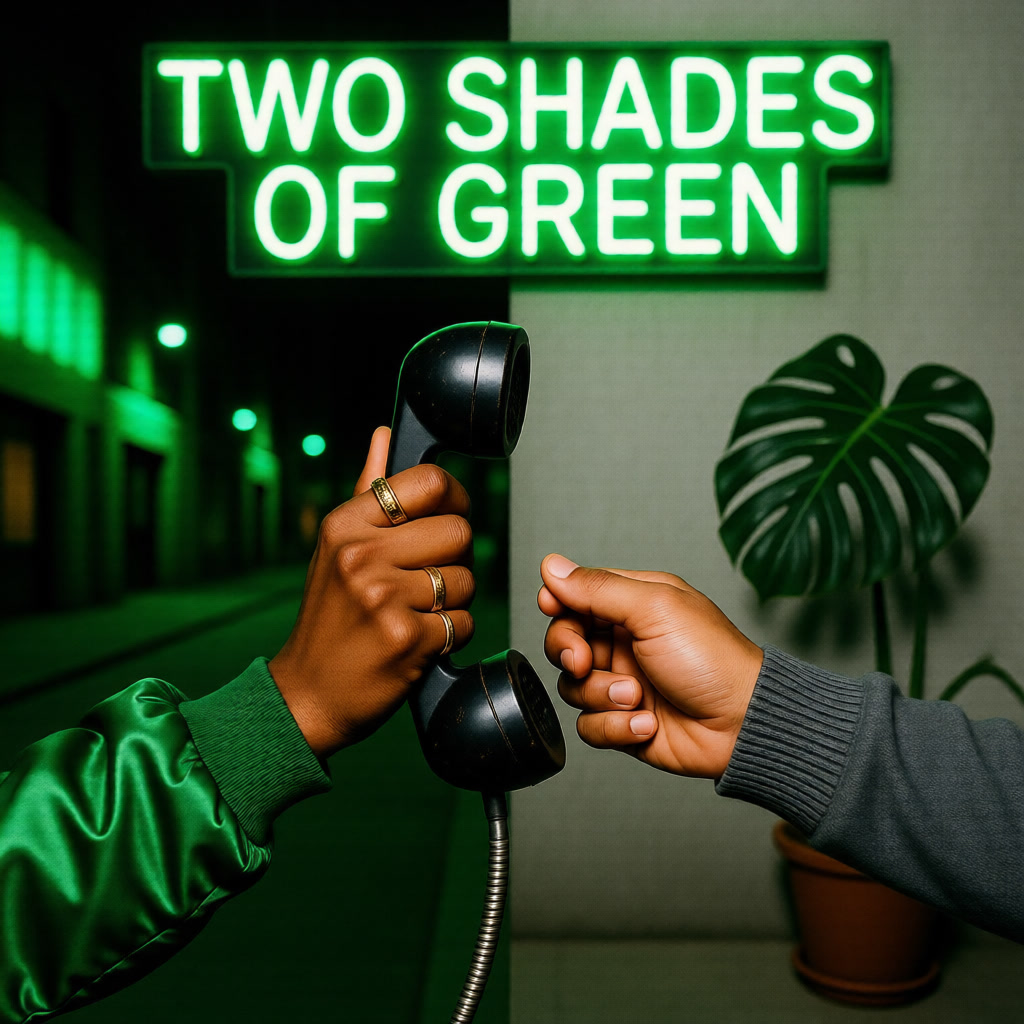 Two Shades of GreenSizzleCcoming
- 10
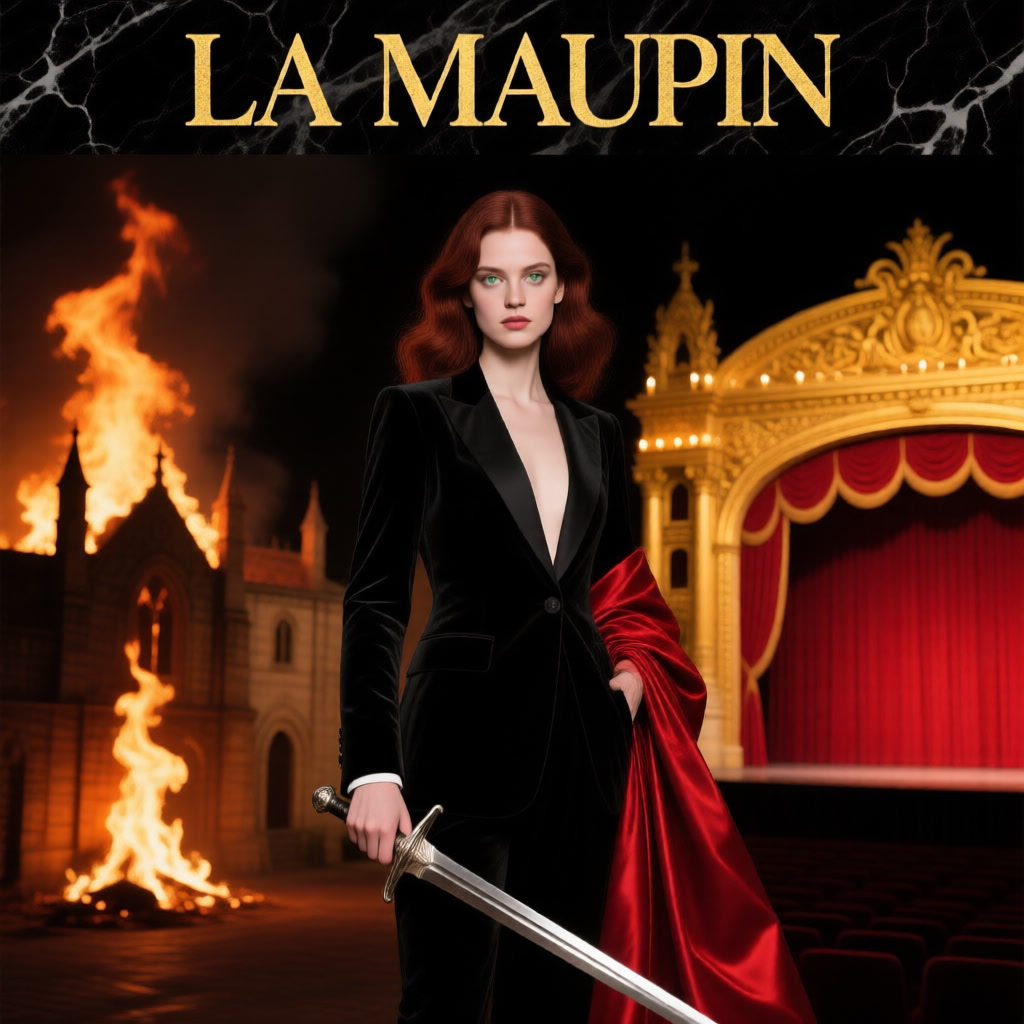 La MaupinSizzleCcoming
Podcast feed for Apple Podcasts, Spotify, Overcast: feed.xml