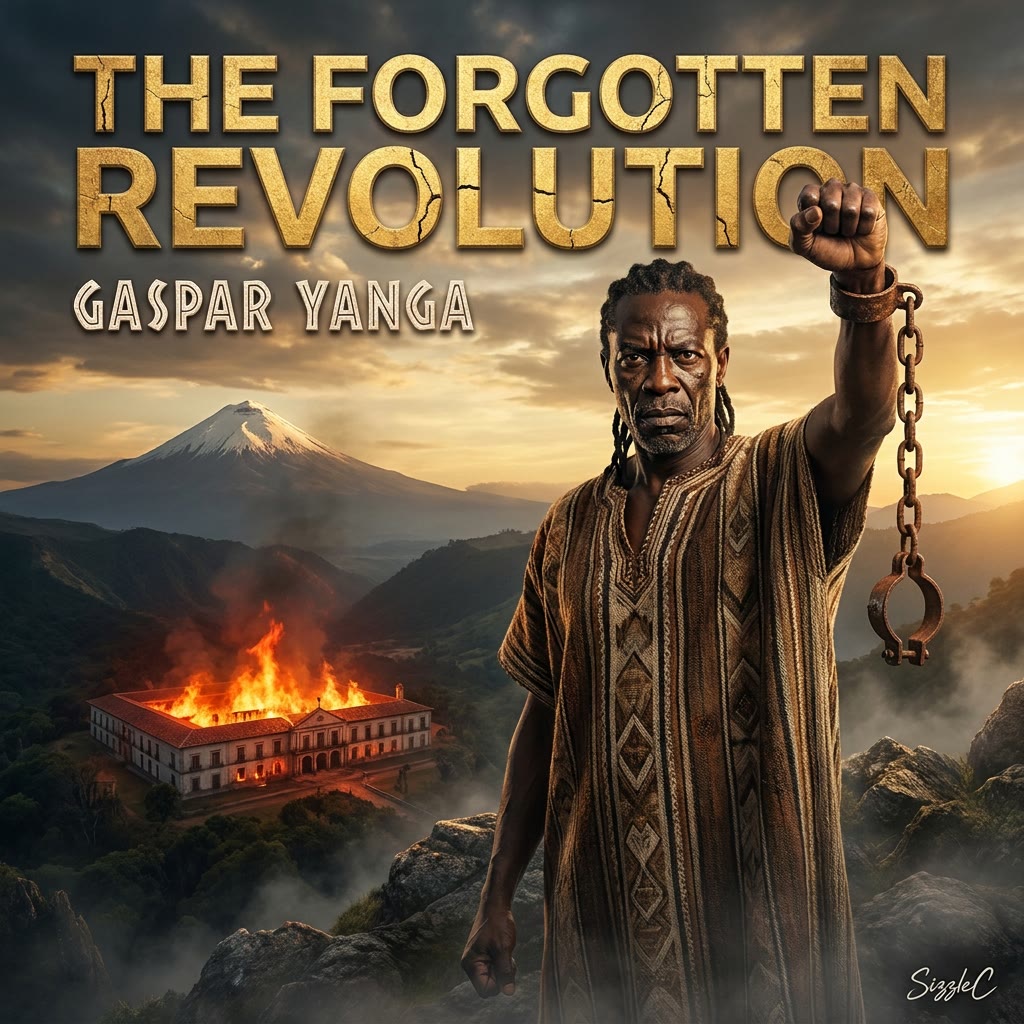
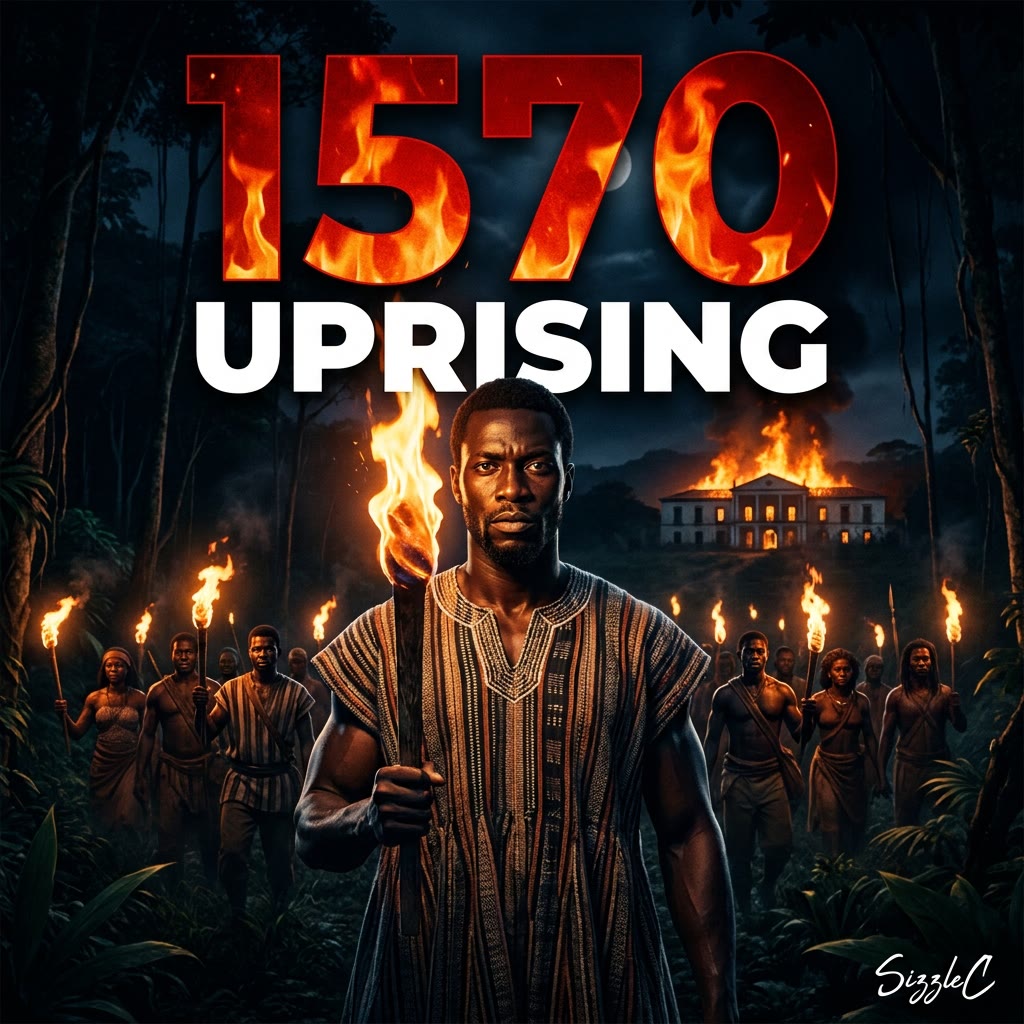
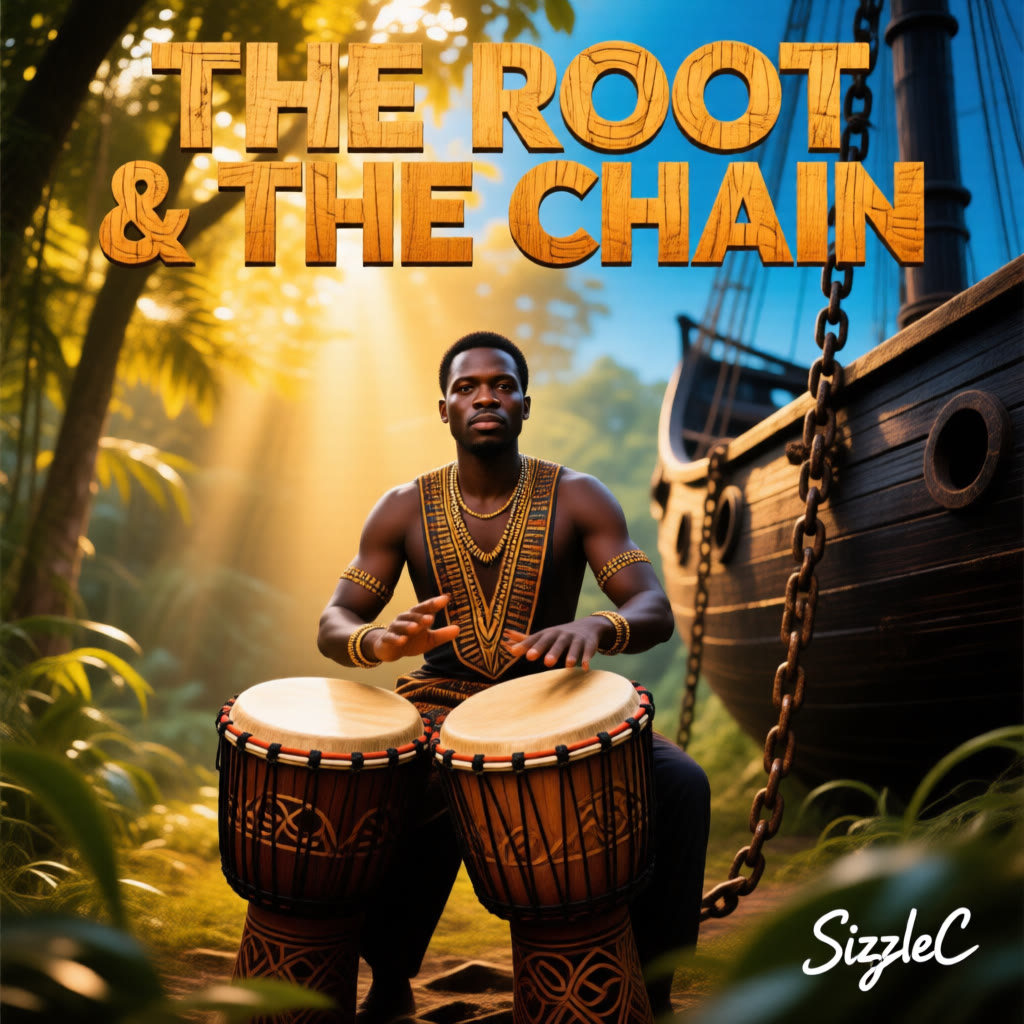
BEATRIFULThe storyThe Forgotten Revolution: Gaspar Yanga: The Forgotten Revolution: Gaspar Yanga (Vol 1) · The Forgotten Revolution: Gaspar Yanga (Vol 2)SizzleC

THE FORGOTTEN REVOLUTION: GASPAR YANGA (VOL 1)

SizzleC · 5 songs · in production

A concept album about Gaspar Yanga, the enslaved African who around 1570 led an escape into the mountains of Veracruz, held off Spain for nearly forty years and won a free African town in the Americas. Every song starts in a sound of the era and drops into a modern one halfway through, from West African drums and son jarocho to tech house, Latin trap and drill.

West African drums → tech house · son jarocho → Latin trap · jungle ambient → UK drill · orchestral → midtempo bass · Spanish guitar → minimal tech house

all takes and alternates →

The Root & The Chain (The Arrival) cover

[Intro]

From the soil of the mother, from the Mbamba line,

Taken in the dark, stolen out of time.

[Verse 1]

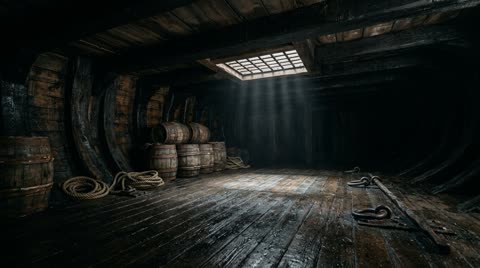
Cross the black water to the Veracruz coast,

Living as a shadow, living as a ghost.

The Spanish galleons with the iron in the hold,

Trading human heartbeat for a piece of silver gold.

[Pre-Chorus]

But the rhythm never died, it was buried in the chest...

The prince of the Bamba never going down to rest!

[Beat Drop]

Move the chain. Break the iron.

Wake up the Veracruz mountain lion.

Sixteenth century, blood on the sand,

Gaspar Yanga stepping on the land!

No surrender, keep the rhythm alive,

Only the strongest are gonna survive!

01 · The Root & The Chain (The Arrival)

Traditional West African percussion and chanting → heavy 128 bpm tech house

🎶 The Sizzle: A cappella chant over West African drums for the first minute, then a driving 128 bpm tech-house drop built on wooden percussion. Mood: pride, then defiance.

🎬 The Story: The Root & The Chain: taken from the Mbamba line, carried across the black water in the hold of a Spanish galleon to the Veracruz coast. The rhythm survives the crossing, and so does the man who will lead them.
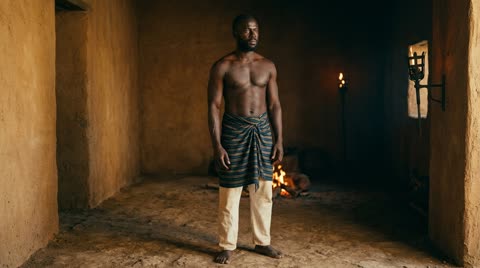
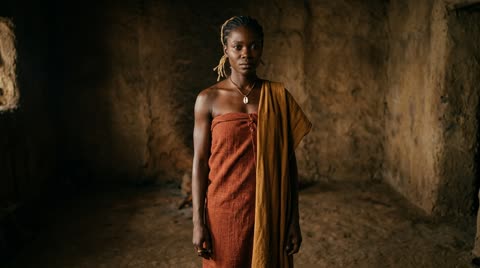
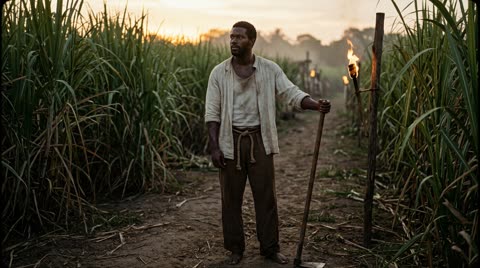
Yanga, the drummer-prince
Yanga, the drummer-princecharacter
Amaka, the fire-keeper
Amaka, the fire-keepercharacter
Tenoch, the mountain guide
Tenoch, the mountain guidecharacter
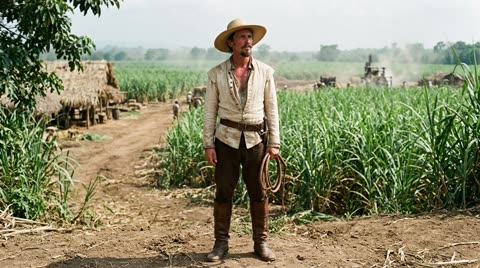
The Spanish overseer
The Spanish overseercharacter
The elder drummer
The elder drummercharacter
Mbamba highland village
Mbamba highland villagelocation
Galleon slave hold
Galleon slave holdlocation
Veracruz landing beach at San Juan de Ulúa
Veracruz landing beach at San Juan de Ulúalocation
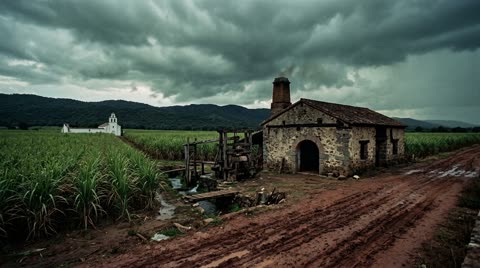
Sugar estate near Córdoba
Sugar estate near Córdobalocation
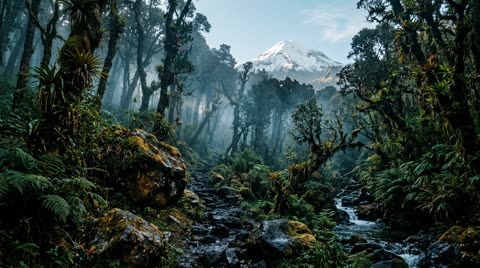
Jungle slopes of Mount Orizaba
Jungle slopes of Mount Orizabalocation
San Lorenzo de los Negros maroon town
San Lorenzo de los Negros maroon townlocation
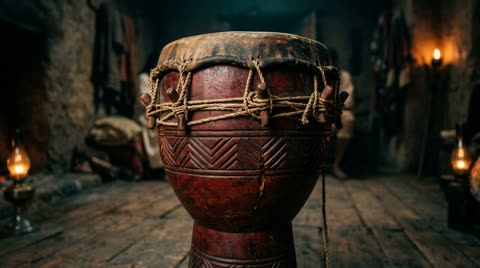
Yanga's ngoma drum
Yanga's ngoma drumprop
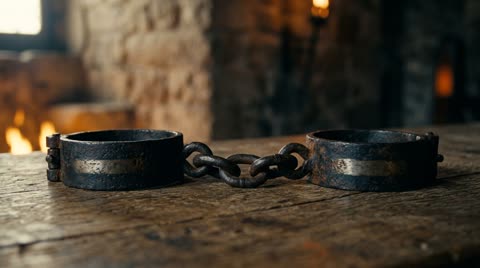
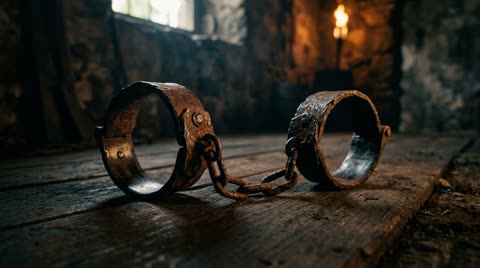
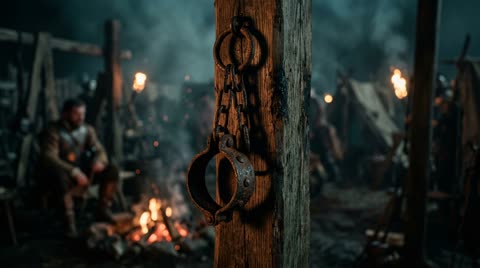
Iron wrist shackles
Iron wrist shacklesprop
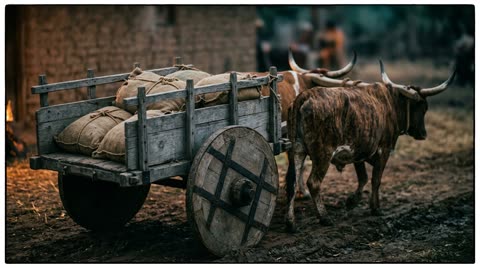
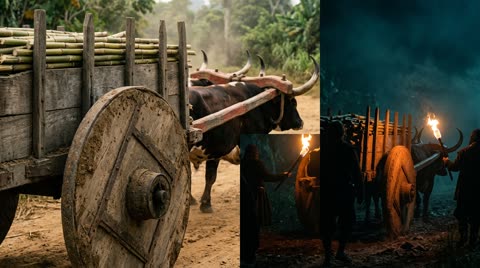
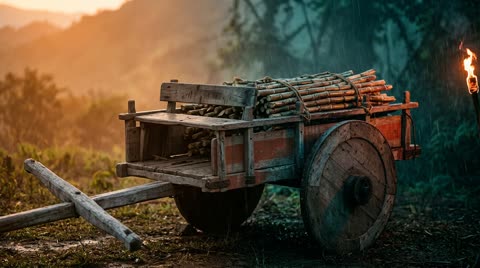
The Castilian ox cart
The Castilian ox cartprop
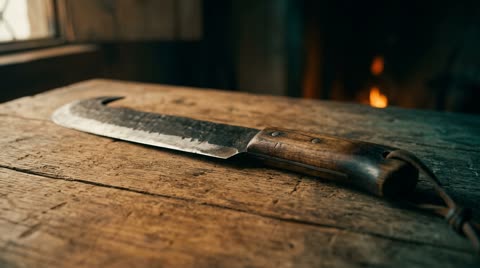
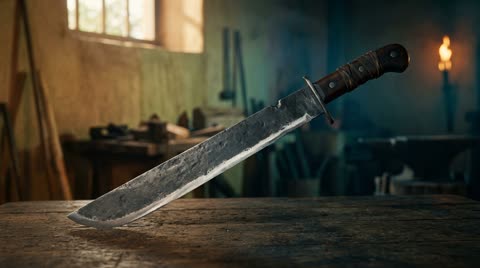
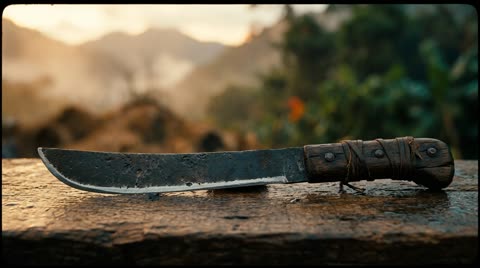
Cane knife
Cane knifeprop
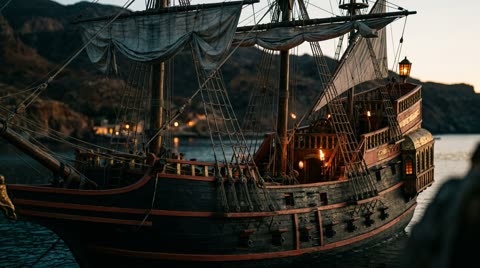
Galleon San Cristóbal
Galleon San Cristóbalprop
Beat sheet — the real board (37 shots)

Characters

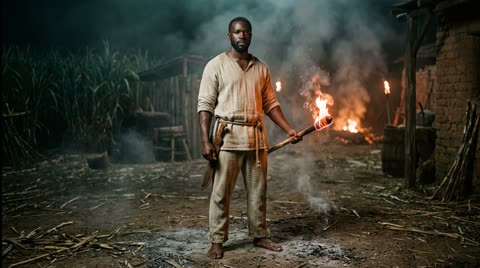
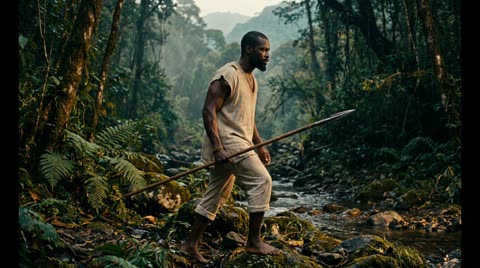
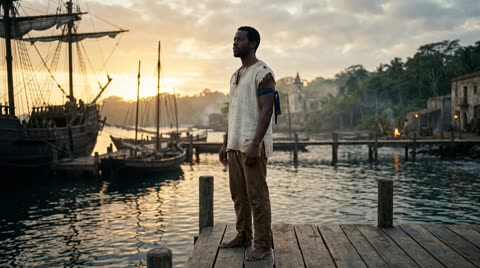
  • Yanga, the drummer-prince — Gaspar Yanga, the drummer-prince. A tall, broad-shouldered West Central African man in his late twenties, very dark brown skin, close-cropped hair, a short dense beard, a thin pale scar across his left forearm, strong hands with calloused fingertips. Bare-chested, wearing a hand-woven indigo-and-och
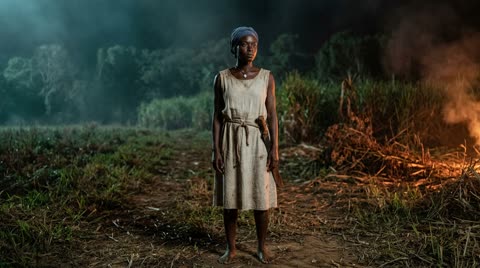
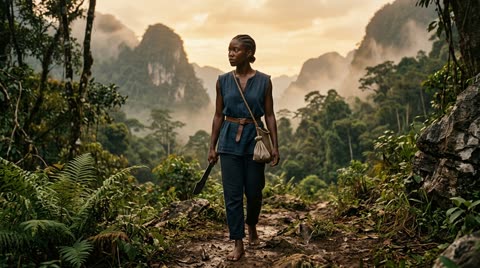
  • Amaka, the fire-keeper — A West Central African woman in her mid-twenties, deep brown skin, hair in tight rows of braids gathered with a strip of raffia, a small cowrie-shell pendant on a leather cord, lean strong arms. She wears a rust-red hand-woven cloth wrap tied above the chest and a second ochre cloth over one shoulde
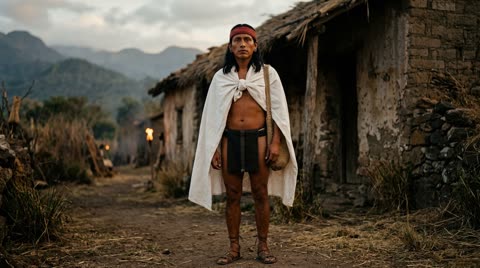
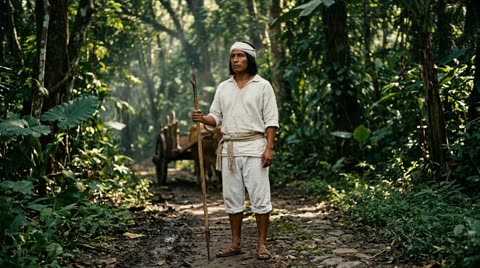
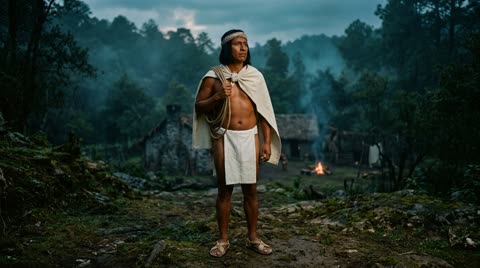
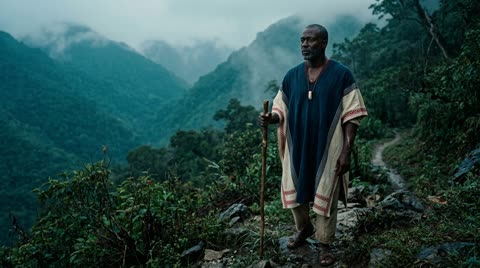
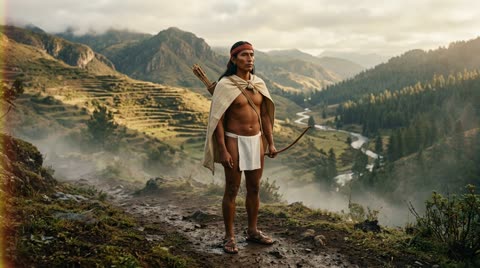
  • Tenoch, the mountain guide — A Nahua man from the Orizaba foothills, about thirty, warm copper-brown skin, straight black hair to the shoulders held back with a red cotton headband, high cheekbones, a small stone ear plug in each ear. He wears a white cotton tilma cloak knotted at one shoulder over a plain cotton loincloth and
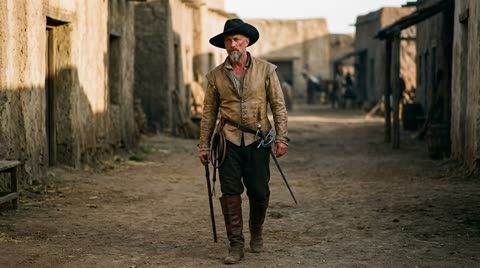
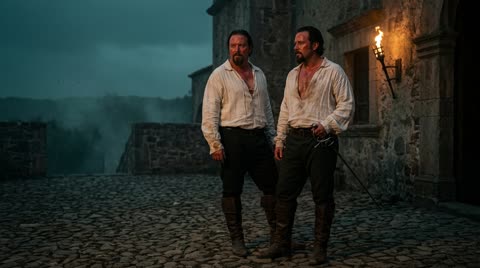
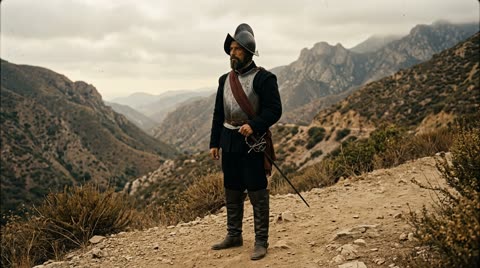
  • The Spanish overseer — A Castilian man in his forties, sun-reddened pale skin, pointed grey-streaked beard trimmed short, heavy brow, a lean hard face. He wears a stained buff leather doublet over a linen shirt, black wool breeches, tall brown riding boots, a wide black felt hat, a steel-hilted sword at the hip and a coil
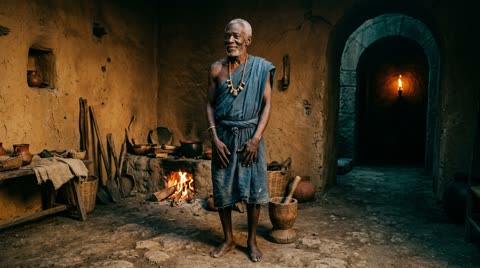
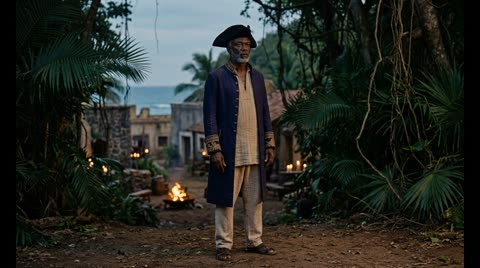
  • The elder drummer — A West Central African man in his sixties, dark brown skin, close white beard and white hair cropped close, deep lines around the eyes, long knotted fingers, a thin frame. He wears a faded indigo cloth wrap over one shoulder and a string of small carved wooden beads around the neck, barefoot. Warm,

Shots

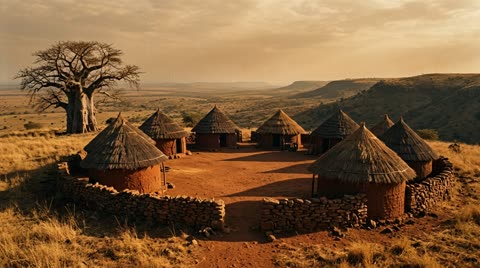
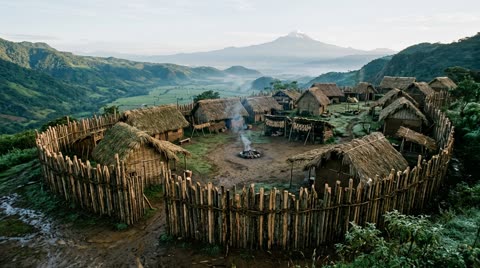
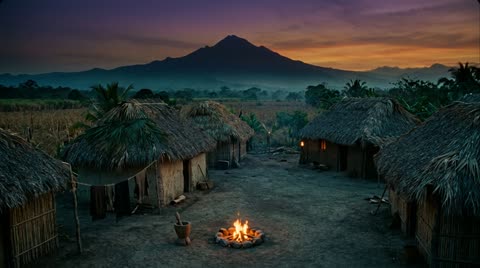
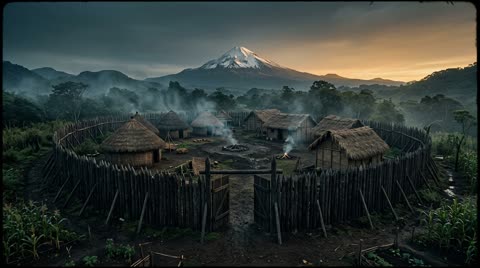
  1. #1 · 5 s — Wide view from the stone wall across the red-earth courtyard of the hilltop village, round clay houses with thatched roofs catching low amber sun, the baobab's grey trunk at frame right, dry gold hills rolling away into haze. Dust hangs in the raking light. The camera drifts very slowly forward toward the courtyard; everything else holds still.
  2. #2 · 5 s — Close view from slightly above of the elder drummer seated cross-legged in the courtyard, his two palms striking the antelope-hide head of the ngoma drum in a slow steady pulse, one stroke and a rest, one stroke and a rest. Red earth beneath him, the carved chevron bands of the drum body in frame. Low amber sun from frame left rakes across his knuckles and the hide. Camera still.
  3. #3 · 5 s — Medium view in three-quarter profile of the drummer-prince standing behind the ngoma drum held between his knees, both hands playing a faster answering pattern on the hide, shoulders rolling with the strokes, eyes on the drum head. Behind him the clay wall of a round house glows rust-orange in the last sun, a thatched eave overhead. Warm sidelight from frame right, dust in the air. Camera still.
  4. #4 · 4 s — Medium view of the fire-keeper in profile at the edge of the courtyard, clapping a slow rhythm with cupped palms, chin lifted, face toward the drummers out of frame at right. Behind her, staggered in depth and out of focus, five village women in different rust, indigo and undyed wraps: one sways slowly, one stands still with arms folded, one bends to a child, two face away toward the hills; no two mirror each other.
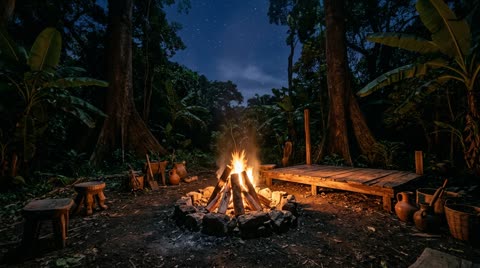
  5. #5 · 5 s — Wide view at dusk of the courtyard fire circle beneath the baobab, a stone-ringed fire burning tall at center, the ngoma drum silhouetted beside it. Around the fire, irregularly spaced, a dozen Kongo villagers in dark wraps seen mostly from behind and in silhouette: two seated close to the flames, a group of three standing further back, one man walking away toward a house, an old woman sitting apart on the stone wall
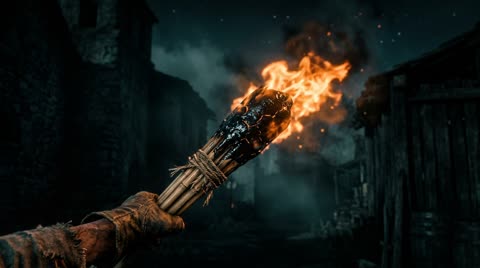
  6. #6 · 4 s — View from the stone wall down the dark hillside at night, dry grass black under a moonless sky. Low in the frame, a scattered chain of seven pitch torches moves up the slope toward camera at irregular spacing, some brighter, one guttering, one far behind the rest, carried by figures too dark to make out. Only the small flames read against the black. The camera holds completely still.
  7. #7 · 5 s — Medium-close view of the drummer-prince on his knees on the red earth beside the fire, a thick hemp rope already knotted around both wrists, his arms pulled forward and down toward frame left as the rope goes taut, jaw set, eyes fixed on the overturned drum beside him. Firelight orange on his shoulders and the scar on his forearm, the round house wall in shadow behind. Camera still, slight tremor.
  8. #8 · 4 s — Low close view at ground level of the ngoma drum lying on its side in the red earth, its antelope-hide head toward camera, the carved chevron bands catching a dull orange glow from a bed of dying embers just out of frame at right, a spilled scatter of wooden beads beside it. The ember glow is a steady low orange on the hide. The camera pushes in very slowly on the hide.
  9. #9 · 5 s — Wide view from behind of a line of roped captives walking away from camera along a dry ridge track, heel-to-toe, backs toward the lens, heads leading toward a pale grey dawn on the horizon where the land flattens toward the sea. Dark figures at uneven intervals, one limping and falling behind, one child close to a woman's side. Gold grass on both sides going grey in the cold pre-dawn light. Camera still.
  10. #10 · 5 s — Wide view from low on the water of the galleon San Cristóbal driving forward toward camera and slightly to frame right, bow leading, cutting through a heavy teal-black swell, spray bursting white off the beak-head, sails full and grey against a bruised storm sky. Cold steel-blue light from a break in the cloud behind the ship. The hull's red-ochre wales flash wet. Camera still on the water, the ship does all the movi
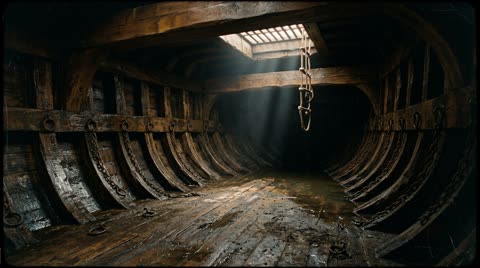
  11. #11 · 5 s — Close view from the side of the drummer-prince seated on the wet plank deck of the hold, iron wrist shackles on both wrists, the chain pooled in his lap, his right fist knocking a slow steady pulse against the oak plank beside his knee, eyes on the barred grey light from the hatch grating above. Black tarred beams low over his head, water casks behind. Cold grey light falls in bars from above. Camera still.
  12. #12 · 5 s — Medium view of the fire-keeper alone on the plank deck of the hold, seated against the curved hull with her back to the casks, one hand pressed flat to the dark wet planking in front of her, head bowed toward that hand, braids fallen forward. Iron bar and ring-bolts along the deck at frame bottom. A single bar of grey hatch light crosses her shoulders; the rest is deep brown shadow. The camera drifts very slowly towa
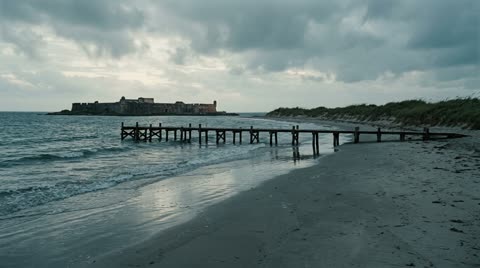
  13. #13 · 5 s — Wide view from the grey-sand beach across flat slate-teal water at dawn: the galleon San Cristóbal at anchor, sails furled, hull black against the pale sky, the coral-stone walls of the San Juan de Ulúa fortress on its island beyond her stern, the long timber pier on black piles running from the beach into the water at frame right. Overcast pale light, low surf sliding up wet sand in the foreground. Camera still.
  14. #14 · 5 s — Low view from the wet sand of the drummer-prince wading forward toward camera out of knee-deep grey surf, heel-to-toe, chest leading, iron shackles joining his wrists in front of him, seawater streaming off his trousers, eyes fixed on the fortress walls behind the camera. The timber pier's black piles at frame left, low overcast light flat and cold, the sand mirroring the sky faintly. Camera still.
  15. #15 · 5 s — Medium view from low on the beach looking up at the overseer standing on the timber pier planks, a leather-bound ledger open in his left hand with its pages toward his own face and its cover toward the lens, a quill in his right hand scratching down one column, his eyes on the page. Grey sky behind his black hat, the fortress a pale shape at frame right. Flat overcast light. Camera still.
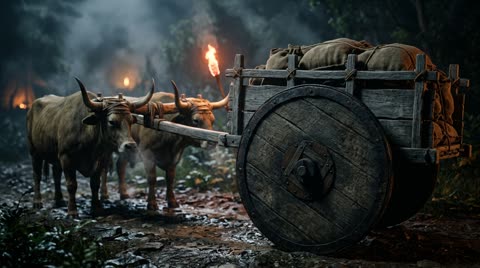
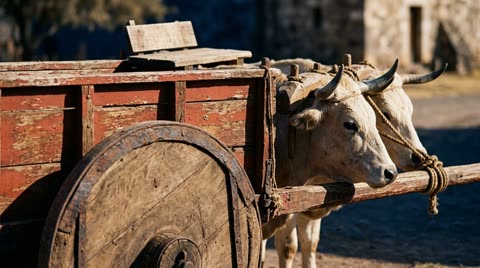
  16. #16 · 5 s — Wide view along the rutted red-earth cart road at the edge of the cane field: the Castilian ox cart rolling forward left-to-right across frame, the two brindle oxen leading with the yoke, its solid oak disc wheels turning slowly, jute sugar sacks stacked in the bed. The mountain guide walks beside the near ox's head, a slender cut stick in his hand, stepping heel-to-toe in the same direction the oxen travel. Tall gre
  17. #17 · 5 s — Close view from across a rough plank table of the overseer's right hand in a worn brown leather riding glove laying hammered Spanish silver reales one at a time into a short stack on the wood, a small iron-banded strongbox open at frame left, his buff leather sleeve and the coiled whip at his belt visible above the table edge. Behind, the arched stone doorway of the boiling house, orange fire-glow inside. Warm fire l
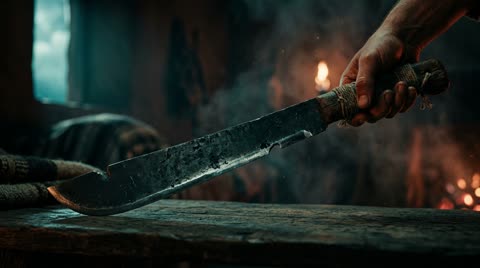
  18. #18 · 5 s — Medium view in three-quarter profile of the drummer-prince deep in the cane rows, swinging the cane knife down and through a cane stalk in one steady stroke, then the arm rising for the next, a rhythm in the blade, sweat on his shoulders, the scar on his forearm catching light. Tall green cane close on both sides, dark hills and a bruised grey-green storm sky beyond. Humid flat light. Camera still.
  19. #19 · 5 s — Close view from the side of the fire-keeper kneeling on a dirt floor at night, both palms tapping a quick quiet pattern on the base of an upturned unglazed clay water pot between her knees, head bent close to it. Behind her the whitewashed chapel wall of the estate glows faintly and a single tallow candle burns on the ground at frame right, warm yellow light on her hands and the brass thumb ring. Camera still.
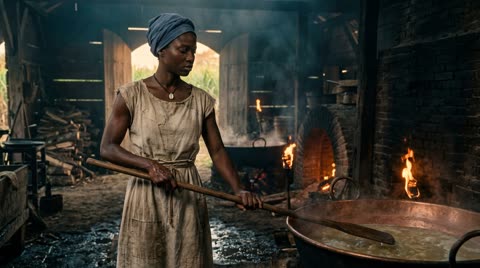
  20. #20 · 5 s — Wide view inside the stone boiling house at night: a row of four great copper kettles set in a brick furnace bench, each a different age of tarnish, the nearest boiling over with thick brown syrup, orange fire licking from the furnace mouths beneath, a long wooden ladle propped against the wall, soot-black beams overhead. Sulphur-orange fire light from below. The camera pushes very slowly toward the nearest furnace m
  21. #21 · 5 s — Close view from low beside a flat black anvil stone of the drummer-prince's arms bringing a heavy blacksmith's hammer down onto the middle link of the iron wrist shackles laid across the stone, both cuffs still on his wrists, one blow landing, the chain jumping. Orange furnace light from frame right hard on the iron and his forearms, soot-black wall behind. Camera still.
  22. #22 · 5 s — Medium view of a single tawny puma lying on a moss-edged black volcanic boulder in the cloud forest, lifting its head slowly and fixing its eyes on the valley below, ears forward, tail still, four paws on the rock. Ferns and bromeliad-wrapped oak trunks behind, blue-grey mist low between the trees, one soft shaft of morning light on the cat's shoulders. Camera still.
  23. #23 · 5 s — Medium view of the drummer-prince running forward toward camera between two walls of tall dark cane at night, heel-to-toe, chest leading, the cane knife in his right hand held low, a single shackle cuff still on his left wrist with two broken links swinging, cane leaves whipping his shoulders. Far behind him at frame top the orange glow of the boiling house fire against the black sky. Orange firelight catches the edg
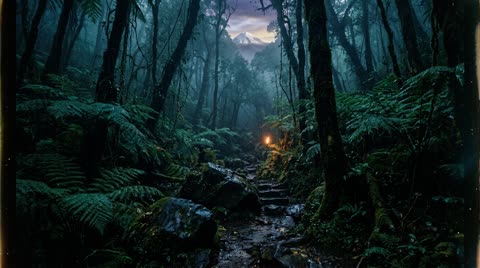
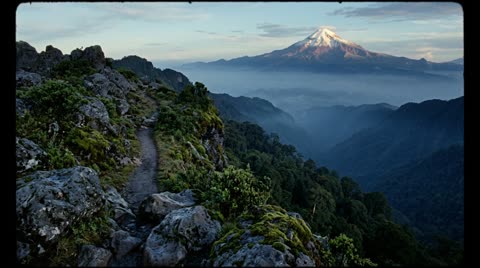
  24. #24 · 5 s — Low wide view from the trail of the drummer-prince climbing forward toward camera up a narrow path of black volcanic rock between boulders, heel-to-toe, one hand steadying on a moss-covered stone, eyes lifted to the snow-capped Orizaba cone at frame top. Ferns wet on both sides, blue-grey mist below him in the trees, first pale morning light on the snow above. Camera still.
  25. #25 · 5 s — Medium view in three-quarter profile of the mountain guide standing on the black rock trail among ferns, his right arm extended, pointing up-slope toward a gap in the oaks at frame top right where the snow peak shows, his face toward that gap, the maguey carry bag across his back, white tilma cloak stirring. Mist drifting through the trunks behind him, cool soft light from above. Camera still.
  26. #26 · 5 s — Wide view from a rock ledge above the tree line: the snow-capped volcanic cone of Orizaba filling the upper frame against a pale blue morning sky, below it a sea of cloud forest canopy with mist pooled in the folds of the slopes, one hawk circling far off at frame left. Clean cold morning light on the snow, the forest still in blue shadow. The camera drifts slowly upward toward the peak.
  27. #27 · 5 s — Medium view of the fire-keeper standing at the palisade wall of the maroon town, both hands pulling a vine lashing tight around two upright fresh-cut timber poles, her face toward the knot, the brass ring on her thumb bright against the pale wood. Thatched cane houses behind her inside the wall, morning light from frame right, dew shining on the timber. Camera still.
  28. #28 · 5 s — Wide view from inside the plaza of the maroon town looking toward the open palisade gate: the Castilian ox cart already through the gate and rolling forward across the packed earth toward camera, the two brindle oxen leading under the yoke, solid oak disc wheels turning, jute sugar sacks in the bed. The mountain guide walks at the near ox's head in the same direction, one hand on its neck. Fresh timber poles either s
  29. #29 · 5 s — Close view from slightly above of the drummer-prince seated on a log in the plaza, the ngoma drum upright between his knees, his hands drawing a sisal cord tight through the hide's tension ring one pull at a time, eyes on the lacing. The carved chevron bands and the resin-filled crack on the drum body in frame. Stone fire pit and maize drying racks behind, soft morning light from frame left. Camera still.
  30. #30 · 5 s — Medium view in three-quarter profile of the overseer climbing forward up the black rock trail toward frame left, heel-to-toe, sword drawn and held low, eyes on the trail ahead. Behind him at irregular intervals, out of focus, a patrol of Spanish soldiers in steel morions and rust and grey doublets, one carrying an arquebus on his shoulder, one bent to catch breath, one looking up into the trees. Mist between the oaks
  31. #31 · 5 s — Low view from the trail looking up into the ferns on the slope: the drummer-prince rising from a crouch to standing among the wet fronds, the cane knife lifted in his right hand to shoulder height, face toward the trail below at frame bottom, chest held steady. Bromeliad-wrapped oak trunks behind him, mist at his back lit pale by the morning, dark fern shadow across his legs. Camera still.
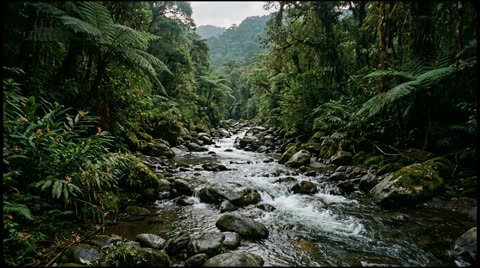
  32. #32 · 5 s — Close view at water level of the iron wrist shackles lying on dark stones in the bed of the clear mountain stream, both cuffs open, the chain broken at its middle link, cold water running over the pitted iron in a steady clear sheet, one oak leaf turning in the current beside them. Blue-grey light off the water surface, moss on the stones at frame edge. Camera still.
  33. #33 · 5 s — Wide view across the plaza of the maroon town at night, the stone fire pit blazing at center. Around it, unevenly spaced, maroon townspeople of African and Nahua descent in mixed rust, indigo and white cotton: a man stamping slowly near the fire, a woman turning with arms raised at half his speed, two elders seated on a log clapping at different tempos, a child running the outer ring, a man with his back to camera po
  34. #34 · 5 s — Medium view in profile of the drummer-prince standing on the timber walkway atop the palisade wall, the ngoma drum upright before him, both palms driving a fast full pattern on the hide, shoulders rolling with the strokes, eyes on the drum head. Beyond the wall at frame right the green valley and distant cane lands under a pale gold sunrise, the Orizaba peak faint at frame top. Warm first light from the right across
  35. #35 · 5 s — Medium view from behind and to the side of the fire-keeper standing at the palisade wall, both hands resting on the top of a timber pole, her face toward the gold sunrise breaking over the distant cane lands at frame right, braids stirring faintly, the cowrie pendant at her throat catching light. Dew on the poles, the valley below in blue shadow. Warm light from the horizon on her cheek. The camera drifts slowly forw
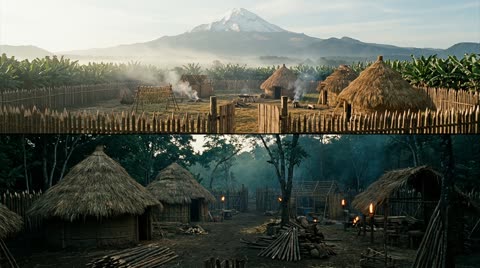
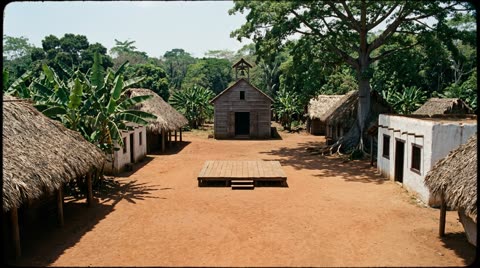
  36. #36 · 5 s — Wide view from the slope above the maroon town at sunrise: the palisade of fresh-cut poles ringing thatched cane houses, the maize drying racks in the plaza, the Castilian ox cart standing unhitched by the gate with its oxen grazing nearby, green valleys falling away below and the snow peak faint behind. Gold light across the timber, blue shadow in the valley. The camera drifts slowly forward over the wall.
  37. #37 · 5 s — Close view from directly above of the ngoma drum's antelope-hide head, the drummer-prince's right hand already low over the hide at frame bottom, forearm in frame with the pale scar visible, lowering palm-flat onto the center of the hide in one slow movement and then holding, fingers spread. The carved chevron bands of the drum body ring the frame. Warm gold sunrise light from frame right across the hide and his knuc
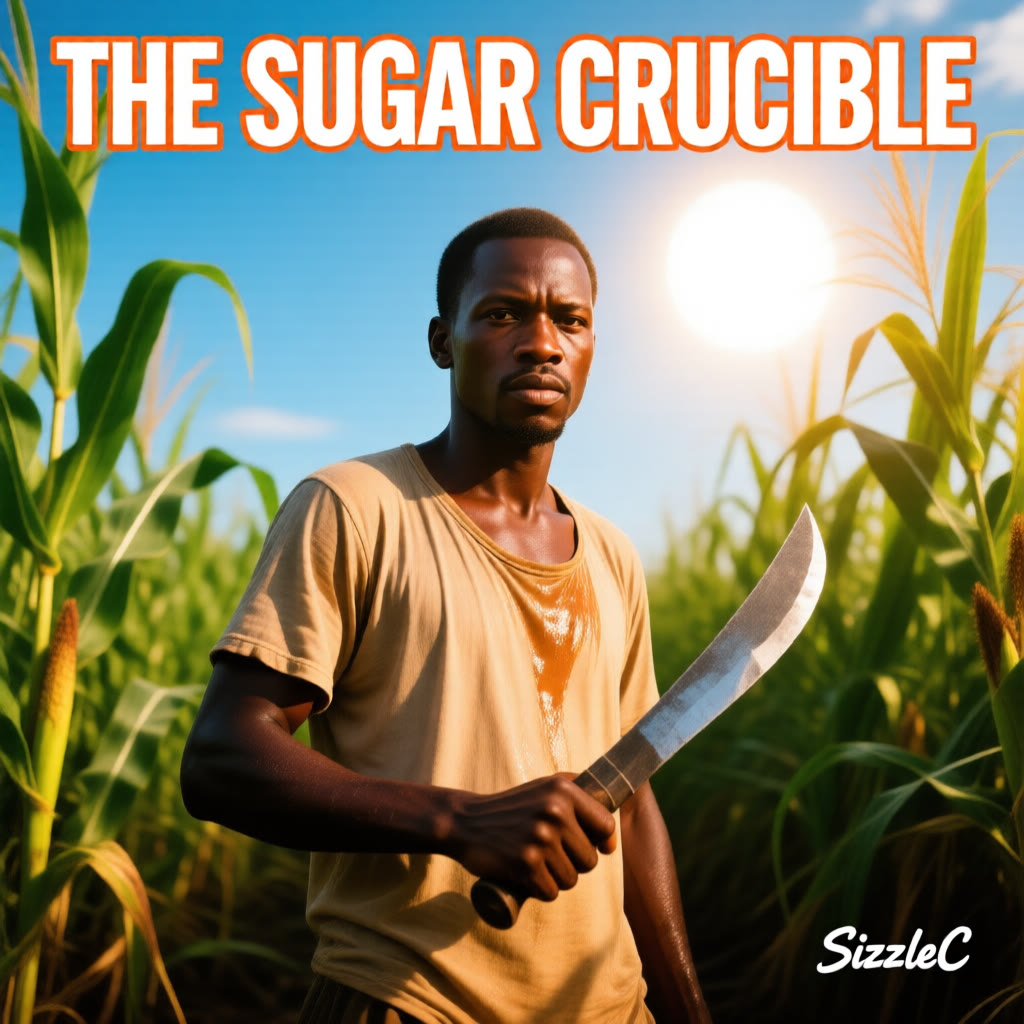
The Sugar Crucible (The Labor) cover

[Intro]

Sun beating down on the sugar cane field,

Waiting for the day that the master's gonna yield.

[Verse 1]

Swing the machete from the morning to the night,

Building up the colony, keeping out of sight.

The Spanish whip cracks, but the spirit doesn't break,

Look into the eyes of the devil, see him shake.

[Pre-Chorus]

Whispers in the dark when the overseer sleeps...

The harvest of the sorrow that the royal crown reaps...

[Beat Drop]

Swing the blade! (Slash!) Cut the cane!

Gaspar Yanga gonna break the chain!

Thirty years working in the Veracruz heat,

Now the revolution moving to the beat!

Sharpen up the steel, hide it in the grass,

Spanish crown thinking that the empire gonna last!

Time is up. Blood in the dirt.

Show the colonizer exactly how it hurt!

02 · The Sugar Crucible (The Labor)

Acoustic son jarocho with requinto guitar → aggressive Latin trap
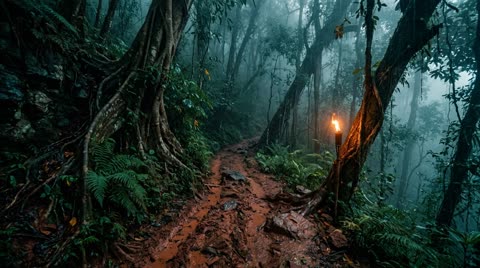
🎶 The Sizzle: Fast son jarocho requinto guitar and zapateado foot-stomping, then an aggressive Latin trap drop with sliding 808s. Mood: heat, sweat, then fury.

🎬 The Story: The Sugar Crucible: machetes swinging from morning to night on the colonial sugar estates. Whispers at night while the overseer sleeps, and steel hidden in the grass.

Yanga
Yangacharacter
Don Mateo
Don Mateocharacter
Lucía
Lucíacharacter
Tochtli
Tochtlicharacter
Cane field near Córdoba
Cane field near Córdobalocation
Sugar mill boiling house
Sugar mill boiling houselocation
Slave quarters at the estate edge
Slave quarters at the estate edgelocation
Jungle slopes of Orizaba
Jungle slopes of Orizabalocation
Estate house veranda
Estate house verandalocation
San Lorenzo palisade town
San Lorenzo palisade townlocation
Yanga's machete
Yanga's macheteprop
The estate ox cart
The estate ox cartprop
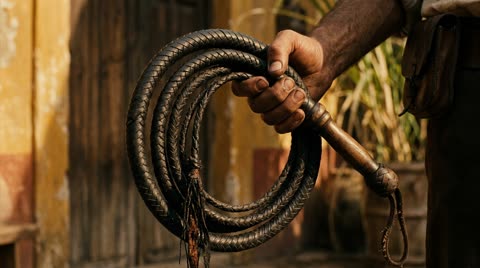
The overseer's whip
The overseer's whipprop
Iron shackles
Iron shacklesprop
Beat sheet — the real board (30 shots)

Characters

  • Yanga — Tall, broad-shouldered West Central African man, dark brown skin, close-cropped hair, a short beard, a thin pale scar across his left forearm. Wears a coarse woven cloth tunic over loose trousers, a sweat-soaked undyed linen shirt open at the chest, bare feet or rough leather sandals. Carries himsel
  • Don Mateo — Spanish overseer, pale olive skin reddened by sun, mid-40s, lean and hard-faced, thin dark moustache and pointed beard, hair greased back under a wide-brimmed straw hat. Wears a sweat-stained cream linen doublet unbuttoned, dark brown breeches, tall scuffed leather riding boots, a wide leather belt
  • Lucía — West Central African woman, late 20s, deep brown skin, strong shoulders and forearms from kettle work, hair wrapped in a faded indigo cotton headcloth. Wears a rough undyed cotton shift dress tied at the waist with cord, a burn scar on the back of her right hand, a small cowrie shell on a cord at he
  • Tochtli — Indigenous Nahua man, early 30s, warm copper-brown skin, straight black hair cut at the jaw, no beard. Wears a white cotton manta shirt and knee-length trousers, a woven maguey-fibre sash, huarache sandals, a folded cotton headband. Carries a long wooden ox goad. Compact, wiry build, quiet face. Dro

Shots

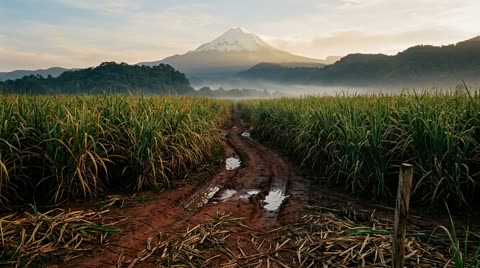
  1. #1 · 5 s — Very wide view from a low hill of the sugar-cane field near Córdoba at first light, rows of tall green cane stretching to dark jungle foothills, the white snow cone of Mount Orizaba catching the first gold sun above them, a red-earth cart track cutting through the cane toward the camera, thin ground mist between the rows. The camera drifts slowly forward at walking height above the cane tops. Hushed, humid, gold and
  2. #2 · 5 s — Wide view along the red-earth cart track as the estate ox cart rolls FORWARD toward the camera, the two oxen leading nose-first down the track, solid wooden wheels turning in the ruts, cut cane stacked between the side stakes. The drover walks beside the near ox on the track, his goad resting on the yoke, pacing the animals heel-to-toe toward the camera. Low gold sun from behind the cart lights the dust the wheels ra
  3. #3 · 5 s — Medium view in profile of the leader standing waist-deep in a cane row, the machete resting flat on his shoulder, his eyes fixed on the sunlit peak of Mount Orizaba at the top of the frame. He stands settled and still, lips closed; his hand adjusts once on the machete grip. Low gold sun rakes across the cane leaves and the sweat on his shirt. The camera pushes in very slowly toward his shoulder.
  4. #4 · 4 s — Close view of the leader's right hand and forearm as he lowers the machete from his shoulder and closes his fingers slowly around the leather-corded grip, knuckles tightening, the blade edge catching a bright sliver of morning sun. Cane leaves fill the background in soft gold-green. His torso and shoulder are in frame behind the arm. Camera holds still on the grip. Quiet, deliberate, weighted.
  5. #5 · 5 s — Medium-wide view of the overseer standing on the red-earth track at the field edge, the coiled whip hanging from his right hand, his gaze on the cane rows where the workers are. He shifts his weight and taps the whip handle once against his boot. Behind him the mountain and haze; hard morning sun under the brim of his straw hat throws his eyes into shadow. Camera holds still, slightly below his eye height so he looms
  6. #6 · 5 s — Wide view down a cane row of enslaved workers cutting cane in the heat, all West Central African and Nahua men and women: nearest, a woman in a torn indigo wrap bends to gather cut stalks; farther, a young man in a rag headcloth pauses and wipes his face with his forearm; a stooped older man drags a bundle toward the track, walking away from the camera; a tall man mid-row stands upright and still, resting. Irregular
  7. #7 · 5 s — Medium view from within the cane row, stalks framing the leader in the foreground as he stands still and stares at the overseer's straw hat and cream doublet seen small on the sunlit track at the top of the frame. His lips are closed and still for the whole take, his jaw set; a single bead of sweat runs down his temple. Harsh midday sun falls on his face through the cane leaves in hard stripes. Camera holds still.
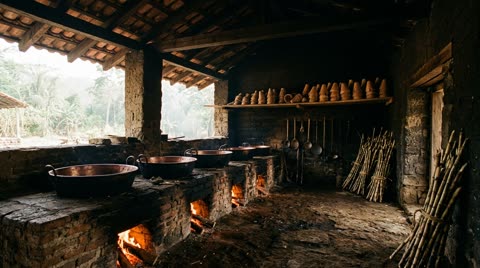
  8. #8 · 5 s — Wide view inside the open-sided ingenio boiling house: four blackened copper kettles set in a brick furnace trench, orange fire glowing through the stoke holes below, dark cane juice at a rolling boil, wooden skimmers hung on hooks along an adobe pillar, clay sugar cones stacked on a plank shelf. Hard daylight cuts in from the open side and dies in the dark interior. Camera pushes in slowly toward the nearest kettle.
  9. #9 · 4 s — Medium view in profile of the kettle woman working the nearest copper kettle, both hands on a long wooden skimmer as she drags it slowly across the surface of the boiling cane juice, her eyes on the dark froth in the kettle. Orange furnace light from below lights her forearms and the underside of her jaw; hard daylight from the open side edges her headcloth. Camera holds still. Slow, practiced, unhurried labor.
  10. #10 · 5 s — Medium-wide view in the bright mill yard beside the boiling house doorway, the ox cart standing still with its oxen yoked and heads low, the drover at the rear of the cart bed pulling one heavy bundle of cane down over the tailboard into his arms, the bundle sliding from the bed down to his chest. White midday sun on the grey cart wood and the red-ochre yoke beam. Camera holds still. Dust, heat, the routine of the es
  11. #11 · 5 s — Wide view of the thatched bohío huts at the field edge at dusk, a single cooking fire ringed with stones burning in the packed-earth yard, drying cloths hanging still on a cord, a wooden mortar by the nearest doorway, and the black silhouette of Mount Orizaba against a sky graded from ember orange to deep violet. Firelight the only warm source, blue dusk over everything else. Camera drifts slowly toward the fire at k
  12. #12 · 5 s — Medium view of the leader seated on a log by the cooking fire, the machete laid across a flat whetstone on his knee, his right hand drawing the blade slowly along the stone in one long continuous stroke, his eyes on the edge of the blade in his lap. Firelight from below on his forearms and the steel; blue dusk behind him on the thatch. Camera holds still. Patient, private, the first act of preparation.
  13. #13 · 5 s — Low view from cane-stubble height as the leader swings the machete in one clean arc from high on his shoulder down through the base of a cane stalk, the stalk toppling away from him, the blade following through low. His feet planted, torso driving the cut. Harsh white midday sun behind him, the sky white with glare, bright edges on the sweat of his arms. Camera holds still at ground level. Labor as violence held in c
  14. #14 · 4 s — Medium view at cane-leaf height of the leader crouched low in the row, one knee in the red earth, the machete flat on the ground under his hand, his eyes fixed on the overseer's straw hat moving along the top edge of the frame above the cane. He holds absolutely level and still; only his eyes track the hat. Dappled hard sun through the leaves stripes his shoulders. Camera holds still. Hidden, coiled.
  15. #15 · 5 s — Medium view of the overseer standing on the track, his right arm sweeping the uncoiled whip back and then forward in one hard continuous crack, the long rawhide snapping out over the cane toward the workers out of frame. His boots planted, hat brim low, doublet dark with sweat. Harsh midday sun from above, his shadow short on the red earth. Camera holds still below his eye height. Brutal, casual authority.
  16. #16 · 4 s — Close view of the overseer's face under the straw hat brim, sweat on his lip, his eyes level on the man standing before him out of frame. His stare falters and his eyes drop to the bright machete blade held low at the bottom edge of the frame; the coiled whip trembles slightly in his fist at the frame edge. Hard sun on one cheek, the other in hat shadow. Lips pressed shut. Camera holds still. Fear leaking through aut
  17. #17 · 5 s — Medium view in profile at night of the leader crouched at the doorway of the kettle woman's bohío, his face close to hers as she kneels inside the threshold, both in profile to the camera, his hand resting flat on the doorframe as he speaks low to her. She listens, eyes on his face. A dying cooking fire behind them the only warm light on their cheeks; blue-black night beyond the thatch. Camera holds still. Conspiracy
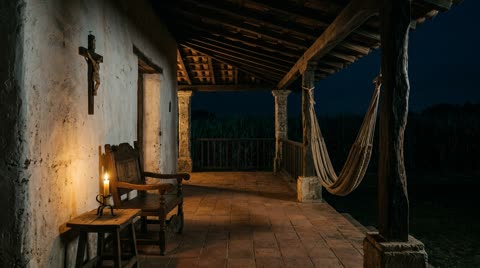
  18. #18 · 5 s — Wide view along the whitewashed hacienda veranda at night, the overseer asleep in the rope hammock slung between timber posts, hat over his chest, the whip coiled on the terracotta tiles beneath him, a single beeswax candle in an iron holder on the carved chair beside him. Candle glow on the adobe wall and the wooden crucifix; black night beyond the rail toward the cane. Camera drifts very slowly along the veranda to
  19. #19 · 5 s — Close view at ground level at night of the leader kneeling at the edge of the cane, both hands pushing the machete slowly under a mat of dry cane leaves and grass until only the dark grip shows, his knees and torso in frame above. Cold moonlight through thin cloud on the steel; the last ember light of the quarters far behind. Camera holds still. The pre-chorus tension: the weapon buried, waiting.
  20. #20 · 4 s — Low view from the earth at night in the cane field, cold blue-green darkness with hard orange light from a flaming pine torch held out of frame to one side, as the leader drives the machete in one violent arc through a cane stalk, the stalk falling toward the camera, his body twisting through the follow-through. Flame light flickers on the wet blade and his sweat-slick arm. Camera holds still, very low. Hard, aggress
  21. #21 · 5 s — Medium view at night of the leader standing over a fallen log with the iron shackles laid across it, his machete striking down once onto the chain link, a brief scatter of sparks from the iron as the chain parts and falls in two on either side of the log. His shoulders drive the blow; his feet stay planted. Orange light from a flaming pine torch planted to one side, cold blue night behind. Camera holds still. The cha
  22. #22 · 4 s — Wide view at the jungle edge at night as African and Nahua men and women run from the cane field into the trees, each moving toward the camera and past it at different speeds: a woman with a bundle sprinting hard, a limping older man helped along by a boy, a young man carrying a flaming pine torch that lights the fern fronds orange, one figure pausing at a tree trunk before running on. Staggered depth, no two in step
  23. #23 · 5 s — Medium view at night of the kettle woman kneeling at the cane edge, both hands lifting a cloth-wrapped bundle of machetes up out of the dry grass and cane leaves, the blades sliding free of the cloth as she raises it to her chest, her eyes on the steel. Light from a flaming pine torch to one side on the blades and her forearms, cold blue night behind. Camera holds still at her kneeling height. The buried steel rising
  24. #24 · 4 s — Medium view from behind the overseer as he grips the veranda rail bareheaded in his nightshirt and stares at the orange glow of burning cane filling the horizon beyond the rail, the whole dark field edge lit from below in flickering orange. His shoulders lock; his hands tighten on the rough timber rail. Candle glow behind him, fire glow ahead. Camera holds still. The empire's certainty cracking.
  25. #25 · 4 s — Close view at ground level of the overseer's rawhide whip lying uncoiled and abandoned in the red earth of the cart track, a dark wet stain spreading slowly into the dirt beside its handle, a single boot print pressed in the mud, fallen cane leaves scattered around. Orange fire glow on the horizon lights the scene from the side; cold blue night above. Camera pushes in very slowly on the whip handle. The instrument of
  26. #26 · 5 s — Wide view at night of the ox cart rolling FORWARD away from the camera up the narrow jungle track, the oxen leading nose-first into the trees, the cart bed now carrying freed African men and women seated between the side stakes, one holding a flaming pine torch that lights the ferns orange. The drover walks ahead at the near ox's shoulder, goad raised, pacing forward with the animals. Solid wooden wheels turning in t
  27. #27 · 5 s — Very wide view at first light of a strung-out file of maroons climbing the steep wet jungle path on the flank of Mount Orizaba, moving away from the camera up the slope: a woman with a bundle on her head nearest, a man with a machete on his shoulder farther up, two children together near a boulder, a man resting against a mossy trunk while the others pass. Irregular gaps, no two in step. Bruised violet dawn, mist in
  28. #28 · 5 s — Medium-wide view of the leader standing on a rocky ridge at dawn, the machete planted point-down in the earth under his right hand, his eyes fixed on the tiny burned estate and its faint dark smudge in the valley far below at the bottom of the frame. He stands still; the wind moves his open shirt. Violet-pink dawn light across his shoulders, the white peak of Orizaba huge behind him. Camera drifts slowly around towar
  29. #29 · 5 s — Wide view of the maroon town of San Lorenzo under construction in a mountain clearing at morning: African and Nahua builders each at their own task — a man driving a sharpened pine stake into the palisade footing with a wooden maul, two women lashing thatch onto a round house roof, an older man feeding a cook fire, a boy walking away toward the tree line with a water gourd. Irregular spacing, different tempos. Thin g
  30. #30 · 5 s — Medium view of the leader standing in the open log gate of the palisade, facing the camera, the machete hanging at rest in his right hand at his side, his eyes on the camera, lips together and at rest, then a slow closed-mouth smile spreading. Behind him the thatched houses, cook fires and the white peak of Orizaba in clean morning light; thin mist at his feet. Camera pushes in very slowly toward his face. Earned, qu
The 1570 Uprising (The Strike) cover

[Intro]

Midnight. 1570.

The fire is hungry. The people are ready.

[Verse 1]

Creeping through the grass, torches in the hand,

Taking back the freedom, taking back the land.

Yanga at the front, royalty in the vein,

Tonight is the night that we sever the chain.

[Pre-Chorus]

Strike the flint. Light the spark.

Burn the hacienda down in the dark!

[Beat Drop]

Light it up! (Boom!) Burn the estate!

Gaspar Yanga coming straight through the gate!

First free people in the whole hemisphere,

Making every Spanish soldier shiver in fear!

Take the mountain, leave the ash,

Taking all the freedom and taking all the cash!

Veracruz burning, sky turning red,

Thirty years of vengeance raining on the head!

03 · The 1570 Uprising (The Strike)

Dark ambient tribal → hardcore UK drill

🎶 The Sizzle: Eerie jungle ambience and a slow heartbeat, then explosive UK drill. Mood: silence before the storm.

🎬 The Story: The 1570 Uprising: midnight, torches in the tall grass, and Yanga at the front. The estate burns and the free people head for the mountain.

The Leader
The Leadercharacter
Ana the Torchbearer
Ana the Torchbearercharacter
The Overseer
The Overseercharacter
Tochtli the Guide
Tochtli the Guidecharacter
Cane Field at Midnight
Cane Field at Midnightlocation
Slave Quarters
Slave Quarterslocation
The Hacienda and Trapiche
The Hacienda and Trapichelocation
Jungle Slope of Orizaba
Jungle Slope of Orizabalocation
San Lorenzo Maroon Town
San Lorenzo Maroon Townlocation
The Carreta (ox cart)
The Carreta (ox cart)prop
The Leader's Machete
The Leader's Macheteprop
Cane Torch
Cane Torchprop
Iron Shackle
Iron Shackleprop
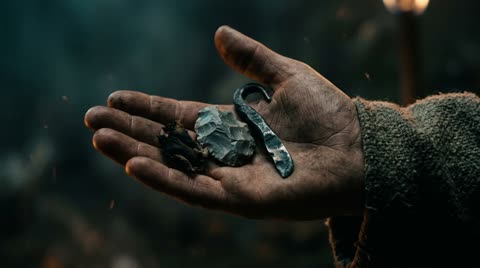
Flint and Steel Striker
Flint and Steel Strikerprop
Beat sheet — the real board (26 shots)

Characters

  • The Leader — The Leader: a tall, broad-shouldered African man, dark brown skin, close-cropped hair, a short beard, a thin scar across his left forearm; undyed woven cotton tunic over loose woven trousers, rope belt, bare feet hardened by cane work, a wooden-gripped machete at his hip and a pitch-soaked cane torc
  • Ana the Torchbearer — African woman, late 20s, deep brown skin, hair wrapped in a faded indigo cotton headcloth, lean strong arms, a small cowrie shell on a cord at her throat; sleeveless undyed woven cotton shift, a rope belt with a wooden-gripped machete, bare feet. Expression steady and unblinking. Look: not specified
  • The Overseer — Spanish colonial overseer, 40s, pale sun-reddened skin, heavy build, dark oiled hair and pointed beard, loose white linen shirt half unlaced, black wool breeches, tall leather boots, a steel-hilted rapier at his belt, a jug-stain on his cuff. Look: not specified by the brief; cast as a European Span
  • Tochtli the Guide — Nahua Indigenous man, 30s, warm copper-brown skin, straight black hair cut at the jaw with a woven headband, wiry build; white cotton maxtlatl loincloth and a short white cotton tilma cape knotted at one shoulder, henequen-fibre sandals, a coiled rope over his shoulder. Look: not specified by the br

Shots

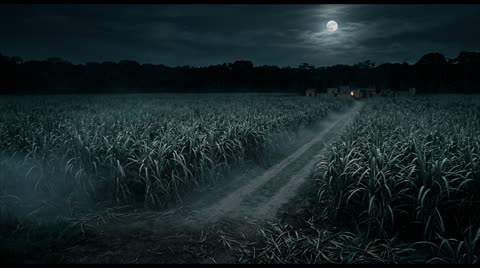
  1. #1 · 5 s — Very wide view from just above the cane tops of a moonlit sugar-cane field near Córdoba, 1570, the stalks silver-grey, mist lying knee-high in the rows, a dirt track running away toward the dim adobe walls of the estate where one faint orange window glows. Full moon high and cold, teal-charcoal shadows. The camera drifts very slowly forward over the cane; the cane and mist hold still. Hushed, held, ominous.
  2. #2 · 5 s — Medium-wide view at ground height of the carreta parked in the packed-earth yard beside the thatched trapiche shed, its two oxen standing yoked and dozing, heads low, hemp sacks stacked in the bed. Moonlight from above picks out the iron-banded wheel rims; a faint ember glow from the mill doorway warms one side of the timber. The camera pushes in slowly toward the near wheel. Still, quiet, the calm before.
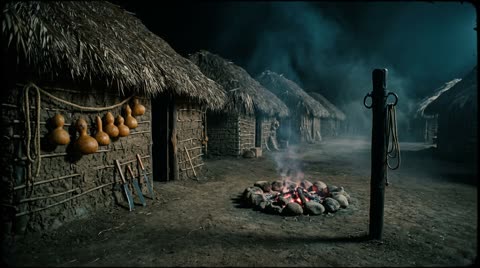
  3. #3 · 5 s — Medium view from beside the ember pit in the slave-quarters yard: the Leader kneels on one knee and draws the machete blade slowly along a flat whetstone in one long continuous stroke, his eyes on the edge of the blade. Palm-thatch huts behind him, drying gourds on a rope, orange ember light from below and cold moonlight from above on his shoulders. The camera holds steady. Deliberate, patient, coiled.
  4. #4 · 5 s — Close view from waist height inside a dark hut doorway: Ana crouches and pulls loose the cord around a bundle of pitch-headed cane torches hidden beneath a pile of dry palm thatch, one slow tug of the cord with her right hand, her gaze fixed on the black pitch heads. Moonlight falls through the doorway behind her onto the packed-earth floor; the pitch gleams. The camera holds steady. Secret, careful.
  5. #5 · 5 s — Extreme close view of the stone-ringed cooking pit in the quarters yard: a bed of charcoal embers glowing deep orange under grey ash, a single half-burnt cane stalk across them, a small flame licking up at its end. Ash flakes lift on the heat. Moonlight touches the stone rim cold blue while the ember light is hot orange below. The camera pushes in very slowly toward the small flame. Patient, hungry.
  6. #6 · 5 s — Medium view along the tiled veranda of the whitewashed hacienda house: the Overseer slumped asleep in a carved wooden chair, head tipped back against a turned column, a clay wine jug tipped on the floor beside his boot, a tallow candle guttering on a small table. His chest rises and falls slowly; the veranda around him holds still. Candle flame gives warm yellow light on his face; moonlight lies blue on the tiles. Th
  7. #7 · 5 s — Wide view down the row of palm-thatch huts in the quarters yard: about six African and two Nahua rebels stand in and beside the dark doorways at irregular intervals — one African man tightening a rope belt, an older African woman resting a cane knife on her shoulder facing away from camera, a young Nahua man crouched retying a sandal, a broad African man simply standing with arms folded — no two bodies mirroring each
  8. #8 · 5 s — Low view from between the cane stalks at knee height: the Leader moves toward the camera in a crouch, heel-to-toe, chest and face leading, a pitch-headed cane torch gripped low in his right hand, its pitch head black and cold, his eyes fixed on the dim orange window of the estate behind the camera. Cane leaves brush his shoulders, mist at his ankles, moonlight silvering the leaf edges. The camera holds steady as he a
  9. #9 · 5 s — View from directly behind Tochtli's shoulder at the edge of the cane field: he reaches forward with his left hand and slowly parts two cane stalks, opening a gap that reveals the whitewashed hacienda wall and the heavy timber gate across the yard, one orange window lit. His eyes are on the gate. Moonlight cold on the cane, the warm window the only colour. The camera holds steady behind him. Reconnaissance, breath hel
  10. #10 · 5 s — Close view at the height of the wooden whipping post in the quarters yard: the rusted iron shackle and its chain hang from the post's iron ring, and Ana's machete comes down from above in one hard continuous chop onto a chain link against the post, her arm and shoulder in frame, her eyes on the link. Moonlight from above, ember light from behind. A few rust flakes fall. The camera holds steady. Decisive, final.
  11. #11 · 5 s — Side view at chest height at the edge of the cane field: the Leader stands at the head of a staggered line of rebels who are only dark shapes among the cane behind him, and he raises his machete slowly from his hip to shoulder height in one continuous movement, pointing its tip at the hacienda gate out of frame. Moonlight rims the blade edge cold, the orange window glow touches his face. The camera holds steady. Comm
  12. #12 · 5 s — Extreme close view of the Leader's hands around the pitch head of a cane torch: his left hand holds the grey flint and a pinch of charred tinder against the pitch, his right hand scrapes the curved black iron striker slowly down the flint once, a single spark drops onto the tinder, which catches with one small orange flame. Everything around is black except the flame's new light climbing his forearm, the thin scar vi
  13. #13 · 5 s — Medium view from the hacienda yard: Ana plants her feet and throws a burning cane torch in one long overhand arc from her right hand up toward the palm-thatch eave of the trapiche mill shed above frame, her whole body following the throw, eyes on the roof. The torch flame streaks orange against the black sky. Firelight from the torch is the only light on her face and the white adobe wall. The camera holds steady. Vio
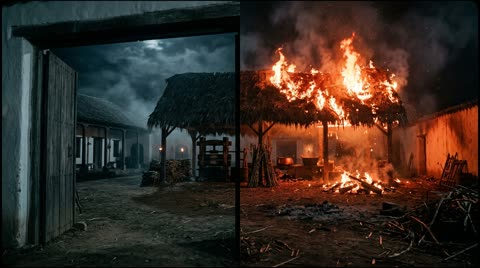
  14. #14 · 5 s — Wide view from across the hacienda yard: the whole palm-thatch roof of the trapiche mill shed erupts in orange flame, fire rolling up along the ridge, embers rising into the black sky, the whitewashed walls of the main house beside it lit hard red-orange, the carved wooden cane press visible in the open shed below. Firelight is the only light source, hot and flickering. The camera holds steady. Roaring, cathartic.
  15. #15 · 5 s — Low view from inside the hacienda yard facing the heavy timber gate, now standing open: the Leader walks straight toward the camera through the gate, heel-to-toe, chest and face leading, machete in his right hand at his side, the burning trapiche throwing orange light and flying embers behind him so his front is half in shadow and his edges glow. Jaw set, lips together. The camera holds steady as he comes. Unstoppabl
  16. #16 · 5 s — Medium view from the veranda tiles: the Overseer stands rigid in the doorway of the hacienda house, his right hand clamped on the hilt of his sheathed rapier, his eyes fixed on the burning mill roof to the left of frame, sweat on his face, mouth shut tight. Orange firelight flickers hard across the white plaster and his linen shirt; the overturned wine jug lies at his boot. The camera pushes in slowly toward his face
  17. #17 · 5 s — Wide view on the dirt track at the cane-field edge: five European Spanish soldiers in steel morion helmets and padded doublets, staggered at uneven depth, halted facing the burning estate glow to the right of frame — one nearest the camera lets his pike fall from his hands, one has a hand raised shielding his eyes, one is half-turned toward his companion, one at the back stands very still. No two bodies mirror each o
  18. #18 · 5 s — Medium-wide view from the side of the mule track on the jungle slope: the carreta rolls forward left-to-right up the track, nose of the yoked oxen leading, iron-banded disc wheels turning in the direction of travel, the bed piled with hemp sacks and a cloth-wrapped strongbox, Tochtli walking at the lead ox's head with a hand on its yoke, feet stepping forward heel-to-toe. Ferns and mossy trunks close in; a red glow f
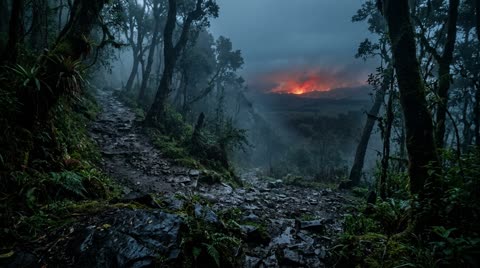
  19. #19 · 5 s — Very wide view from a rocky clearing high on the jungle slope, looking down over the dark lowland plain: the sugar estate burns far below as a cluster of orange fire under a sky stained deep red along the horizon, black cane fields and the black jungle canopy between. Wet rock and ferns in the foreground catch a faint red tint. The camera drifts very slowly forward toward the edge. Vast, vengeful, quiet.
  20. #20 · 5 s — Medium view from behind the Leader at the rocky clearing on the jungle slope: he stands still, machete hanging in his right hand, his gaze on the burning estate far below in the centre of the view, its red glow lining the edges of his shoulders and the back of his head while the rest of him is silhouette. He slowly lowers the machete tip to rest on the rock. Mist drifts between distant trunks. The camera holds steady
  21. #21 · 5 s — View from the rear corner of the carreta's oak bed, riding with it: Ana sits alone on the hemp sacks, the only person aboard, her back against the low side rail, her right hand resting flat on the cloth-wrapped strongbox beside her, her eyes on the pale mule track winding uphill past the oxen's yoke at the front of frame. The bed rocks gently as the wheels roll forward. Grey pre-dawn light filtering through ferns, a
  22. #22 · 5 s — Wide view at ground height of the open timber palisade gate of San Lorenzo at first dawn: sharpened posts lashed with vine, round thatched huts and rectangular Nahua houses inside, maize plots at the fence, and the snow-capped cone of Orizaba pale gold above the treeline, the sky grey-blue below it. The camera drifts slowly forward through the gate. Arrival, sanctuary.
  23. #23 · 4 s — Low view at knee height just inside the San Lorenzo gate: the Leader stoops and drives the machete point-first down into the packed red earth in one continuous thrust, then leaves his hand resting on the wooden grip, the blade standing upright. Dawn light comes low and gold from the right across the ground, palisade posts behind him. The camera holds steady. Claim staked, the chain answered by the blade.
  24. #24 · 4 s — Medium view inside San Lorenzo beside a round thatched hut: the carreta stands parked, its bed still piled with sacks, and Tochtli works the rawhide lashing loose from the near ox's yoke with both hands in one slow unknotting motion, his eyes on the knot. The ox stands patient. Low gold dawn light rakes across the grey-weathered timber and the iron wheel rim. The camera holds steady. Rest earned.
  25. #25 · 4 s — Close view at eye height of the Leader standing before the palisade posts of San Lorenzo, facing the camera, lips together and at rest, then a slow closed-mouth smile spreading as his chin lifts slightly, his eyes steady on the camera. Gold dawn light from the right side on his face, cool blue shadow on the left, the snow of Orizaba a pale shape behind his shoulder. The camera holds steady. A promise of thirty more y
  26. #26 · 4 s — Close view at ground height of a cane torch planted upright in the red earth of San Lorenzo, its pitch head burnt down to a small guttering orange flame, the blurred gold shape of Orizaba's snow peak and the palisade beyond it. Full low sunlight already floods the red earth gold from the right; the small flame flickers steadily. The camera holds steady. The fire that was hungry, satisfied.
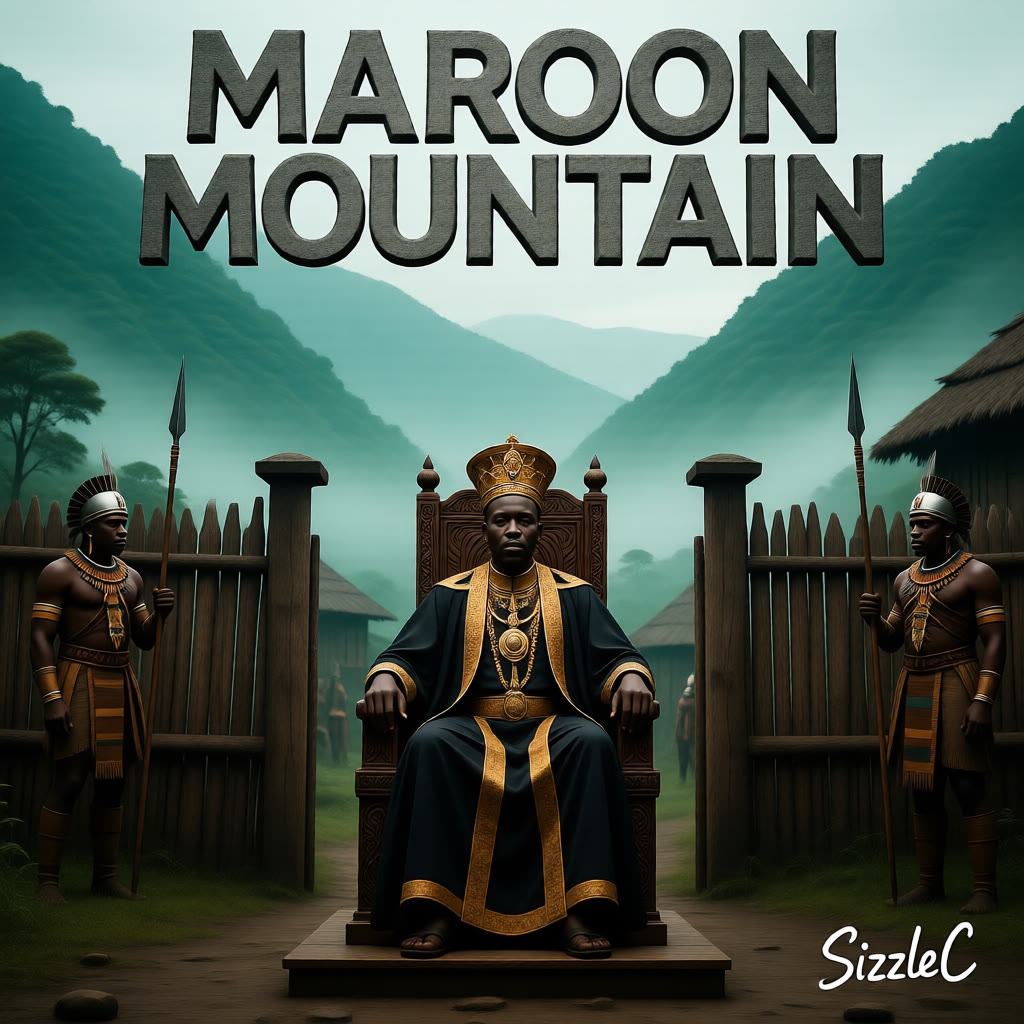
The Maroon Mountain (The Settlement) cover

[Intro]

High up in the clouds where the eagle makes a nest,

The first free city in the whole of the West.

[Verse 1]

San Lorenzo de los Negros, hidden in the stone,

Gaspar Yanga sitting on a wooden throne.

Maroon and Indigenous, fighting side by side,

A fortress in the jungle where the fugitives hide.

[Pre-Chorus]

But the Viceroy sent the army, marching up the peak...

Coming for the rebels, playing hide and seek...

[Beat Drop]

Hold the high ground! Let the rocks fall!

Spanish armor cracking on the mountain wall!

Guerrilla warfare, ghosts in the trees,

Bringing the Conquistadors down to their knees!

Can't beat Yanga, can't beat the ghost,

Defending every inch of the Veracruz coast!

Thirty years of fighting, blood on the leaves,

The jungle takes back what the colonizer thieves!

04 · The Maroon Mountain (The Settlement)

Cinematic orchestral → dark midtempo bass

🎶 The Sizzle: Sweeping orchestral strings of triumph, then grinding dark midtempo bass. Mood: a fortress in the clouds.

🎬 The Story: The Maroon Mountain: San Lorenzo de los Negros, the free town high in the Veracruz mountains, African and Indigenous defenders side by side. When the Viceroy's army marches up in 1609, the mountain wins.

The Chief (Yanga, elder years)
The Chief (Yanga, elder years)character
The Rebel (Yanga, young years)
The Rebel (Yanga, young years)character
The Bowman (Nahua ally)
The Bowman (Nahua ally)character
The Captain (Spanish column commander)
The Captain (Spanish column commander)character
The Scout (maroon fighter woman)
The Scout (maroon fighter woman)character
San Lorenzo from the ridge
San Lorenzo from the ridgelocation
The council hall
The council halllocation
The cliff-top lookout
The cliff-top lookoutlocation
The jungle switchback trail
The jungle switchback traillocation
The jungle fortress
The jungle fortresslocation
The Veracruz coast
The Veracruz coastlocation
The San Lorenzo ox cart
The San Lorenzo ox cartprop
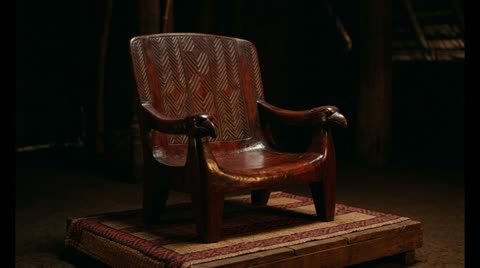
The wooden throne
The wooden throneprop
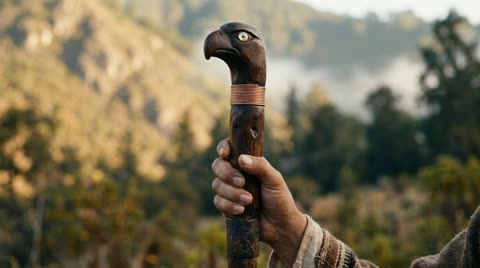
The chief's staff
The chief's staffprop
The rebel's machete
The rebel's macheteprop
Beat sheet — the real board (28 shots)

Characters

  • The Chief (Yanga, elder years) — Gaspar Yanga as chief, elder years (c.1609): a tall, broad-shouldered African man, dark brown skin, close-cropped hair, a short beard now flecked grey, deep-set steady eyes, a thin pale scar across his left forearm. Wears a chief's robe of hand-woven indigo-and-cream cotton with red embroidered geom
  • The Rebel (Yanga, young years) — Gaspar Yanga in the war years (c.1580): a tall, broad-shouldered African man, dark brown skin, close-cropped hair, a short black beard, a thin fresh scar across his left forearm. Wears an undyed hand-woven cotton tunic torn at one shoulder and rough cotton trousers rolled to the calf, barefoot, a pl
  • The Bowman (Nahua ally) — An Indigenous Nahua man in his thirties, warm copper-brown skin, long straight black hair tied back with a red cotton band, high cheekbones, a small jade ear-spool in each ear. Wears a white cotton loincloth and a short cape of undyed maguey fiber knotted at one shoulder, leather-soled sandals, a qu
  • The Captain (Spanish column commander) — A Spanish officer of New Spain, c.1600: an Iberian man in his forties, olive skin weathered by sun, dark pointed beard and moustache, hard narrow eyes. Wears a blackened-steel morion helmet with a comb crest, a steel peascod breastplate over a black wool doublet, red sash across the chest, leather r
  • The Scout (maroon fighter woman) — An Afro-Mexican maroon woman in her twenties, deep brown skin, hair in tight cornrows braided back to the nape, a small brass ring in one nostril, strong shoulders. Wears a sleeveless indigo cotton tunic belted with a strip of leather, cotton trousers, barefoot, a short-handled iron machete in a wov

Shots

  1. #1 · 5 s — Wide view from high above a cloud sea at dawn: the white snow cone of Orizaba volcano rises alone out of a floor of soft grey-amber cloud, the summit lit pink-gold by the first sun from the right while the cloud below stays in blue shadow. The camera drifts very slowly forward toward the peak. Thin cold air, absolute stillness, a sense of triumph and height. Part A warm palette.
  2. #2 · 5 s — Medium view of a single golden eagle perched at the edge of a stick nest on a wet black basalt crag, the bird turning its head slowly to look down into the misty green valley on the left of frame. Behind it the cloud sea and the pink-lit volcano summit. Warm low sun from the right catches the eagle's brown-gold neck feathers. The camera holds still; only the eagle's head moves.
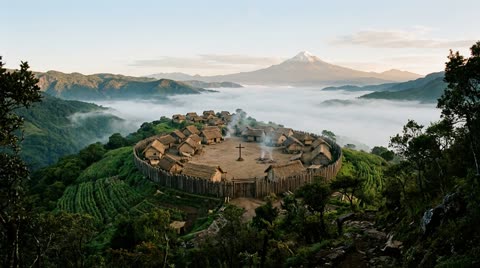
  3. #3 · 4 s — Wide view from the forested ridge above San Lorenzo de los Negros: the ring of sharpened-log palisade, several dozen thatched adobe houses of uneven size scattered on a high green shelf, the plaza with its wooden cross, terraced milpa fields below. Morning mist lies in the valley folds; the snow cone of Orizaba stands far behind under a pale sky. Warm amber early light from the right. The camera drifts slowly down to
  4. #4 · 5 s — Medium view from behind and to the side of the Chief as he stands in the open log gate of the palisade, his staff planted in the earth beside his right foot, both hands resting on its eagle head, his gaze fixed on the terraced cornfields glowing gold below at the bottom of frame. Mist lifts off the fields. Warm amber sun from the right rakes across the log gateposts. The camera holds still; he slowly lifts his chin.
  5. #5 · 4 s — Medium-wide view across the packed-earth plaza of San Lorenzo in the morning: an Afro-Mexican maroon woman kneels at a stone metate grinding maize at a slow rhythm in the foreground, a second woman farther back hangs indigo cloth on a line at a different pace, an old man on a stool mends a fishing net facing away from the camera, and a barefoot child runs from left to right after a brown hen. No two figures move alik
  6. #6 · 5 s — Medium view from the front-right of the ox cart as it rolls FORWARD toward the camera along the packed-earth track into the plaza, the pair of cream criollo oxen leading nose-first at a slow walk, the solid disc wheels turning along the direction of travel. The Bowman sits alone on the plank bench, facing the road ahead, one hand loose on the ox rope, his eyes on the gate posts at the top of frame. Warm amber morning
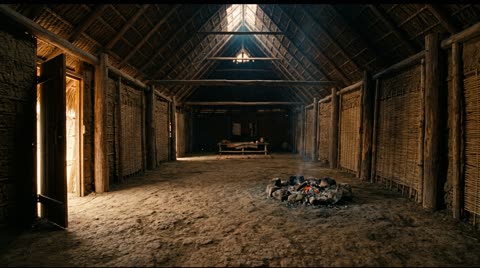
  7. #7 · 5 s — Wide view down the length of the council hall toward the low platform where the Chief sits on the carved wooden throne, the staff resting across his knees, his hands still on the shaft, his gaze fixed on the orange hearth embers in the lower left of frame. Timber posts, reed mats, a shaft of warm amber daylight falls from the open side doorway across the earth floor into the dark roof thatch. The camera pushes forwar
  8. #8 · 4 s — Close view of the Chief's left forearm and hand resting on the pale worn grip of the carved staff, the thin old scar across the forearm lit by a shaft of warm amber daylight from the doorway on the right, the embroidered red border of his robe sleeve at the top of frame, the copper wire band of the staff catching light. His thumb moves slowly back and forth across the worn wood, a single continuous gesture. The camer
  9. #9 · 4 s — Medium-close view of the Chief on the throne from a three-quarter front angle, his face lit warm amber from the doorway on the right, a small bright catchlight in each eye, his gaze settling on the hearth embers low in the frame and then his eyes slowly closing, lips together and still. Outside the doorway a cloud crosses the sun, the light on the hall softening toward cool teal shadow while the hearth embers stay th
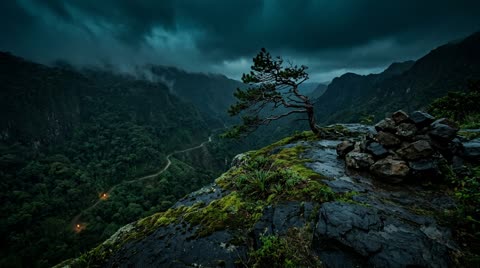
  10. #10 · 5 s — Medium-wide view of the Rebel crouched low on the wet black basalt ledge of the cliff-top lookout at dusk, one hand flat on the rock, his gaze fixed on a thin snaking string of orange torch points far below on the valley trail at the bottom of frame. Teal-black sky, low cloud sliding past the wind-bent pine behind him, mist rising from the canopy. Cold blue dusk light from the sky, faint orange from below. The camera
  11. #11 · 5 s — Wide view from uphill of a Spanish column marching FORWARD up the muddy switchback trail toward the camera, boots leading, torches held high. Iberian soldiers in a ragged mix: some in steel morions, some in leather caps, two with pikes, one with an arquebus over his shoulder, one limping behind, one Nahua porter bent under a bundle, the gaps between them uneven, one soldier half-off the trail hacking at a fern with h
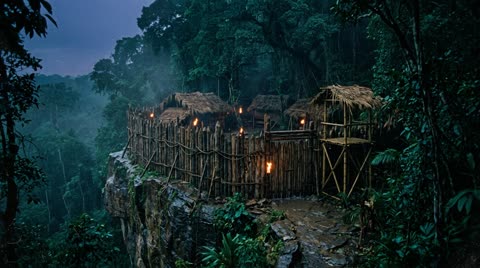
  12. #12 · 4 s — Medium view of the Bowman in profile on a bamboo lookout platform of the jungle fortress at night, a reed arrow already nocked on the wooden bow, the quiver resting on his back, his right hand slowly drawing the string back toward his cheek in one continuous motion, his eyes fixed on the dark trail below at the left edge of frame. Sharpened palisade logs and vine lashings behind him, one torch guttering orange on the
  13. #13 · 5 s — Wide view of the maroon hill-fort hidden under jungle canopy at night: the sharpened-log palisade on its cliff shelf, thatched shelters behind, two torches burning orange at the narrow log gate. Afro-Mexican fugitives move FORWARD through the gate away from the camera at different paces: a woman carrying a child on her hip, an old man leaning on a stick, a young man with a sack hurrying past them both, a girl who sto
  14. #14 · 5 s — Medium-close view of the Captain from a three-quarter front angle at the head of the halted column on the muddy trail, his gloved right hand closing slowly around the basket hilt of his rapier, his gaze fixed on the black cliff top at the upper right of frame, jaw set, lips together. Torchlight from a soldier just behind him lights the steel morion and breastplate orange on one side; teal mist and dripping ceiba root
  15. #15 · 5 s — Low view from below the basalt lip of the lookout, the Rebel standing on the ledge against the teal-black sky, raising the machete slowly in his right hand until the blade stands straight above his head, a single continuous arm movement, his gaze fixed on the trail far below at the bottom of frame, mouth set. Wind pulls at his torn tunic; low cloud races behind him; faint orange torch glow from below lights his chin.
  16. #16 · 5 s — Wide view down the steep jungle slope from just below the cliff lip at night: head-sized and larger black boulders tumble FORWARD down the slope away from the camera, bouncing off roots and snapping fern stems, tearing a pale gash of red mud through the green, dust lifting behind them. Below, the orange torch points of the trail. Teal moonlight through cloud on wet rock, rain in the air. The camera holds still and le
  17. #17 · 4 s — Medium-wide view along the muddy trail at night as the column breaks: one Iberian soldier dives to the left behind a ceiba buttress, a second drops his pike and stumbles backward on his heels, a third crouches with his arms over his morion, a fourth still stands frozen holding his torch. No two men move alike. A boulder crashes into the mud at the right of frame throwing red spray. Orange torchlight swinging wildly,
  18. #18 · 5 s — Medium view in profile of the Scout kneeling behind a great ceiba root in the jungle at night, whirling a cotton sling once slowly overhead and releasing the stone toward the trail at the left edge of frame, a single continuous arm movement, her eyes locked on the swinging torchlight beyond the ferns. Teal mist between trunks, orange light flickering across her face from the left, rain on the leaves. The camera holds
  19. #19 · 5 s — Medium-close view of the Captain from the front, his back to the wet rock wall of the trail, as a fist-sized stone strikes the center of his steel breastplate with a brief flash of sparks and he jolts back against the rock, his hands open at his sides, his eyes fixed on the dark trees at the right of frame, mouth set. His torch already lies burning in the mud below, orange firelight lighting the dented steel and his
  20. #20 · 5 s — Medium-wide view straight down a corridor of ceiba trunks in white mist at night, the Rebel already in frame at mid-distance and walking FORWARD toward the camera heel-to-toe, nose leading, the machete held low along his right thigh, his gaze fixed on a point just below the lens. Dim teal light, a single faint orange glow from a torch far behind the camera edging his shoulders. Ferns brush his knees. The camera holds
  21. #21 · 4 s — Medium view from the side of the Captain kneeling in the red mud of the trail, bareheaded, hair wet, his dented breastplate smeared with mud, both hands open on his thighs, his eyes fixed on the black iron machete blade that hangs still in the lower right of frame, gripped by a dark forearm with a plaited cord at the wrist, already at the right edge. Slow rain falls. The fallen torch behind him burns down to orange e
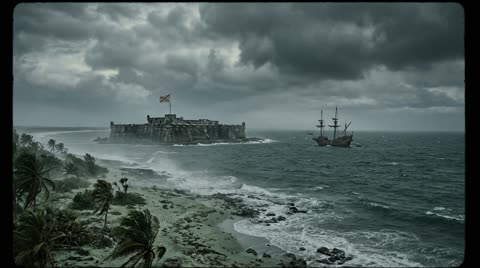
  22. #22 · 5 s — Wide view of the Gulf coast at Veracruz under heavy grey cloud: a three-masted Spanish galleon at anchor with furled sails rolls slowly on the swell in the middle distance, the stone fortress of San Juan de Ulúa on its reef island behind it, palms bending in wind on the sand and coral shore in the foreground, surf breaking white. Dim silver light through a gap in cloud far out at sea. The camera holds still; only the
  23. #23 · 5 s — Close view of a single broad heliconia leaf in the jungle at night, a dark red smear of blood on its green surface, heavy raindrops striking the leaf and the red thinning and running in rivulets down toward the leaf tip at the bottom of frame, dripping off into black water. Teal-grey light filtered through mist, a faint orange glow at the far left. The camera holds still. Only the rain and the running red move.
  24. #24 · 5 s — Medium-close view of a rust-brown Spanish steel breastplate and morion helmet lying on the jungle floor, half-buried under ceiba roots, green vines threaded under the helmet's curved brim and across its comb crest, moss on the dented steel, ferns arching over. Soft green-gold daylight filters down from the canopy above, the first warmth returning to the palette. The camera pushes forward very slowly toward the helmet
  25. #25 · 5 s — Medium-close view of the Chief on the carved wooden throne from a three-quarter front angle, his eyes opening slowly, his gaze settling on the bright open doorway at the right of frame, lips closed and still for the whole take, his shoulders easing down by a finger's width. Warm amber daylight from the doorway on his face, a small catchlight in each eye, hearth embers orange low in the frame, timber posts and reed ma
  26. #26 · 5 s — View from the plank bench of the ox cart beside the Bowman as he drives, seen from his own side, his face toward the log gateposts of the palisade ahead at the top of frame, one hand steady on the ox rope, the cream oxen's horns swaying ahead nose-first as the cart rolls FORWARD along the track and out through the gate, the solid wheels turning along the direction of travel. Warm amber morning sun from the right on t
  27. #27 · 5 s — Medium view from the front and slightly below of the Chief standing in the open log gate of the palisade, the staff planted at his side, his right hand resting on its eagle head, his gaze lifted to the sunlit snow peak of Orizaba at the top of frame, lips together, a slow closed-mouth smile settling on his face. Warm amber sunrise from the right lights his beard and the embroidered robe; mist lifts from the valley be
  28. #28 · 4 s — Wide view from high above the ridge at full sunrise: San Lorenzo de los Negros on its green shelf, palisade and thatch roofs lit gold, terraced fields glowing, the snow cone of Orizaba blazing pink-gold behind under a clear sky, the last mist burning off the valleys. A single golden eagle glides in a slow wide circle across the upper frame. The camera drifts slowly upward and away from the town. Triumph, height, stil
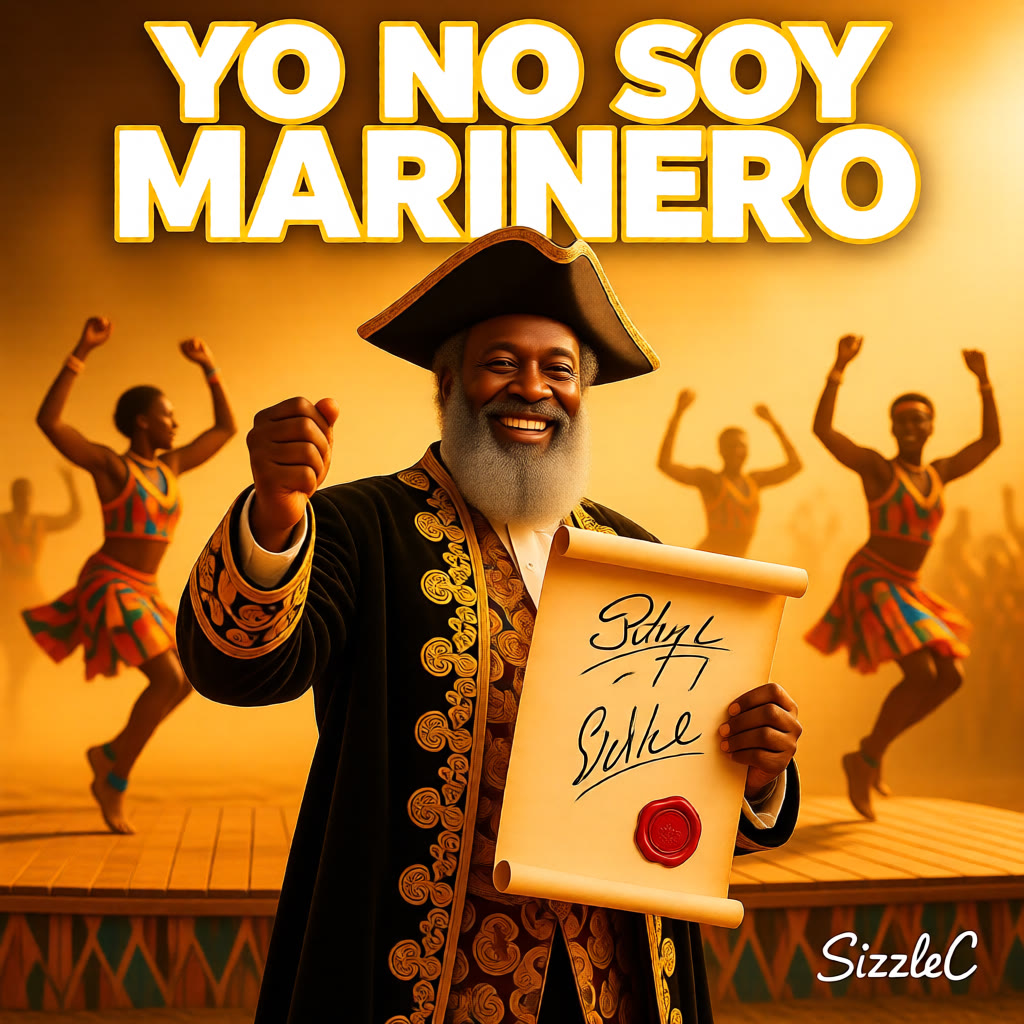
Yo No Soy Marinero (The Captain) cover

[Intro]

The Viceroy surrendered, the treaty was signed.

The greatest rebellion that history designed.

They gave us the land, they gave us the right,

We beat the Spanish crown in the middle of the night.

[Verse 1]

Not a slave on a ship, not a man in the hold,

A king of the mountain, courageous and bold.

I don't row the boat. I don't swab the deck.

I got the royal army in a bottleneck.

[Pre-Chorus]

Listen to the wood. Listen to the feet.

Three decades of blood pouring into the street.

[Beat Drop]

Yo no soy marinero... I'm the Captain.

Soy Capitán. Soy Capitán.

Gaspar Yanga!

King of the Veracruz, broke the chain.

First to beat the empire of Spain.

I ain't a sailor, I run the fleet.

Now the whole world dancing to the Bamba beat!

[Drop 2]

(Stomp! Stomp! Stomp!)

Soy Capitán!

Mountain king, let the bonfire burn!

Watch the whole colonial system turn!

From the Mbamba soil to the Mexico stone,

Gaspar Yanga on a free man's throne!

[Outro]

Yo no soy marinero.

05 · Yo No Soy Marinero (The Captain)

16th century Spanish classical guitar → minimal tech house with tarima foot-stomping

🎶 The Sizzle: Three acts in three minutes: clean, elegant 16th-century Spanish guitar, then dry minimal tech house with tarima stomps as the kick drum, then a filthy, distorted second drop as the stomping doubles in speed. Mood: victory, then a street party, then a bonfire night.

🎬 The Story: Yo No Soy Marinero: the treaty is signed and the town is free. Yanga is not a sailor, he's the captain. By night the bonfires burn, the boots hit the wood, and the whole world ends up dancing to the Bamba beat.

The Captain
The Captaincharacter
The Young Rebel
The Young Rebelcharacter
The Viceroy's Envoy
The Viceroy's Envoycharacter
The Tarima Dancer
The Tarima Dancercharacter
The Totonac Ally
The Totonac Allycharacter
The Lieutenant
The Lieutenantcharacter
Orizaba Jungle Ridge
Orizaba Jungle Ridgelocation
San Lorenzo Plaza
San Lorenzo Plazalocation
The Treaty Chamber
The Treaty Chamberlocation
The Cane Estate
The Cane Estatelocation
Bonfire Clearing
Bonfire Clearinglocation
The Ship's Hold
The Ship's Holdlocation
Mountain River
Mountain Riverlocation
The Ox Cart
The Ox Cartprop
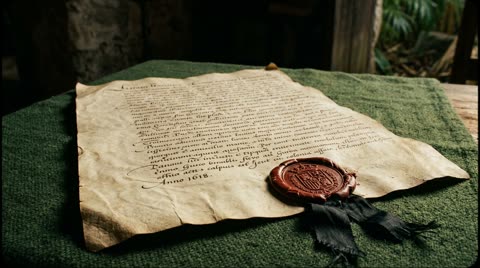
The Treaty Parchment
The Treaty Parchmentprop
The Tarima
The Tarimaprop
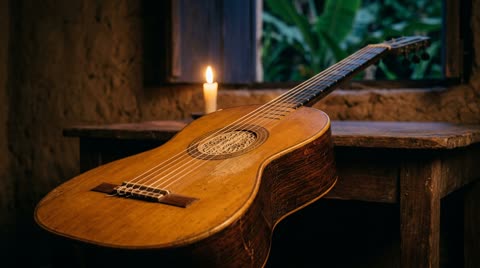
The Baroque Guitar
The Baroque Guitarprop
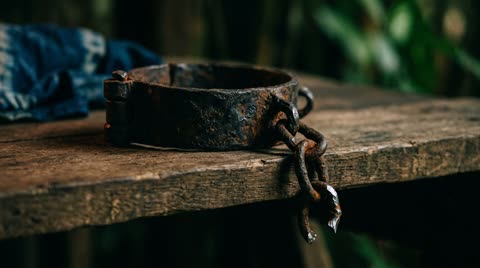
The Broken Shackle
The Broken Shackleprop
Beat sheet — the real board (38 shots)

Characters

  • The Captain — West Central African man, Angolan-born, dark brown skin, tall and broad-shouldered, close-cropped grey hair and a full grey beard, deep-set steady eyes, a thin old scar across his left forearm. Wears a rich indigo embroidered long coat with gold thread at the cuffs and collar over a woven undyed cot
  • The Young Rebel — The Captain forty years earlier: West Central African man in his late twenties, dark brown skin, tall, broad shoulders, close-cropped black hair and a short black beard, a fresh thin scar across his left forearm. Wears a torn woven undyed cotton tunic and rough trousers, barefoot, a strip of indigo
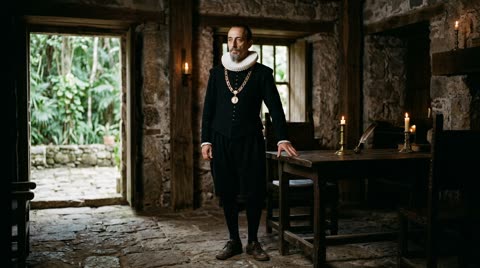
  • The Viceroy's Envoy — Spanish man, pale olive skin, fifties, thin face with a pointed grey-streaked goatee and heavy-lidded eyes. Wears a black 1600s Spanish court doublet with a stiff white ruff collar, black breeches, black stockings, and a heavy gold chain of office. Carries himself stiffly, one hand often resting on
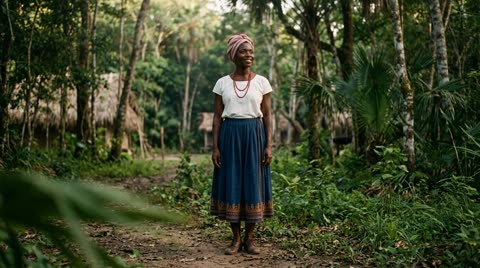
  • The Tarima Dancer — Afro-Mexican maroon woman, early thirties, deep brown skin, hair wrapped in a red-and-white striped cotton headwrap, high cheekbones, bright expressive eyes. Wears a wide indigo-dyed cotton skirt with an ochre embroidered hem, a white cotton blouse, a string of red seed beads, and hard leather-soled
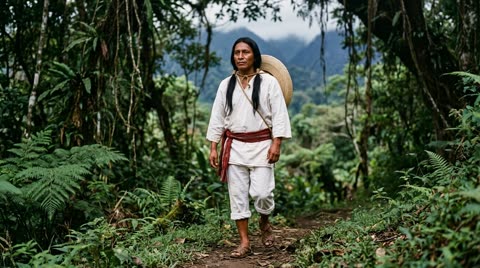
  • The Totonac Ally — Indigenous Totonac man from the Veracruz mountains, early forties, warm copper-brown skin, long straight black hair tied back with a woven cord, a broad calm face. Wears a white cotton wraparound tunic with a red woven sash, white cotton trousers rolled to the shin, huarache sandals, a woven palm ha
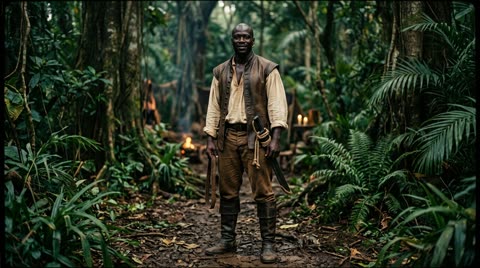
  • The Lieutenant — West Central African man, Angolan-born, mid-thirties, very dark skin, shaved head, a broad chest and a small gold hoop in his left ear. Wears a leather jerkin over a loose white cotton shirt, brown breeches, tall worn leather boots, and a machete in a rope scabbard at his hip. Watchful, easy smile,

Shots

  1. #1 · 5 s — Very wide view from the ridge trail: the snow-capped cone of Mount Orizaba rises above a sea of blue-grey mist filling the jungle valley below, wet moss-furred boulders in the foreground, ferns beaded with dew. First gold light touches the peak while the valley stays cold blue. The camera drifts slowly forward along the packed-earth trail. Silent, patient, the world before the story.
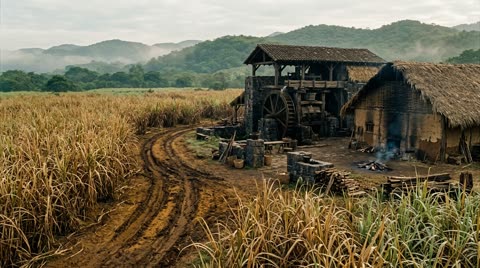
  2. #2 · 5 s — Wide view down a rutted ochre earth track between tall rows of dry-gold sugarcane, the stone-and-timber cane mill with its wooden crushing wheel standing at the end of the track, a thatched boiling house behind it. Hazy early-morning light comes low from the right, dew glinting on the cane leaves. A single cane leaf sways in the foreground. The camera holds still.
  3. #3 · 5 s — Wide view along the ridge trail: the ox cart rolls forward left-to-right across frame, the two cream oxen leading with their horns forward, solid wooden wheels turning along the packed earth, the Totonac Ally walking beside the near ox, heel-to-toe in the same direction, one hand on the yoke rope. Mist-filled valley drops away behind, dawn gold on the wet boulders. The camera holds still as the cart passes.
  4. #4 · 5 s — Seen from beside the cart's plank bench at his own side: the Captain sits on the front bench of the ox cart, body facing the trail ahead, his face toward the oxen's horns in front of him, lips together and at rest. His right hand rests on the ochre painted rail and slowly tightens its grip as the cart jolts. Dawn light from the front, cool and grey. The camera rides with the cart, steady.
  5. #5 · 5 s — Medium view in profile: the Tarima Dancer sits on the cedar step of a palm-thatch house at the plaza edge, the baroque guitar across her lap, its rosette toward the lens, her right hand plucking the gut strings in a slow steady pattern while her left holds one chord. Her face is turned down toward the strings. Morning sun from the right, warm on the honey varnish. The camera holds still.
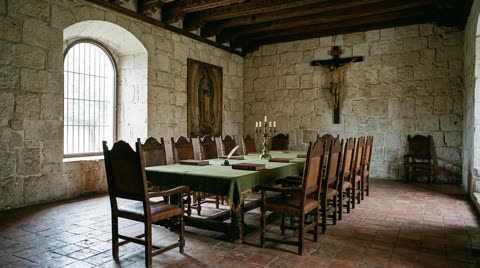
  6. #6 · 5 s — View from the far end of the long mahogany table in the stone treaty chamber: the treaty parchment lies flat on the green cloth at the near end, a goose quill and a brass inkwell beside it, high-backed carved chairs empty on both sides, the brass candelabra unlit. Cool morning light falls in one shaft through the tall arched window with iron grillework, striping the tile floor. The camera pushes slowly toward the par
  7. #7 · 4 s — High view looking down onto the green-clothed table: the Viceroy's Envoy, seated, brings a brass seal matrix down onto a pool of red wax at the foot of the treaty parchment and presses, his black-sleeved forearm and white ruff cuff in frame, his gaze on the wax. The dense brown handwriting fills the vellum above. Cool window light from the left. The camera holds still.
  8. #8 · 4 s — Medium view from across the table: the Captain stands at the mahogany table, his left hand with the thin scar resting flat on the edge of the treaty parchment, the sheet facing him, his eyes lowered onto the handwriting and the red seal, lips together. He slowly draws the parchment a hand's width toward himself. The tall arched window behind him throws cool light across his shoulders. The camera holds still.
  9. #9 · 4 s — Medium view from a three-quarter front angle: the Young Rebel stands between rows of tall sugarcane on the estate, swinging a rusted machete down through a cane stalk in one clean stroke, his gaze on the stalk in his left hand. Sweat on his shoulders, dry-gold cane towering around him, the thatched boiling house far behind. Hazy morning light from behind the cane. The camera holds still.
  10. #10 · 4 s — Wide high view over San Lorenzo plaza: palm-thatch houses on cedar posts ringing the packed red-earth square, the raised cedar tarima at its centre, the small wooden chapel with its bell at the far end, banana and ceiba trees at the edges, green mountains rising behind. Hard midday sun straight down, sharp short shadows. A few chickens peck near the chapel. The camera drifts slowly forward over the rooftops.
  11. #11 · 4 s — Medium-wide view from the plaza edge: the Captain stands on the cedar tarima platform and slowly raises the treaty parchment high above his head with both hands, its handwriting and red seal toward the town, his face lifted toward the parchment. In front of him, backs to the camera, stand a handful of African maroon townspeople: a woman holding a clay jug, a boy leaning on a post, an old man with a cane. Hard midday
  12. #12 · 5 s — Wide view on the ridge at night: the Young Rebel stands on a wet volcanic boulder at the ridge edge, his body toward the dark valley, and slowly raises his right arm straight up, fist closed, holding it there. Far below, three small torch fires flicker at irregular distances in the black jungle. Cold moonlight from above silvers the boulder and his shoulders. The camera holds still.
  13. #13 · 5 s — Low view at water level of the mountain river: clear water pours over rounded grey stones from upstream at the top of frame down toward the camera, white water breaking between two mossy boulders, tree ferns and wild ginger overhanging the banks. Soft green-filtered dawn light from above. The camera holds still and the water does the moving.
  14. #14 · 5 s — Close view on the wet oak planking of the ship's hold: the broken iron shackle lies on the boards, its three chain links trailing to the snapped-open last link, an iron ring-bolt on the hull rib behind it. One hard shaft of daylight from the hatch grating above cuts across the shackle, everything else amber-brown shadow. Bilge water trembles in the plank seams as the hull rolls. The camera pushes in very slowly.
  15. #15 · 4 s — Medium view from slightly above: the Young Rebel sits against the hull ribs of the ship's hold, face lifted toward the hatch grating overhead, the shaft of daylight falling across his eyes and cheek, lips together. Both hands grip the iron chain across his lap and slowly pull it taut. Low oak beams close above him, wet planking around. The camera holds still.
  16. #16 · 4 s — Wide view from behind and below: the Young Rebel stands on the highest boulder of the ridge, body toward the mist-filled valley and Mount Orizaba beyond, arms hanging loose, his torn tunic moving in the wind. He slowly spreads both arms out to shoulder height and holds them there. Dawn gold on the peak, cold blue below. The camera holds still.
  17. #17 · 5 s — Low view along the surface of the cedar tarima platform: the darkened smooth planks run away from the camera, the one paler plank at the far side, chipped edges, a fine dust lying on the wood, the red-earth plaza and palm-thatch houses soft behind. Hard midday sun from above throws the plank seams into sharp shadow. A single fallen banana leaf skitters across the boards. The camera holds still.
  18. #18 · 5 s — Medium view from a three-quarter front angle, slightly low: the Tarima Dancer stands alone on the cedar tarima, knees soft, back straight, chin high, driving her hard-soled shoes down onto the planks in a steady heel-toe stomp, her indigo skirt held out in her right hand and swinging with each strike, her eyes on the boards in front of her. Hard midday sun from above, dust rising from the planks. The camera holds sti
  19. #19 · 5 s — Wide view across the plaza toward the tarima: African maroon and Totonac townspeople stand loosely around the platform at uneven distances. An old woman in a yellow headwrap claps slowly, a boy in a white tunic hops on one foot, a broad man in a leather apron leans on a post with his back to the camera, two girls share a clay cup, a grey-haired man shuffles away toward the chapel. No two bodies mirror each other. Har
  20. #20 · 5 s — Medium view in profile: the Captain sits in a carved cedar chair in the shade of a palm-thatch eave at the plaza edge, body toward the tarima out of frame, his eyes on the dancers, lips together in a slow closed-mouth smile. His right hand rests on the chair's carved wooden armrest and slowly closes into a fist. Hard sun on the red earth beyond, cool shade on his face. The camera holds still.
  21. #21 · 5 s — Medium view from a three-quarter front angle: the Lieutenant stands at the corner of the cedar tarima, the baroque guitar held high against his chest, rosette toward the camera, his right hand striking the gut strings in a hard rhythmic strum while his left holds the neck, his gaze down on his strumming hand. Palm-thatch eaves and banana leaves behind. Hard sun from above, bright on his shaved head. The camera holds
  22. #22 · 5 s — View from behind the Young Rebel's shoulder as he crouches still on the ridge boulder, his eyes on the valley: far below, a thin column of Spanish soldiers in steel morion helmets and dull breastplates picks its way into a narrow rocky pass, moving away from the camera along the trail. Gaps between men uneven, some carrying pikes, some muskets, one stopped adjusting his pack, a mule with baggage lagging behind, the c
  23. #23 · 5 s — Low view at plank level along the cedar tarima: three pairs of feet strike the boards. Nearest, a woman's hard leather dancing shoes below an ochre-hemmed indigo skirt hammer a fast heel rhythm; behind them a man's bare brown feet land in slow heavy steps; at the far edge a pair of worn huarache sandals shuffle sideways and pause. Dust jumps from the planks with each strike. Hard midday sun. The camera holds still.
  24. #24 · 5 s — Medium-wide view at the plaza edge: the ox cart stands still, its two cream oxen resting in the yoke with heads low, the ochre rails flaking in the sun. The Totonac Ally stands at the cart bed and lifts a bundle of cut sugarcane down from the bed into his arms and against his chest, his eyes on the bundle. Palm-thatch houses and a ceiba trunk behind. Hard midday sun. The camera holds still.
  25. #25 · 5 s — Close view beside a cedar log table in the plaza: pale green sugarcane juice streams from the lip of a raised wooden trough at the top of frame, falls straight down under gravity, and splashes into the open mouth of a red clay jug on the table below, froth rising in the jug. Cut cane stalks and a rusted machete lie beside it. Hard midday sun from above, the falling stream glinting. The camera holds still.
  26. #26 · 5 s — Wide view from behind the crowd: the backs and shoulders of African maroon townspeople fill the lower frame, an old woman in a yellow headwrap, a boy on a man's shoulders, a woman with a jug on her hip, standing at uneven depths. Beyond them the Captain stands alone at the centre of the cedar tarima and slowly opens both arms wide to the sky, his face lifted toward the chapel bell. Hard midday sun on his embroidered
  27. #27 · 5 s — Medium-wide view from a slightly high three-quarter front angle: the Tarima Dancer stands on the red earth beside the tarima and turns in one slow full spin on her heel, both hands lifting the indigo skirt so it flares out wide, her chin high and her eyes following the swing of the ochre hem. Dust lifts around her shoes. Palm-thatch eaves and a ceiba trunk behind. Hard midday sun. The camera holds still.
  28. #28 · 5 s — Close view from below: the Captain's two hands already hold the broken iron shackle high in the hard sun, the three rust-brown chain links swinging slowly from it and the snapped last link catching the light, his face beneath it turned up toward the iron, lips together and still. Palm-thatch eave and white sky behind. The shackle stays high, only the links swaying. The camera holds still.
  29. #29 · 5 s — Wide view of the night clearing: the bonfire of stacked cedar logs burns in its stone ring at centre, flames tall and steady, the cedar tarima platform beside it with its planks lit orange, carved wooden stools and clay jugs at the edges, dark ceiba trunks and banana leaves closing the ring. Deep blue night sky above, the fire the only light. The camera pushes slowly toward the fire.
  30. #30 · 5 s — Medium view from a three-quarter front angle, low: the Lieutenant stands on the cedar tarima beside the bonfire, knees bent and chest up, driving his tall leather boots down onto the planks in a heavy heel stomp, his fists loose at his sides, his eyes on the boards in front of him. Orange firelight from the left on his shaved head and leather jerkin, black night behind. The camera holds still.
  31. #31 · 4 s — Medium-wide view at the clearing's edge: the ox cart alone stands parked, its plank bench bare, its ochre rails and solid wooden disc wheels lit orange on the fire side and black on the other, the two cream oxen lying down in the yoke, one slowly turning its horned head toward the fire. Dark ceiba trunks behind. Firelight flickering from the right, deep blue night above. The camera holds still.
  32. #32 · 4 s — Low view at plank level along the cedar tarima at night: three pairs of feet strike the orange-lit boards. Nearest, tall leather boots hammer fast and hard; behind them a woman's hard-soled shoes below an indigo hem tap a quicker double rhythm; at the far edge bare brown feet land slow and heavy and then stop. The bonfire's glow moves on the far planks. Firelight from the right. The camera holds still.
  33. #33 · 4 s — Medium close view in profile: the Captain sits on a carved wooden stool close to the bonfire, body toward the tarima out of frame, his eyes on the dancers' feet, lips together, firelight from the left on the side of his face and on the gold thread of his coat, the rest in dark. His right hand rests on his knee and slowly tightens its grip. Black night behind him. The camera holds still.
  34. #34 · 5 s — Medium view from a three-quarter front angle: the Tarima Dancer stands at the stone ring of the bonfire, a split cedar log held in both hands, and swings it down from waist height into the heart of the flames, her eyes on the fire, the log settling onto the burning stack. Her indigo skirt and red beads glow orange, the tarima dark behind her. Firelight from below and in front. The camera holds still.
  35. #35 · 4 s — Medium view from a three-quarter front angle: the Totonac Ally kneels beside a hollowed cedar log drum laid on its side near the fire, a hardwood stick in each hand, striking the top of the log in a fast steady rhythm, his eyes on the drum, his long tied-back hair swinging with each strike. Firelight from the right on his white tunic and red sash, deep blue night behind. The camera holds still.
  36. #36 · 5 s — View from the head of the long mahogany table in the treaty chamber at night: the signed treaty parchment lies on the green cloth beneath the brass candelabra, one candle burning, its red wax seal glinting, the high-backed carved chairs pushed back and empty on both sides, the tall arched window black behind the iron grillework. Warm candle amber on the vellum, cold blue moonlight on the tile floor. The camera pushes
  37. #37 · 5 s — Wide view from behind the crowd at night: the dark backs and shoulders of African maroon and Totonac townspeople fill the lower frame at uneven depths, a woman's red headwrap, a man's palm hat, a child on a hip. Beyond them, on the cedar tarima beside the bonfire, the Captain rises slowly from a carved cedar chair to his full height and stands still, his face toward the fire. Orange firelight on his embroidered coat
  38. #38 · 5 s — Very wide view along the ridge at first light: the ox cart alone stands parked in silhouette against the pale gold sky, its plank bench bare, its two cream oxen lying down in the yoke with horns raised, the solid wooden wheels black against the mist-filled valley below, Mount Orizaba's snow cone catching the first sun behind. Cool blue mist, one warm edge of gold on the cart rails. The camera drifts very slowly forwa